Why you should experience Noor-Us-Sabah Palace in Bhopal, India.
Noor-Us-Sabah Palace is not a hotel that asks for your attention; it commands your posture, slows your breathing, and quietly reminds you what it feels like to inhabit space designed for authority, perspective, and permanence.
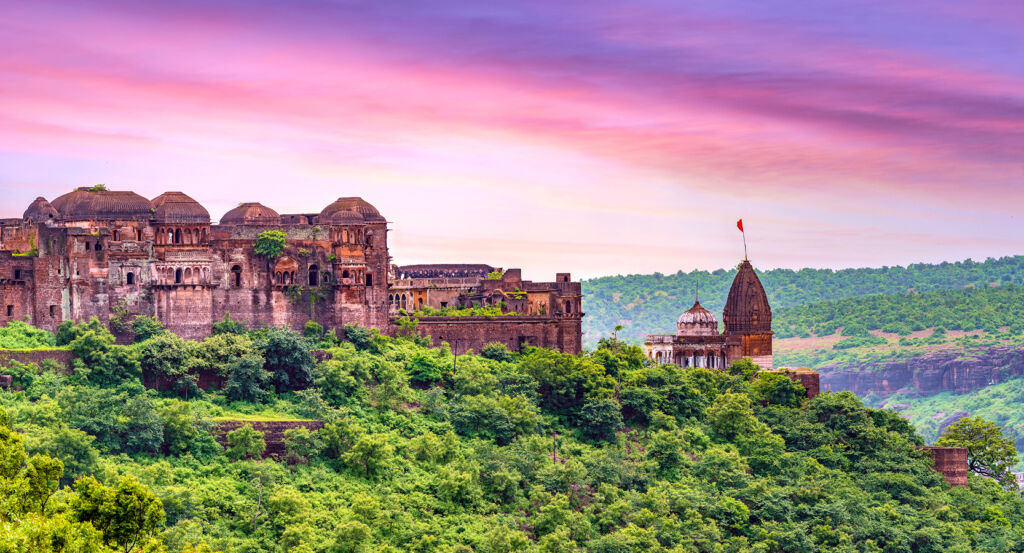
Perched high above Bhopal on the slopes of Shamla Hills, Noor-Us-Sabah Palace occupies a position that feels less like a location and more like a statement. The ascent itself is part of the experience. As the road rises, the city loosens its grip, noise thins, and the horizon opens. By the time you arrive, you are no longer moving through Bhopal; you are looking over it. This elevated vantage defines everything about the stay. The palace was never meant to blend into its surroundings. It was built to oversee them. That intention remains intact the moment you step through its gates. The scale is unmistakable: sweeping façades, symmetrical gardens, long corridors, arched windows, and expansive terraces that frame the Upper Lake and the city beyond like a living map. Inside, the atmosphere is formal. Interiors lean into classical palace architecture, high ceilings, polished stone, restrained ornamentation, and a sense of proportion that immediately alters how you move through the space. You walk slower here. You speak more deliberately. The building demands it. Guest rooms echo this sense of command and composure. They are spacious, structured, and intentionally uncluttered, with layouts that privilege symmetry and sightlines. Beds are firm and grounding, windows open wide to sky and water, and furnishings feel chosen for longevity. This is not indulgent comfort designed to make you forget where you are; it is composed comfort designed to remind you that you are somewhere significant. Sound behaves differently at Noor-Us-Sabah. The city exists below, distant and softened, while wind, birds, and silence take precedence. Dining unfolds with similar gravitas. Meals here feel anchored in setting rather than performance, meant to be taken slowly, often accompanied by views that dwarf the plate in front of you. As the day moves toward evening, the palace becomes even more commanding. The lake reflects light, the city flickers on below, and the palace seems to settle into itself, as though dusk is its natural state. Walking the terraces at night, you do not feel entertained; you feel positioned. Noor-Us-Sabah Palace is for travelers who are drawn to places that alter perspective, who understand that luxury can be structural rather than physical, and who want to feel what it is like to inhabit a space built to last far longer than the moment they occupy it.
What you should know about Noor-Us-Sabah Palace.
Noor-Us-Sabah Palace was conceived as a seat of power and visibility, and that original purpose still governs how the property feels, moves, and holds authority today.
The palace was built during the reign of the Nawabs of Bhopal, a princely state notable not only for its political significance but for its progressive leadership, including a lineage of female rulers who shaped governance with discipline and foresight. Noor-Us-Sabah Palace was designed less as a private residence and more as a strategic vantage point, a place from which the city, the lake, and the surrounding terrain could be observed, understood, and symbolically overseen. This explains its elevated placement and commanding geometry. Unlike palaces meant primarily for domestic life, this one was built with outward orientation in mind. Every axis, terrace, and window reinforces that relationship with the city below. When the palace transitioned into a hotel, its conversion followed a philosophy of adaptation. The structure was not softened to feel intimate, nor was it overloaded with modern ornament. Instead, the palace retained its formal bones, allowing guests to experience a version of aristocratic life that emphasized governance, perspective, and distance. This restraint is why the property feels so distinct from more romanticized heritage hotels. Service culture here mirrors that lineage. Hospitality is practiced with formality and respect, not familiarity. Interactions are measured, professional, and unobtrusive, reinforcing the sense that this is a place governed by protocol. Even the gardens and open spaces follow this logic. They are expansive and orderly, designed for walking, contemplation, and outlook. Over the years, Noor-Us-Sabah Palace has attracted travelers who are drawn not to nostalgia, but to authority: diplomats, officials, academics, and visitors who appreciate environments that encourage clarity and perspective. In a world increasingly shaped by immediacy and noise, the palace stands apart as a reminder that power, when well-exercised, is quiet, elevated, and patient.
How to fold Noor-Us-Sabah Palace into your trip.
Noor-Us-Sabah Palace works best when you allow it to recalibrate how you relate to time, space, and movement rather than treating it as a sightseeing stop.
Arrive with margin. This is not a property to rush into or out of. Plan the days so that mornings and evenings are spent on the palace grounds, using the elevation and quiet to establish mental distance before engaging with the city. Begin your mornings with the view. Let the lake, the sky, and the unfolding city below orient you before you descend into activity. When you venture into Bhopal, whether to explore its old quarters, museums, markets, or civic landmarks, do so knowing that your return will lift you back above the city's compression. Use afternoons for rest, reading, or unstructured thought; the palace's scale and silence support this in a way few hotels can. Evenings are where Noor-Us-Sabah fully asserts itself. Watch the city lights emerge from the terraces, dine without urgency, and allow the day to close deliberately rather than abruptly. Over multiple nights, the effect compounds. You begin to feel less reactive, less hurried, more positioned.
Where your story begins.
Foresyte Travel reveals places that feel extraordinary long before you arrive.
Experience premium editorial crafted for luxury travelers.