
Why Onjium matters.
Onjium is a distinguished Korean fine-dining restaurant where Seochon's Joseon-era cultural heritage meets Cho Eun-hee and Park Sung-bae's preservation of royal court cuisine, historical culinary scholarship and contemporary interpretations of Korea's regional food traditions.
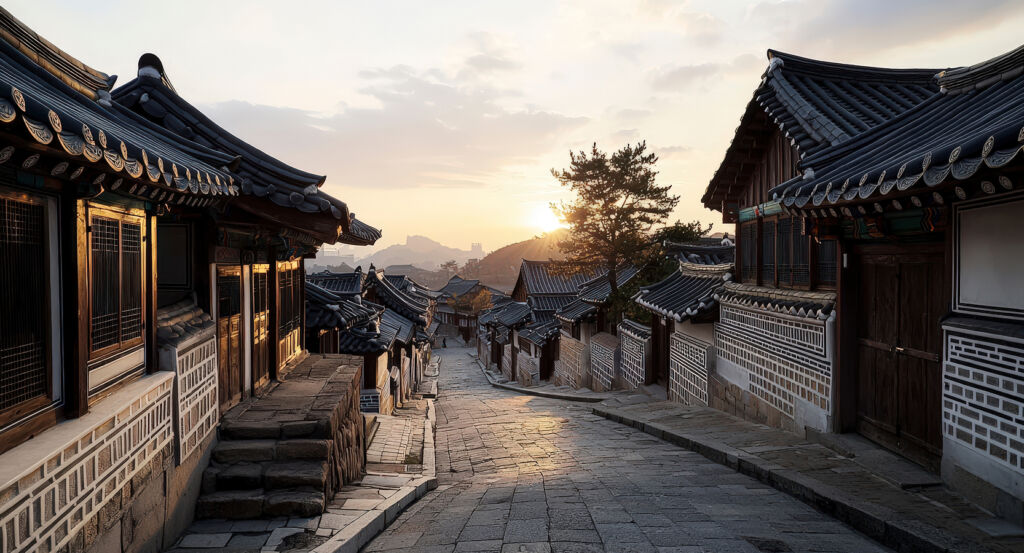
Positioned opposite Gyeongbokgung Palace's western stone wall, near the intersection of Hyoja-ro and Jahamun-ro, the restaurant occupies the upper floors of a contemporary cultural building between the palace grounds, Seochon's traditional residential streets and the wooded slopes of Inwangsan. Its restrained exterior establishes a modern architectural presence alongside the neighborhood's historic hanok houses and low-rise commercial buildings. Inside, pale surfaces, exposed concrete, natural wood and carefully selected Korean ceramics create a composed dining room overlooking the palace landscape. Counter seating faces the open kitchen, and broad windows introduce natural light and views of the surrounding trees, connecting the interior to the historic setting beyond. The result is a restaurant whose contemporary architectural restraint, traditional craftsmanship and immediate relationship with Korea's principal royal palace provide a compelling physical setting for the preservation of Korean culinary heritage.
What defines Onjium.
Onjium is best known for chefs Cho Eun-hee and Park Sung-bae transforming the culinary traditions of Korea's royal court, aristocratic households and regional communities into an internationally recognized restaurant devoted to the transmission of historical knowledge through contemporary cooking. Cho began studying Korean royal court cuisine in her twenties at the Institute of Korean Royal Cuisine, entering a field whose formal preservation had become an important part of South Korea's cultural heritage program. The government designated Joseon royal court cuisine Important Intangible Cultural Property No. 38 in 1970, recognizing a culinary tradition shaped by the royal household's access to ingredients and cooking practices from Korea's eight provinces. Cho subsequently became an education team leader at the institute, developing her expertise through the instruction and preservation of historical preparations. She also served as an adjunct professor at Baewha Women's University, extending her teaching into an academic environment concerned with Korean food culture. Her professional work included culinary consultation for publications, cultural events and historical television dramas, connecting traditional cooking techniques to broader interpretations of the Joseon period. Park developed a complementary culinary background through professional work in Japan and the United States, bringing experience with international restaurant operations into their eventual partnership. Together, the chefs established Onjium in 2013 as part of a cultural institution devoted to traditional Korean clothing, architecture and food. The institution's name combines the Korean concepts of completeness and making, expressing a commitment to producing contemporary work grounded in inherited knowledge. Its three principal workshops examine traditional garments, architectural craftsmanship and culinary practices, creating a multidisciplinary setting for the preservation and adaptation of Korean culture. The culinary division developed into a restaurant where historical recipes could be reconstructed, tested and interpreted through meals prepared for contemporary diners. Cho and Park studied traditional manuscripts, regional preparations and the techniques associated with royal and aristocratic households, gradually establishing a distinctive culinary program. Their educational activities extended to twice-monthly classes in Korean history and culture for members of the restaurant team, connecting practical kitchen training to the historical circumstances surrounding individual preparations. The chefs also developed a substantial body of culinary material that contributed to the publication of an Onjium recipe book in 2016. As the restaurant evolved, its original intimate dining arrangement expanded to accommodate additional guests and provide greater capacity for the storage and maturation of traditional ingredients. Onjium received a MICHELIN star in the 2020 Seoul guide, establishing international recognition for its interpretation of Korean historical cuisine. Its influence subsequently extended to New York through Onjium at Genesis House, which opened in Manhattan in November 2021 and introduced the culinary program to an American audience. The Seoul restaurant continued gaining regional recognition, reaching twenty-first place on Asia's 50 Best Restaurants list in 2024 and tenth place in 2025. Cho received the Asia's Best Female Chef Award in 2026, recognizing her longstanding contribution to the preservation and development of Korean royal court cooking. Onjium placed fourteenth on Asia's 50 Best Restaurants list that year, completing a sustained period of international recognition for a culinary institution whose origins lay in the preservation of Korea's historical cultural practices.
Cho's cooking begins with the accumulated knowledge of Korean royal court cuisine, where the selection of seasonal ingredients, careful preparation of fermented seasonings and balance between individual dishes establish the foundations of a complete meal. The kitchen prepares its own doenjang, ganjang and gochujang, allowing the fermentation of soybeans and grains to develop the savory depth, salinity and aromatic complexity essential to traditional Korean cooking. A dedicated fermentation facility in Joan-ri, Namyangju, provides space for aging these preparations under conditions influenced by temperature, humidity and the passage of time. Doenjang contributes concentrated earthy flavors to vegetables and broths, and ganjang introduces a different expression of fermented soy through its liquid texture and capacity to season ingredients during cooking. Gochujang adds chile heat and grain-derived sweetness, establishing another relationship between fermentation and the natural flavors of seasonal produce. These foundational seasonings give the kitchen a consistent culinary style through which historical preparations acquire depth and balance. Tangpyeongchae demonstrates that relationship through delicate strips of mung bean jelly combined with vegetables and carefully measured seasoning. The jelly's restrained flavor and yielding texture create a foundation for contrasting ingredients, allowing the dish's characteristic balance to emerge through freshness, acidity and subtle savory notes. Its traditional arrangement also reflects the Korean principle of obangsaek, the five directional colors associated with harmony and balance in historical cultural practices. Seasonal vegetables extend this attention to color and flavor through spring greens, mountain herbs and cultivated produce selected at different stages of maturity. The kitchen's treatment of these ingredients preserves their individual bitterness, sweetness and aromatic character, using blanching, seasoning and fermentation to create contrast within the meal. Bangpung juk, a porridge incorporating coastal hogfennel, develops another dimension of traditional Korean cooking through the relationship between grain and medicinally valued plants. Slow cooking softens the rice into a cohesive texture, allowing the herb's distinctive fragrance to emerge through a preparation associated with nourishment and seasonal health. The restaurant's seafood preparations draw on historical court techniques that transform delicate marine ingredients through steaming, stuffing and carefully controlled cooking. Haesamjeung develops the concentrated flavor and unusual texture of sea cucumber through a traditional preparation whose complexity depends on the ingredient's handling and accompanying seasonings. Abalone introduces a firmer marine texture and natural sweetness, allowing mushrooms and concentrated broths to supply additional savory depth. Jinju-style galbi-jjim provides a richer expression of the same culinary foundations through beef short ribs braised until their connective tissue softens and the meat absorbs the flavors of its cooking liquid. The prolonged cooking develops tenderness and concentration, creating a substantial savory course that balances the lighter vegetable and seafood preparations preceding it. The restaurant's changing monthly menu brings these techniques into a seasonal sequence, with certain ingredients appearing for brief periods determined by their availability. Traditional Korean alcoholic beverages extend the relationship between fermentation and food, introducing rice-based drinks whose sweetness, acidity and aromatic complexity complement the changing intensity of the courses. Tea service provides another expression of Korean hospitality, allowing delicate infusions to accompany the concluding stages of the meal. Onjium's culinary distinction emerges through this sustained relationship between historical recipes, carefully matured seasonings, seasonal ingredients and precise preparation, translating the accumulated knowledge of Korean cooking into a coherent contemporary dining program.
How Onjium fits.
Onjium works as the concluding destination for a Seochon itinerary connecting Korea's royal heritage, the transformation of neighborhood commerce and the preservation of twentieth-century Korean painting within the historic streets west of Gyeongbokgung Palace.
Begin at National Palace Museum of Korea, the principal institution devoted to the material culture and ceremonial history of the Joseon royal household and the Korean Empire. Its institutional origins extend to the Imperial Museum established during the reign of Emperor Sunjong in 1908, when Korea's monarchy began organizing royal collections for public presentation. The museum opened to visitors in November 1909, establishing an early foundation for the preservation of objects associated with the royal court. Its collections underwent successive administrative transformations during Japanese colonial rule and the decades following Korean liberation, eventually contributing to the development of a dedicated national institution for royal heritage. The National Palace Museum of Korea opened in August 2005, bringing royal ceremonial objects, paintings, furnishings, scientific instruments and historical artifacts into exhibition galleries beside Gyeongbokgung Palace. Continue to Tongin Market, the traditional neighborhood marketplace whose development reflects Seochon's changing commercial life during the Japanese occupation and the decades following the Korean War. Established in June 1941 to serve Japanese residents living near the palace, the market subsequently became an important commercial center for Korean street vendors and neighborhood households. Population growth following the Korean War expanded demand for groceries, prepared food and everyday household goods, gradually establishing the network of small businesses that characterizes the market. Its traditional food stalls developed a reputation for gireum-tteokbokki, a preparation of rice cakes seasoned and fried in oil that became closely associated with Seochon's local food culture. In January 2012, the market introduced its Dosirak Café program, allowing visitors to exchange traditional-style brass coins for small portions from participating vendors and assemble their own Korean lunchboxes. Conclude at Park No-soo Museum, the preserved residence and artistic collection associated with painter Park No-soo, an influential figure in the development of modern Korean painting. Architect Park Gil-ryong designed the house in 1937, combining Korean residential traditions with Western architectural elements in a two-story building distinguished by its gabled roof and varied interior spaces. The property became Park's home in 1973, providing a domestic setting for his artistic work during the following decades. Seoul designated the residence Cultural Heritage Material No. 1 in 1991, recognizing the significance of its architecture within the city's surviving twentieth-century residential landscape. Following Park's donation of the property and his artworks, the Jongno Cultural Foundation opened the museum in 2013, preserving his paintings and personal collection within the house where he had lived and worked. The progression moves from the National Palace Museum of Korea's preservation of royal material culture through Tongin Market's changing neighborhood traditions and culminates in Park No-soo Museum's connection between domestic architecture and modern Korean painting, placing Onjium within Seochon's continuing relationship with historical preservation and contemporary cultural life.
Where your story begins.
Foresyte Travel reveals places that feel extraordinary long before you arrive.
Enjoy editorial crafted for luxury travelers.
Foresyte may earn a commission when you book.

















































































































