
Why Palazzo Petrucci Ristorante matters.
Palazzo Petrucci Ristorante is a distinguished Posillipo dining destination where Naples' historic waterfront meets Lino Scarallo's contemporary interpretation of Neapolitan cuisine, Edoardo Trotta's independent hospitality enterprise and the culinary traditions of Campania's Mediterranean coast.
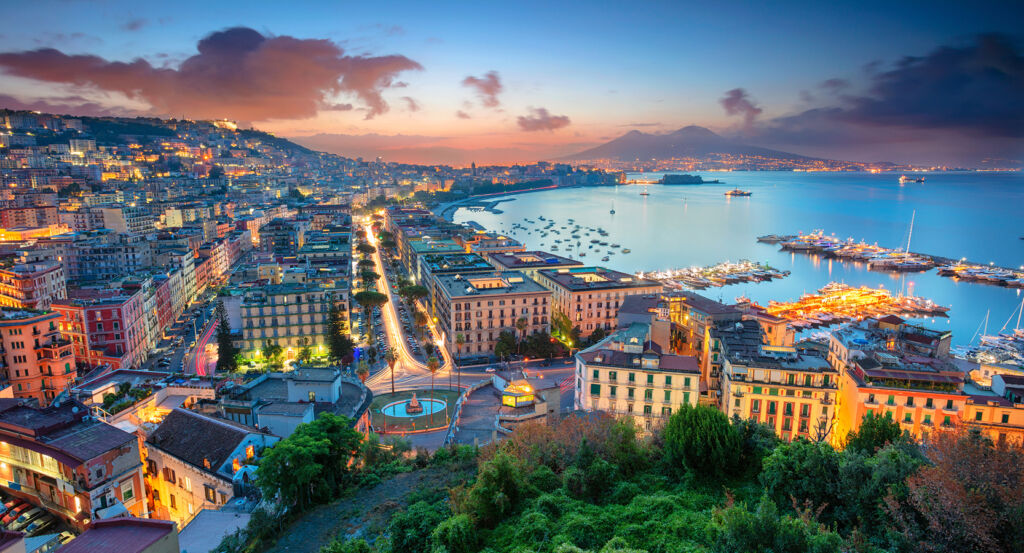
Occupying a seafront position along the lower slopes of Posillipo, near Largo Sermoneta and the waterfront approach from Mergellina, the restaurant sits above a small beach overlooking the Gulf of Naples, with Mount Vesuvius rising across the water and Capri visible toward the western horizon. Its multilevel hospitality building incorporates broad sea-facing windows, contemporary interior finishes and dining areas connected by internal circulation between the waterfront and the elevated street entrance. A recently redesigned first-floor dining room accommodates thirty-six diners around an open kitchen, with a dedicated wine cellar and a two-seat chef's counter incorporated into the arrangement. Additional hospitality spaces occupy the building's other levels, including a cocktail lounge, private event facilities and a terrace overlooking the coastline. The result is an intimate fine-dining restaurant whose contemporary architecture, visible culinary preparation and expansive coastal outlook establish a distinctive physical connection between Neapolitan gastronomy and the Mediterranean landscape.
What defines Palazzo Petrucci Ristorante.
Palazzo Petrucci Ristorante is best known for the partnership between Neapolitan chef Lino Scarallo and entrepreneur Edoardo Trotta, whose collaboration established one of Naples' earliest MICHELIN-recognized contemporary restaurants and subsequently transformed the business into a multilevel waterfront hospitality destination. Scarallo grew up in the Sanità district, developing his culinary career within a city whose cooking traditions draw on centuries of aristocratic dining, popular street food, agricultural production and Mediterranean fishing. Trotta entered hospitality from a professional background in accountancy, bringing commercial expertise and an interest in fine dining to a partnership centered on developing a distinctive interpretation of Neapolitan cuisine. Their restaurant opened in 2007 inside the former stables of Palazzo Petrucci, a historic building overlooking Piazza San Domenico Maggiore in Naples' ancient center. The original premises connected an ambitious contemporary kitchen to one of the city's most historically significant urban settings, establishing a deliberate relationship between modern restaurant cooking and the architectural heritage of the old town. Scarallo introduced a culinary program that reworked familiar Neapolitan preparations through carefully controlled cooking, revised textures and combinations of ingredients drawn from the region's established food traditions. His seafood ragù became an early expression of this approach, translating the concentrated flavor development associated with traditional Neapolitan meat sauces into a preparation centered on marine ingredients. The restaurant received a MICHELIN star in 2008, becoming the first restaurant within Naples itself to achieve the distinction and establishing Scarallo among the chefs contributing to the city's growing contemporary fine-dining reputation. The recognition arrived during a period when Campania's internationally celebrated restaurant industry was concentrated heavily along the Sorrentine Peninsula and Amalfi Coast, giving the Naples establishment particular importance within the regional dining landscape. Trotta and Scarallo subsequently developed the business around tasting menus that combined recognizable local preparations with increasingly elaborate presentations and technical experimentation. Their partnership also expanded into pizza, creating a complementary operation that preserved the connection between the Palazzo Petrucci name and the historic center. A major transformation arrived in 2016 when the fine-dining restaurant relocated from Piazza San Domenico Maggiore to the waterfront of Posillipo. The move established a purpose-developed gastronomic complex extending across three levels and a panoramic terrace, introducing separate spaces for restaurant dining, private events, cocktails and additional culinary concepts. Its location beside one of Naples' most recognizable stretches of coastline gave the business a new architectural character and connected its dining program directly to the city's maritime geography. The relocation also strengthened the distinction between the original Palazzo Petrucci premises, which continued operating as a pizzeria, and the fine-dining restaurant under Scarallo's leadership. The Posillipo operation subsequently developed Il Malandrino as a dedicated cocktail and hospitality space, introducing a preliminary stage to the dining experience through aperitifs and small culinary preparations. Further expansion brought additional pizza service to the waterfront complex, extending the company's approach to Neapolitan cooking across complementary dining formats. The restaurant's culinary reputation developed through Scarallo's signature preparations, including his reinterpretations of traditional ragù, Genovese sauce, buffalo mozzarella and regional seafood. The company also established Notte di Stelle, a charitable dining initiative bringing together chefs and hospitality professionals in support of Telethon's medical research activities. Its 2025 edition raised €165,000, demonstrating the scale achieved by a philanthropic program connected to the restaurant's wider professional network. A subsequent redesign of the fine-dining facilities introduced a new open kitchen, an adjacent wine cellar and a smaller dining arrangement emphasizing direct interaction between Scarallo's culinary team and diners. The contemporary restaurant continues to organize its principal dining program around tasting menus, preserving the relationship between its original MICHELIN-recognized cooking and the more elaborate hospitality infrastructure developed along the Posillipo waterfront.
Lino Scarallo's cooking develops the foundations of Neapolitan gastronomy through the concentration of familiar flavors, precise treatment of seafood and carefully constructed contrasts between ingredients traditionally associated with the city's domestic kitchens. His approach begins with the recognition that preparations such as ragù, Genovese and pastiera possess distinctive flavor structures capable of supporting substantial technical development. Slow reduction provides one of the kitchen's most important methods, allowing onions, meat juices and aromatic ingredients to develop the sweetness and savory depth characteristic of long-cooked Neapolitan sauces. Genovese becomes particularly expressive through this process because prolonged cooking transforms onions into a concentrated foundation whose natural sweetness can support ingredients with pronounced salinity and delicate texture. Scarallo extends that foundation into combinations involving raw fish, smoked cheese and citrus, using the contrasting temperatures and aromatic qualities of the components to change how the traditional sauce is experienced. Pasta provides a structural element in these preparations, with substantial shapes such as candele and paccheri retaining their firmness and supporting concentrated sauces through their thickness and internal surfaces. The kitchen's treatment of paccheri also explores their physical arrangement, positioning individual pieces upright to create a composition that preserves the recognizable flavor of Neapolitan ragù through a different form of presentation. Buffalo mozzarella introduces another essential Campanian ingredient, contributing a soft, lactic richness that develops particularly well alongside the natural sweetness of raw prawns. Scarallo uses this relationship in his signature lasagnetta, allowing the mozzarella to provide the creamy foundation for delicate seafood and seasonal vegetable sauces. The combination depends on preserving the prawn's tender texture and subtle marine flavor, with the vegetable component contributing freshness and a controlled degree of bitterness or acidity. This attention to seafood continues through the transformation of squid into pasta-like strands, creating a preparation whose appearance recalls traditional tagliolini but whose texture and flavor remain unmistakably marine. Clams and seaweed deepen the composition through natural salinity, connecting the delicacy of the squid to the concentrated character of shellfish and coastal vegetation. Broths provide another means of developing these flavors, extracting depth from fish and shellfish before introducing aromatic ingredients that give the finished preparation additional complexity. The kitchen's boiled seafood preparation incorporates rockfish and a green herb sauce alongside a dashi-inspired broth, combining the familiar Neapolitan treatment of mixed seafood with a carefully developed savory liquid. The relationship between land and sea also appears through preparations that bring pork into contact with concentrated squid sauces, allowing the richness of slow-cooked meat to interact with the pronounced flavor of marine ingredients. Bitter greens contribute an important counterpoint, particularly through escarole, friarielli and puntarelle, whose characteristic sharpness balances the richness of meat, cheese and reduced sauces. These vegetables maintain the connection between Scarallo's contemporary preparations and the produce historically associated with Campanian home cooking. The restaurant's vegetarian tasting menu develops the same attention to flavor concentration through legumes, seasonal vegetables and aromatic preparations, extending the kitchen's technical approach across ingredients beyond meat and seafood. Desserts continue the reinterpretation of familiar Neapolitan preparations through the careful separation and reconstruction of textures. Pastiera provides an especially important foundation because its traditional combination of wheat, ricotta, citrus and aromatic ingredients can be developed through distinct layers that preserve the dessert's recognizable flavor. Scarallo's tasting menus organize these preparations into a progression that moves through delicate marine flavors, concentrated sauces, richer land-based ingredients and carefully balanced sweet conclusions. The chef's-discretion format introduces flexibility, allowing the kitchen to respond to seasonal ingredients and develop combinations beyond the established signature preparations. Wine service supports this progression through selections capable of responding to the acidity, salinity, sweetness and richness of successive courses. The open kitchen gives the preparation of these compositions a visible presence within the dining room, and the chef's counter establishes an especially direct relationship between cooking and service. Scarallo's distinctive culinary achievement lies in the sustained development of Neapolitan flavor through precise reductions, contrasting textures and inventive combinations that preserve the recognizable character of Campanian ingredients across an elaborate fine-dining sequence.
How Palazzo Petrucci Ristorante fits.
Palazzo Petrucci Ristorante works as the concluding destination for an exploration of Naples' coastal history, connecting seventeenth-century aristocratic architecture, Renaissance humanism and the expansive public works of the Spanish viceregal period.
Begin at Palazzo Donn'Anna, the extraordinary unfinished Baroque residence commissioned by Anna Carafa, princess of Stigliano and wife of the Spanish viceroy Ramiro Núñez de Guzmán, duke of Medina de las Torres. Architect Cosimo Fanzago developed the project in 1642, transforming an earlier coastal residence known as Villa Sirena into an ambitious princely palace constructed directly above the sea. Its expansive design incorporated three principal levels, extensive arcades and an unusual relationship between the residential apartments and a theater overlooking the Gulf of Naples. Construction was interrupted after the viceroy returned to Spain in 1644, and the building remained incomplete following Anna Carafa's death. The surviving masonry, exposed arches and expansive coastal position preserve an important example of the architectural ambitions of Naples' seventeenth-century aristocracy. Continue to Santa Maria presso San Satiro del Parto, the Renaissance church established through the patronage of poet and humanist Jacopo Sannazaro. King Frederick of Aragon granted Sannazaro land at Mergellina in 1499, enabling the poet to develop a residence and religious complex overlooking the coast. The lower church was completed in 1525, and Sannazaro donated the property to the Servite order in 1529, requiring the completion of the upper church and the construction of his funerary monument. Giovanni Angelo Montorsoli executed the poet's elaborate tomb in 1536, incorporating classical sculptural elements associated with Renaissance humanism. The church also preserves Leonardo da Pistoia's Saint Michael the Archangel, a sixteenth-century painting associated with the Neapolitan legend of the Devil of Mergellina. Conclude at Fontana del Sebeto, the expansive Baroque fountain commissioned in 1635 during the Spanish viceregal period and designed by Cosimo Fanzago with contributions from his sons Carlo and Cesare. Its composition centers on a reclining male figure representing the ancient Sebeto River, accompanied by marine creatures, flowing water and heraldic decoration. The fountain originally occupied a position near Santa Lucia, connecting its sculptural program to the waterfront improvements undertaken by the Spanish administration. Subsequent changes to Naples' coastal road network prompted its relocation to Largo Sermoneta during the twentieth century. Its marble basins, triumphal architectural arrangement and sculptural personification preserve the relationship between Baroque public art and the symbolic geography of the city. The progression moves from Palazzo Donn'Anna's aristocratic coastal architecture through Santa Maria presso San Satiro del Parto's Renaissance literary patronage and concludes at Fontana del Sebeto's expansive Baroque sculpture, connecting successive expressions of political authority, artistic patronage and urban development along Naples' historic waterfront.
Where your story begins.
Foresyte Travel reveals places that feel extraordinary long before you arrive.
Enjoy editorial crafted for luxury travelers.
Foresyte may earn a commission when you book.




















































































































