
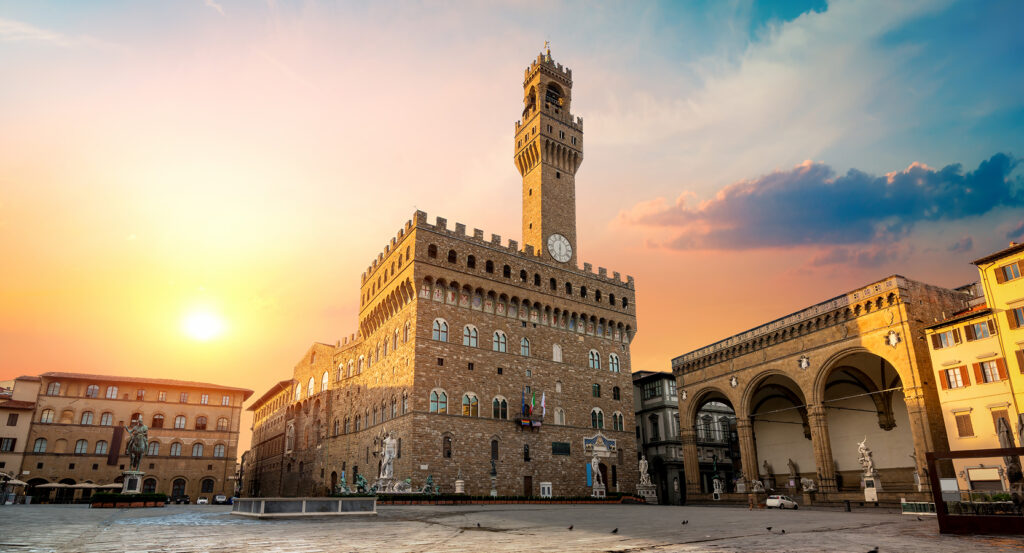
Why you should experience Hall of Five Hundred at Palazzo Vecchio in Florence, Italy.
The Hall of Five Hundred at the Palazzo Vecchio in Florence is among the grandest civic chambers in Europe, a soaring symphony of art, architecture, and political ambition.
Stepping into the Salone dei Cinquecento feels like crossing into the very heart of the Renaissance. The room stretches nearly 50 meters long, its gilded coffered ceiling shimmering like sunlight on water, each panel painted with allegories of Florence's victories and virtues. The walls explode with color and motion, vast frescoes by Giorgio Vasari and his workshop depicting grand battle scenes: The Taking of Siena and The Victory of Cosimo I at Marciano. The effect is overwhelming, a mirror of history, triumph, and symbolism meant to celebrate Florence's power and identity. The scale alone commands reverence, but the intimacy of detail draws you closer: the faces of soldiers rendered with startling humanity, the banners unfurling in bursts of red and gold. It's not just a hall, it's a declaration carved in pigment and stone, where politics became theater and art became the language of authority.
What you should know about Hall of Five Hundred at Palazzo Vecchio.
The Hall of Five Hundred began as an experiment in democracy before becoming the stage for dynastic grandeur.
Commissioned in 1494 by the Florentine Republic under Girolamo Savonarola, the chamber was built to house the Consiglio Maggiore, the Great Council of 500 citizens who would govern Florence after the Medici were expelled. Its immense size reflected a revolutionary ideal: that government should belong to the people, not a single family. But the dream was short-lived. When the Medici returned to power, Duke Cosimo I transformed the hall into a royal audience chamber, a place of performance designed to glorify his reign. Giorgio Vasari expanded the room and covered its walls and ceilings with propaganda masquerading as art, replacing republican ideals with Medici mythology. Beneath Vasari's frescoes, however, legend holds a mystery: Leonardo da Vinci's unfinished Battle of Anghiari, a lost masterpiece some believe still lies hidden behind the painted walls. Whether or not it remains, the idea that two of the Renaissance's greatest minds, Leonardo and Michelangelo, once competed to decorate the same space adds a mythic aura to the hall's grandeur.
How to fold Hall of Five Hundred at Palazzo Vecchio into your trip.
Experiencing the Hall of Five Hundred is a journey into Florence's soul, a single room that tells the story of its rise, rebellion, and rebirth.
Enter through the Palazzo Vecchio's courtyard, then ascend the grand staircase to the first floor, where the hall opens in staggering scale. Give yourself time to absorb the details, look up to see the ceiling's intricate wooden panels and the sculptural frieze of angels and laurel wreaths. Seek out Giambologna's marble group Genius of Victory, once intended for Michelangelo's tomb, now resting serenely along the wall. If you can, join a guided tour to access the hidden rooms above the ceiling, where Vasari's scaffolding and secret walkways reveal the hall's astonishing engineering. Visit in the late afternoon, when golden light streams through the high windows, igniting the frescoes in a soft glow. Standing at the center, surrounded by the triumphal imagery of Florence's past, you'll feel what generations before have felt, awe, reverence, and the pulse of a city that once ruled the world through art and intellect. The Hall of Five Hundred at the Palazzo Vecchio in Florence isn't just a masterpiece, it's the living chamber of history itself.
Where your story begins.
Foresyte Travel reveals places that feel extraordinary long before you arrive.
Experience premium editorial crafted for luxury travelers.




















































































































