Why you should experience Pendry Chicago in Chicago, Illinois.
Pendry Chicago is a glamorous Art Deco hotel where the Burnham family's architectural inheritance, Union Carbide's industrial ascent and Michigan Avenue's interwar reinvention converge inside one of Chicago's most expressive skyscrapers.
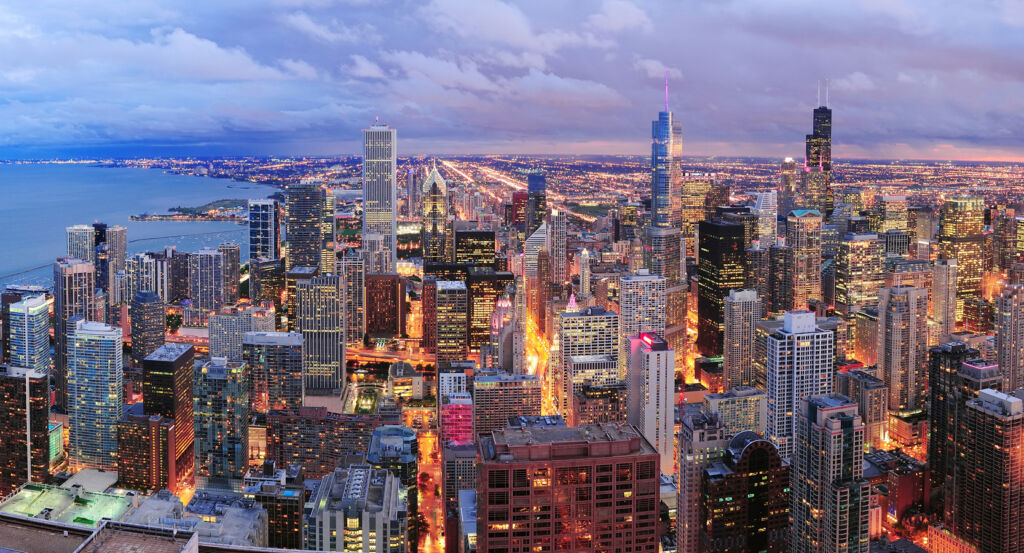
Set along North Michigan Avenue near East South Water Street and just steps from the Chicago Riverwalk, the hotel occupies the 37-story Carbide and Carbon Building, completed in 1929 by Daniel Burnham's sons Daniel Jr. and Hubert Burnham as the regional headquarters of Union Carbide and Carbon Company. The corporation had grown from technologies surrounding the first commercially successful dry-cell battery, commissioning a tower whose polished black granite base, dark green and gold terra cotta, bronze trim and genuine 24-karat gold-leaf cap projected industrial prosperity immediately before the Wall Street Crash. A companion tower planned beside the original was abandoned after the 1929 market collapse, leaving the single 503-foot composition to dominate its stretch of Michigan Avenue as the corridor developed around the decade-old Michigan Avenue Bridge. The result is a hotel where Union Carbide's industrial confidence, the Burnham brothers' Art Deco imagination and the economic rupture of 1929 remain compressed into a skyscraper conceived at the precise end of Chicago's Jazz Age building boom.
What you should know about Pendry Chicago.
Pendry Chicago is best known for opening in May 2021 as Montage International's first Pendry property in the Midwest, introducing the brand into a 364-room building whose hospitality history had already passed through a $106 million restoration completed in 2004, the Hard Rock Hotel era and the subsequent St. Jane Chicago. Alessandro Munge and Toronto-based Studio Munge directed the 2021 reworking of the public interiors, juxtaposing the building's surviving Belgian marble, bronze and frosted-glass style with contemporary commissions including Amsterdam artist Arnout Meijer's light-based work in the reception parlor. The opening connected Montage founder and CEO Alan J. Fuerstman's expanding Pendry portfolio with a structure that had received Chicago architectural designation in 1996, giving the company a Midwest flagship inside an internationally recognizable piece of the city's interwar skyline. Pendry's arrival consequently became another chapter in the building's unusually persistent cycle of reinvention, extending a chronology from Burnham Brothers and Union Carbide through the 2004 restoration and successive hotel identities without displacing the architecture as the primary protagonist.
Studio Munge developed a second creative strand through Venteux, where Alessandro Munge divided the ground-floor restaurant between a bright café and darker French brasserie while Clique Hospitality supplied the operating partnership and Chicago-born Donald Young became its opening Executive Chef-Partner. Young arrived after cooking at Les Nomades and France's Bistrot Saveurs before earning a MICHELIN star at Temporis at age 28, making him the youngest MICHELIN-starred chef in Chicago at the time and bringing a distinctly local culinary biography into Pendry's French concept. Twenty-four floors above Michigan Avenue, Château Carbide reclaimed the tower's vertical drama as the hotel's rooftop identity, its name directly returning the contemporary hospitality program to the corporation for which Daniel Jr. and Hubert Burnham designed the building almost a century earlier. Munge, Clique Hospitality, Young and Montage International extend the Burnham brothers' original architectural performance through design, restaurant culture and contemporary hotel authorship, preserving the Carbide and Carbon Building as the connective idea rather than treating its history as background decoration.
How to fold Pendry Chicago into your trip.
Pendry Chicago works as the anchor for an afternoon tracing how Daniel Burnham's vision for Michigan Avenue became a sequence of corporate architecture, newspaper ambition and metropolitan engineering during the decade surrounding the Carbide and Carbon Building.
Begin at Wrigley Building, where William Wrigley Jr. commissioned Graham, Anderson, Probst & White for the chewing-gum company's headquarters, completing the south tower in 1921 and north tower in 1924 with six shades of white terra cotta, a clock tower modeled partly on Seville Cathedral's Giralda and Chicago's first air-conditioned office building rising beside the newly opened boulevard. Continue to Tribune Tower, where the Chicago Tribune marked its 75th anniversary in 1922 by offering $100,000 through an international competition seeking the world's most beautiful office building, attracting architects from across the globe before John Mead Howells and Raymond Hood's Gothic Revival proposal won the $50,000 first prize and reached completion in 1925. Conclude at DuSable Bridge, the double-deck trunnion bascule crossing envisioned within Daniel Burnham and Edward Bennett's 1909 Plan of Chicago and opened on May 14, 1920, when Mayor William Hale Thompson cut the ribbon amid fireworks, aircraft, boats and music before historical bas-reliefs were added in 1928. The progression moves from Wrigley's corporate confidence through the Tribune's global architectural competition into Burnham and Bennett's metropolitan intervention, revealing the extraordinary burst of ambition that remade Michigan Avenue immediately before the Burnham brothers crowned Pendry Chicago's future home in gold.
Where your story begins.
Foresyte Travel reveals places that feel extraordinary long before you arrive.
Experience premium editorial crafted for luxury travelers.