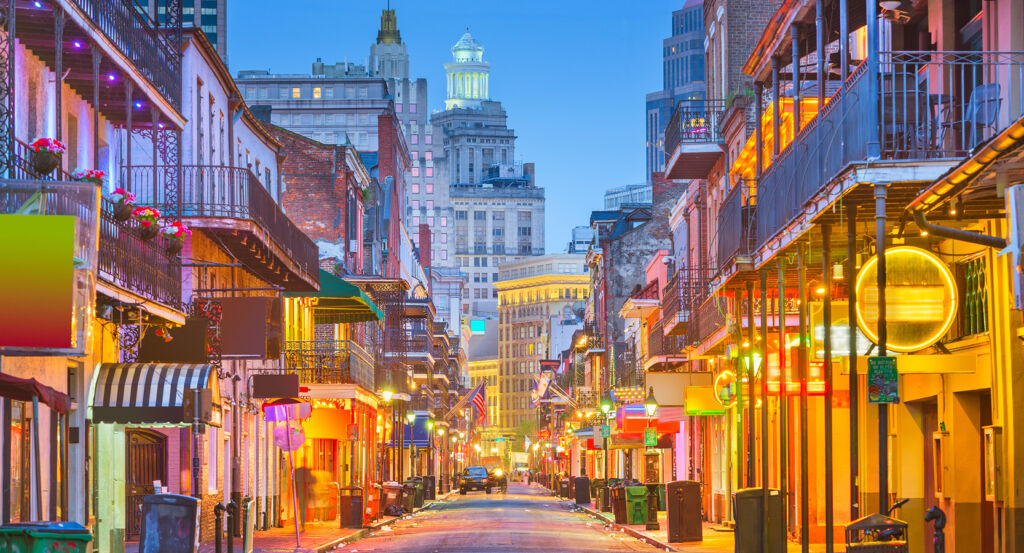
Why Piety Street matters.
Piety Street is a storied corridor where Bywater's Creole residential fabric meets riverfront industry, neighborhood commerce and an artistic lineage that turned an ordinary Ninth Ward street into a consequential address for groceries, recorded music and experimental art.
Running through Bywater between the Mississippi River and St. Claude Avenue, the corridor follows a perpendicular path inland from the riverfront through Chartres Street, Royal Street, Dauphine Street and Burgundy Street before reaching the neighborhood's principal commercial artery. Near the river, Piety meets the active rail corridor and floodwall that historically separated Bywater from the working wharves, with the Piety Street bridge now carrying pedestrians above both barriers into Crescent Park. Shotgun houses and Creole cottages establish the prevailing residential scale farther inland, joined by corner commercial buildings and industrial structures inherited from Bywater's nineteenth and twentieth-century development. Royal and Dauphine place the corridor inside particularly dense stretches of the historic neighborhood before St. Claude marks the transition toward the inland Ninth Ward. The result is a compact cross-section of Bywater where the Mississippi riverfront, industrial remnants, nineteenth-century housing and neighborhood storefronts unfold across a short sequence of blocks.
What defines Piety Street.
Piety Street is best known for accumulating an unusual sequence of businesses and cultural projects that repeatedly reached far beyond its Bywater blocks. Garret Schwegmann Sr., a German immigrant who served in the Union Army, entered the grocery trade after the Civil War and operated a neighborhood store at Piety and Burgundy that became an early foundation of the Schwegmann grocery enterprise. His son Garret Jr. purchased the store on March 3, 1895, reopened it as G.A. Schwegmann Grocery Company and operated it with brothers Henry and John before the business became Schwegmann Brothers Company. A surviving 1895 photograph places the family inside the Piety and Burgundy store, decades before the enterprise expanded into the giant supermarkets that eventually employed more than 7,000 people across a regional network approaching 50 stores. Another Piety address entered American music history after producer, engineer and musician Mark Bingham converted a former post office into Piety Street Recording in 2001. Its 1,700-square-foot main playing room accommodated orchestral sessions, and the studio became a recording site for Dr. John, Terence Blanchard, Cassandra Wilson, the Dirty Dozen Brass Band, John Scofield and numerous other musicians before closing in 2013. Elvis Costello and Allen Toussaint recorded part of The River in Reverse there after Hurricane Katrina, and Dr. John recorded Mercernary with Bingham as engineer.
A collapsing Creole cottage on Piety Street opened another chapter in 2010 when New Orleans Airlift co-founder Jay Pennington placed the property in the hands of Delaney Martin, sound artist Taylor Lee Shepherd and artist Swoon. Twenty-five artists transformed the site into the Music Box: A Shantytown Sound Laboratory, embedding invented instruments into floors, walls and ceilings so architecture itself generated music. The project opened in 2011, drew 15,000 people during its nine-month run and brought more than 70 musicians into orchestral performances played through the structures. Its October 22 debut began an experiment that subsequently traveled through other cities before securing a permanent New Orleans home as Music Box Village in 2016. At the river end of the street, a different transformation converted former port infrastructure into Crescent Park, where Hargreaves Associates worked with Eskew+Dumez+Ripple, David Adjaye and Michael Maltzan on a 20-acre landscape extending along 1.4 miles of Mississippi riverfront. Adjaye's Cor-Ten steel Piety Bridge rises above the floodwall and active railroad tracks before descending toward Piety Gardens and the transformed 26,000-square-foot Piety Wharf, making the corridor one of the principal physical connections between Bywater and the river.
How Piety Street fits.
Piety Street works as the anchor for an outing connecting a reclaimed industrial riverfront with a warehouse-scale body of contemporary Black art and a permanent village of playable architecture descended directly from an experiment first constructed on Piety itself.
Begin at Crescent Park, where 20 acres of former Port of New Orleans wharves and railroad sidings became a linear public landscape along the Mississippi. Hargreaves Associates led the project with Eskew+Dumez+Ripple, David Adjaye and Michael Maltzan, incorporating industrial remnants into paths, planting, bridges and reused wharf structures. The larger Reinventing the Crescent plan emerged after Hurricane Katrina as a six-mile riverfront proposal, with Crescent Park becoming its first constructed phase. Its Piety connection is architecturally explicit: the bridge arcs above the rail line and floodwall to a 26,000-square-foot transformed wharf, converting a historic barrier between neighborhood and working river into direct pedestrian access. Continue to StudioBE, the 36,000-square-foot gallery Brandan “BMike” Odums established in 2016 as the final component of his BE Trilogy. Odums had begun experimenting with graffiti in 2012, developing ProjectBE inside the abandoned Florida Housing Development before creating ExhibitBE with more than 40 artists at a vacant West Bank apartment complex. StudioBE carried those experiments into a permanent warehouse setting through Ephemeral.Eternal, combining more than a dozen original murals, room-scale installations and reconstructed works salvaged before ProjectBE's demolition. Conclude at Music Box Village, whose permanent Upper Ninth Ward site preserves the concept born from Piety Street's collapsing Creole cottage. New Orleans Airlift secured the one-acre property in 2016 beside a 13,000-square-foot former metal-fabrication shop, creating a permanent home for interactive structures conceived simultaneously as sculpture, architecture and musical instruments. The project has involved 100 artists and hundreds of musicians, with performers including Norah Jones, Animal Collective, Sun Ra Arkestra, Tony Allen, Tank and the Bangas and Wilco. The progression moves from industrial infrastructure reclaimed for public access through grand contemporary art and culminates in a playable architectural experiment whose origins return directly to the cultural invention once unfolding on Piety Street.
Where your story begins.
Foresyte Travel reveals places that feel extraordinary long before you arrive.
Enjoy editorial crafted for luxury travelers.
Foresyte may earn a commission when you book.