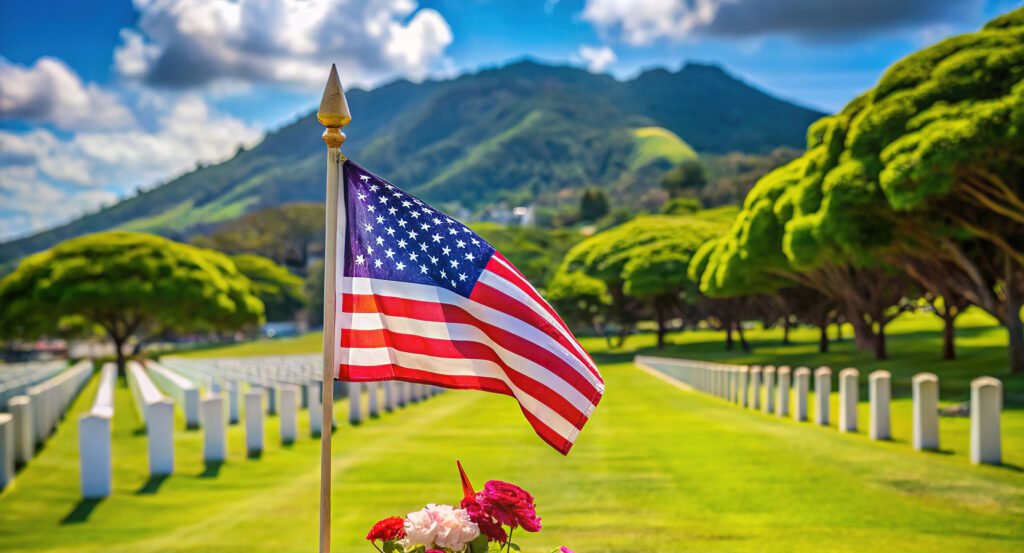
Why you should experience National Memorial Cemetery in Hawaii.
The National Memorial Cemetery of the Pacific (Punchbowl) in Honolulu is among the most solemn and beautiful places in the Hawaiian Islands, a sacred amphitheater of remembrance carved into the heart of an ancient volcano.
Set within the Puowaina Crater, whose Hawaiian name means “Hill of Sacrifice,” this national cemetery serves as a place of honor for the men and women who gave their lives in service to the United States. From the moment you enter, there's a stillness that feels almost celestial. Lush green lawns unfold in perfect symmetry, ringed by flowering trees and framed by the crater's steep, emerald walls. The air is hushed but charged with emotion, a space where grief and gratitude intertwine beneath the tropical sun. At its summit stands the Court of Honor, with the Lady Columbia statue, known as “The Spirit of the Pacific”, gazing outward, her expression both solemn and serene. Behind her, mosaic maps and marble panels recount the battles fought across the Pacific during World War II, each one etched with precision and reverence. Visitors often describe the experience as transcendent, not only for the site's beauty but for the sense of unity it inspires, a reminder that sacrifice and peace are forever intertwined. From the upper terraces, sweeping views of Honolulu, Diamond Head, and the Pacific stretch into the horizon, making this one of the most poignant vantage points in all of Hawaii.
What you should know about the National Memorial Cemetery of the Pacific.
Though now a symbol of solemn remembrance, Punchbowl Crater's history stretches back long before its modern memorial purpose.
Formed between 75,000 and 100,000 years ago by a single volcanic eruption, Puowaina was long considered a sacred site by Native Hawaiians, who believed it was a place of ritual and offering, where chiefs and warriors honored their ancestors and gods. In the 1940s, following the Second World War, the U.S. government sought a fitting resting place for the Pacific's fallen soldiers. Construction of the cemetery began in 1948, and the first burials took place the following year. More than 13,000 service members, many of whom died in World War II, the Korean War, and Vietnam, now rest within its grounds. Among them are heroes awarded the Medal of Honor and those whose names were once lost to history, later rediscovered through advances in forensic science. The site's design reflects a fusion of Western memorial architecture and Hawaiian landscape philosophy, the crater walls enclosing the cemetery like the embrace of the earth itself. The grand staircase leading to the Court of Honor was designed to mirror a spiritual ascent, culminating at the Lady Columbia statue, whose outstretched arms seem to offer eternal peace to the departed. The memorial also houses the names of over 28,000 missing soldiers, sailors, and airmen, a tribute to those whose remains were never recovered but whose service remains immortalized in stone. In 2012, a new memorial dedicated to the veterans of the Gulf War and other modern conflicts expanded the site's legacy, linking past and present in a single continuum of honor.
How to fold the National Memorial Cemetery of the Pacific into your trip.
A visit to Punchbowl is more than an act of sightseeing, it's a moment of reflection that deepens your understanding of Hawaii's history and its role in the Pacific.
The cemetery is located just north of Downtown Honolulu, about a 10-minute drive from Waikiki, and is open daily from morning until dusk. Begin your visit by walking through the main entrance along the memorial path, where each section is carefully labeled by war and branch of service. The Visitor Center provides context about the site's history, as well as the stories of those interred here. Take time to ascend the grand staircase toward the Court of Honor, pausing at the large mosaic maps that demonstrate the major Pacific campaigns, from Guadalcanal to Okinawa. The artistry of these maps, created from millions of colored tiles, reflects both the precision of military strategy and the beauty of memorial design. At the top, stand before the Lady Columbia statue and take in the panoramic view of Honolulu; it's one of the most moving vistas in the islands, a literal and symbolic meeting of life, sacrifice, and eternity. For a quieter experience, visit early in the morning or near sunset, when the light softens and the city below hums gently in the distance. Many visitors pair their trip with Pearl Harbor, creating a powerful full-day journey through Hawaii's military and cultural memory. Before leaving, take a final look across the crater, the rows of gravestones standing in serene formation like waves on the earth, each one a tribute to courage, loss, and peace. The National Memorial Cemetery of the Pacific is not just a resting place; it's a living reminder that the cost of freedom echoes far beyond the battlefield, carried forever in the hearts of those who remember.
Where your story begins.
Foresyte Travel reveals places that feel extraordinary long before you arrive.
Experience premium editorial crafted for luxury travelers.