
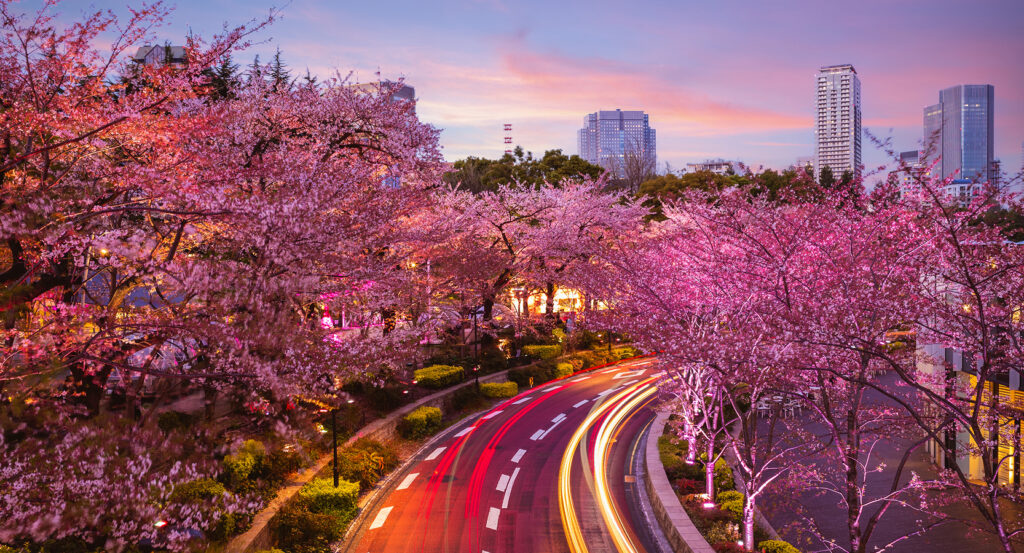
Why Tokyo Midtown matters.
Tokyo Midtown is an expansive urban complex where Roppongi's concentration of international culture meets high-rise architecture, contemporary art and one of Central Tokyo's most substantial landscaped precincts.
Set along Gaien Higashi-dori near Roppongi-dori and just steps from Hinokicho Park, the complex occupies 68,900 square meters beside a historic garden landscape at the northern edge of Roppongi. Midtown Garden and the adjoining park place lawns, trees, water and pedestrian paths beside the development's towers, with green and open areas covering close to four hectares across the combined grounds. Galleria draws movement through a four-storey interior lined by long sightlines and large glazed surfaces, connecting the commercial core with exterior terraces and planted areas. The transition into Hinokicho Park introduces a 1.4-hectare garden descended from the Edo-period estate of the Mōri family of Hagi, whose former grounds were known as Hinokiyashiki and whose garden, Seisuitei, commanded views across Edo. The result is a Central Tokyo complex where immense built scale gives way repeatedly to gardens, water and inherited landscape, making the contrast between contemporary Roppongi and the older terrain beneath it central to the encounter.
What defines Tokyo Midtown.
Tokyo Midtown is best known for transforming the former Japan Defense Agency property into a major new district through a six-company consortium led by Mitsui Fudosan. The government site had remained closed to general public access for six decades before the consortium acquired the 68,891-square-meter property in September 2001, opening an exceptional piece of Central Roppongi to redevelopment. Mitsui Fudosan worked alongside the National Mutual Insurance Federation of Agricultural Cooperatives, Meiji Yasuda Life Insurance, Sekisui House, Fukoku Mutual Life Insurance and Daido Life Insurance on a project that advanced from Tokyo's planning decision in March 2003 to construction beginning in May 2004. Skidmore, Owings & Merrill entered as master architect under David M. Childs, and Nikken Sekkei became core architect for a development conceived as a coordinated district rather than a collection of independent buildings. SOM organized Midtown Tower as the principal vertical element and arranged lower structures around it, establishing a deliberate hierarchy across offices, residences, hotel, cultural uses and public ground. Another major decision arrived in July 2005 when the consortium selected the Tokyo Midtown name and simultaneously announced 21_21 Design Sight, making design culture part of the development strategy before the buildings were finished. The completed project contained 569,000 square meters of planned floor area, including 330,000 square meters of offices, 111,000 square meters of residences, 48,000 square meters devoted to the hotel and 57,000 square meters of commercial space. Tokyo Midtown opened on March 30, 2007, completing a six-year transformation from restricted government property into a privately developed district whose architectural, residential, commercial and cultural components had been planned as a single undertaking. Mitsui Fudosan's consortium, Childs and SOM, Nikken Sekkei and the decision to embed cultural institutions within the development turned the former Defense Agency site into a new center of Roppongi whose significance came from the breadth of the commission as much as any individual building.
Issey Miyake gave the development's cultural ambitions their deepest institutional form after spending decades arguing that Japan needed a permanent center devoted to examining design. His discussions since the 1980s involved Isamu Noguchi, Ikko Tanaka, Shiro Kuramata and Tadao Ando, and his January 2003 Asahi Shimbun essay, “Time to Create a Design Museum,” pushed that long-running idea into public debate shortly before Tokyo Midtown took shape. Mitsui Fudosan supported the resulting 21_21 Design Sight, with the Miyake Issey Foundation directing its activities and Tadao Ando Architect & Associates working with Nikken Sekkei on the building. Ando translated Miyake's “A Piece of Cloth” clothing concept into a roof resembling a single folded steel plate and placed close to 80 percent of the architectural volume underground, leaving a restrained low structure beside the surrounding greenery. Miyake joined product designer Naoto Fukasawa and graphic designer Taku Satoh as founding directors, with journalist Noriko Kawakami as associate director, giving the institution creative leadership spanning fashion, industrial design, graphics and criticism. Tokyo Midtown Design Hub opened on the fifth floor of Midtown Tower on the same day as the larger complex, initially joining the Japan Industrial Design Promotion Organization, Japan Graphic Designers Association and Kyushu University School of Design Tokyo Site. Its first exhibition, Good Design Good Life, assembled close to 100 Japanese designs ranging from the electric rice cooker and Butterfly Stool to ASIMO and Wii, turning the development's declared interest in design into an institutional program from its first weeks. The Design Hub subsequently made Graphic Design in Japan an annual series, hosted its fiftieth exhibition in 2015 and reached its hundredth exhibition in 2022 as Tama Art University and other organizations entered its evolving institutional structure. Miyake's decades-long campaign, Ando's architecture, the multidisciplinary leadership of 21_21 Design Sight and the Design Hub's continuing program gave Tokyo Midtown a cultural apparatus built into the project from inception, extending the development far beyond its commercial and corporate functions.
How Tokyo Midtown fits.
Tokyo Midtown works as the anchor for a daytime route through three nearby institutions connecting Meiji memorial culture, postwar museum development and one of Japan's major private collections of premodern East Asian art.
Begin at Nogi-jinja Shrine, created after General Nogi Maresuke and his wife Shizuko died on September 13, 1912, the day of Emperor Meiji's funeral. Tokyo mayor Sakatani Yoshiro became chairman of the Chuo Nogi-kai formed in 1913 to establish a shrine, official approval followed in 1919, and the enshrinement ceremony took place on November 1, 1923. Air raids destroyed the principal shrine buildings in May 1945 before nationwide support financed their reconstruction for the fiftieth anniversary of Nogi's death in September 1962. Continue to The National Art Center, Tokyo, where the Agency for Cultural Affairs began planning a new national exhibition center in 1999 and commissioned Kisho Kurokawa with Nihon Sekkei in 2000. Construction concluded in 2006, and the institution opened on January 21, 2007 without a permanent collection, establishing a national museum devoted to changing exhibitions and artist-association shows across twelve galleries. Kurokawa's undulating glass facade became one of the final major works of the architect who had helped launch Metabolism in 1960. Conclude at Nezu Museum, founded around the collection of businessman and Tobu Railway president Nezu Kaichiro, whose son established a foundation in 1940 and opened the family's Aoyama residence as a museum the following year. The collection survived World War II after evacuation from Tokyo, then expanded from 4,642 works at the institution's beginning to 7,600 objects, including seven National Treasures and 93 Important Cultural Properties. Kengo Kuma designed the present main building completed in 2009, returning Nezu's paintings, calligraphy, sculpture, ceramics, lacquerware and tea objects to a purpose-built home beside the family garden. The progression moves from Nogi-jinja Shrine's transformation of Meiji-era remembrance into a permanent sacred precinct through Kisho Kurokawa's collection-free national exhibition institution into Nezu Kaichiro's private collecting legacy and Kengo Kuma's museum architecture, tracing distinct models of cultural patronage across the districts surrounding Tokyo Midtown.
Where your story begins.
Foresyte Travel reveals places that feel extraordinary long before you arrive.
Enjoy editorial crafted for luxury travelers.
Foresyte may earn a commission when you book.

















































































































