
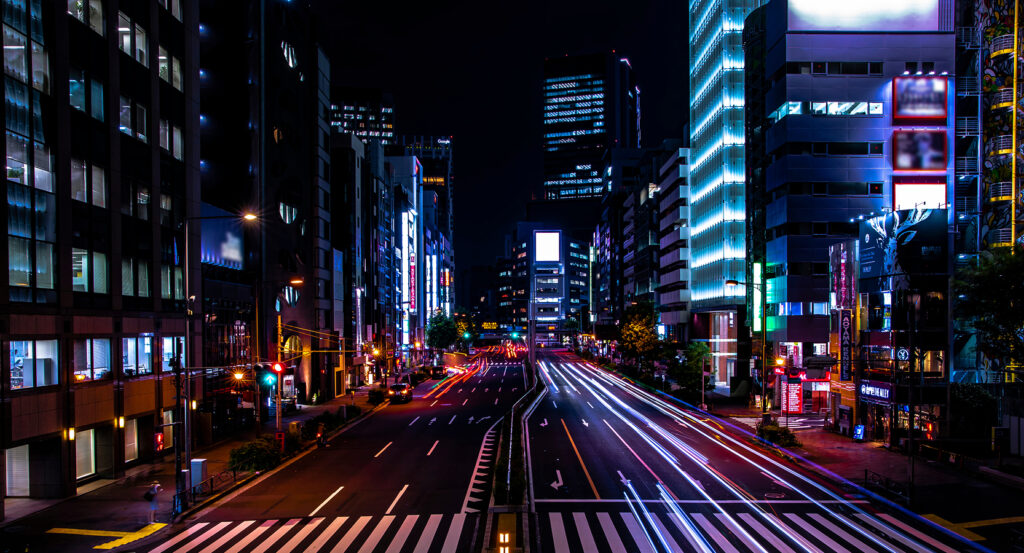
Why Aoyama matters.
Aoyama is a polished enclave where Central Tokyo meets the wooded edge of the Meiji precinct through broad ceremonial avenues, intimate residential lanes and an exceptional concentration of architecture, fashion and cultural institutions.
Positioned between Akasaka, Roppongi, and Jingumae, the neighborhood occupies a western Minato pocket where Aoyama-dori establishes a powerful metropolitan axis before smaller streets descend into the quieter residential fabric of Kita-Aoyama and Minami-Aoyama. The main avenue runs at a scale created through successive enlargements, yet the blocks behind it quickly contract into sloping lanes, walled properties and tree-lined approaches that give the district considerably greater spatial depth than its commercial frontage suggests. Omotesando establishes the primary encounter through a broad, zelkova-lined approach extending west from Aoyama toward Meiji Jingu, carrying pedestrians through one of Tokyo's most concentrated corridors of postwar and contemporary architecture. Minami-Aoyama supplies a distinct secondary mechanism as side streets fold galleries, fashion houses, residences and small cultural institutions into a finer network where major architectural commissions frequently occupy unusually constrained urban sites. Northern Aoyama changes scale again beside the open grounds and mature planting associated with Meiji Jingu Gaien, allowing the dense city to release into long sightlines and extensive greenery within a few blocks of Aoyama-dori. The result is a neighborhood whose metropolitan avenues, secluded backstreets and cultivated architectural culture operate at dramatically different scales, preparing a history that begins with an Edo-period samurai estate and extends through the remaking of western Tokyo.
What defines Aoyama.
Aoyama is best known for taking its name from the Aoyama family, Tokugawa retainers whose extensive Edo-period holdings established a geographic designation that survived the dismantling of the feudal order and became attached to one of modern Tokyo's most prominent districts. Aoyama Tadanari served Tokugawa Ieyasu and received territory in the area, and later generations of the family held Gujo Hachiman Castle in Mino Province while maintaining their connection with the Edo estate. Yoshinari Aoyama's death in 1643 led to the establishment of Baiso-in, whose name derives from his Buddhist name and whose Aoyama Kannon strengthened the family's religious presence within the district. The route later called Aoyama-dori also carried the Oyama Highway, used by travelers bound for Oyama Afuri Shrine in Tanzawa and by commercial traffic moving west from Edo. The Meiji government transformed part of the former Aoyama estate into public burial ground in 1874, creating Aoyama Cemetery during a national reorganization of funerary practice away from the temple-centered system of the Tokugawa period. Its 26 hectares eventually accumulated 14,000 graves containing 126,000 burials, including statesmen, military figures, writers and foreign residents connected with the formation of modern Japan. A separate portion of the former samurai landscape became the Aoyama military drill ground, further replacing feudal property with institutions of the new state. These changes carried the Aoyama name from a daimyo estate through religious, transportation, military and funerary geography, establishing the historical foundation beneath the modern district.
Postwar reconstruction supplied a separate mechanism for Aoyama's emergence as an international center of fashion, design and urban culture. Air raids devastated extensive portions of the surrounding city during World War II, after which nearby Washington Heights introduced shops and services oriented toward American military personnel and strengthened exposure to foreign consumer culture across western Central Tokyo. Aoyama-dori had already expanded from nine meters to 22 meters during the Meiji period, accompanied by municipal railway service, but preparations for the 1964 Tokyo Olympics widened the avenue again to 40 meters as events concentrated around the National Stadium and Meiji Jingu Gaien. Larger commercial buildings followed the new road scale, and Aoyama increasingly developed as a conduit connecting the office districts toward Akasaka with the fashion culture extending through Omotesando. Designers, boutiques, galleries and architectural commissions subsequently concentrated along the avenue and its side streets, turning the rebuilt district into an important platform for Japanese fashion and contemporary design. The transformation joined transportation investment with postwar consumer culture and Olympic-era construction, giving Aoyama the urban conditions from which its present concentration of creative industries emerged.
How Aoyama fits.
Aoyama works as the anchor for an afternoon connecting a private collection of premodern Asian art, an artist's purpose-built studio and a 1980s cultural center through three institutions that bind collecting, artistic production and modern architecture to the neighborhood's creative history.
Begin at Nezu Museum, founded around the collection of railway executive and tea practitioner Nezu Kaichirō, who purchased the Aoyama property in 1906 and assembled painting, calligraphy, sculpture, ceramics, lacquer, textiles, arms and archaeological objects across a collection later preserved through a foundation established by his son in 1940. The museum opened at the family residence in 1941, lost galleries, garden structures and a tea house during the 1945 air raids, resumed exhibitions in 1946 and entered a new architectural chapter in 2009 when Kengo Kuma completed the present main building; its holdings now encompass 7,600 works, including seven National Treasures and 93 Important Cultural Properties. Continue to Taro Okamoto Memorial Museum, occupying the Minami-Aoyama studio Junzo Sakakura designed for Okamoto in 1954 on the site of the artist's childhood home. Sakakura had studied under Le Corbusier, and Yutaka Murata handled construction as Okamoto established the Gendai Geijutsu Kenkyujo there and expanded his practice across painting, sculpture, ceramics, graphics, photography and large public commissions; the studio remained his working base through 1996, encompassing the creation of Tower of the Sun and Myth of Tomorrow, before Toshiko Okamoto drove its conversion into a public museum opened in 1998. Conclude at Spiral, opened by Wacoal in October 1985 as an art center designed by Fumihiko Maki, whose composition uses squares, circles, triangles and cones as fundamental geometric elements assembled across a complex urban facade and interior circulation system. Maki's building received the R.S. Reynolds Memorial Award in 1987 and the JIA 25 Year Award in 2012, and its early programming brought artistic directors including Makoto Sato, Koichi Kimura, Yukio Ninagawa and Ushio Amagatsu into theater and dance alongside exhibitions organized with invited curators, placing architecture and cultural production within a single Aoyama institution. The progression moves from Nezu Kaichirō converting private collecting into a public institution through Sakakura and Okamoto joining architecture directly to artistic production into Maki and Wacoal establishing a purpose-built platform for contemporary art, tracing three distinct models through which Aoyama became one of Tokyo's enduring centers of creative patronage.
Where your story begins.
Foresyte Travel reveals places that feel extraordinary long before you arrive.
Enjoy editorial crafted for luxury travelers.
Foresyte may earn a commission when you book.

















































































































