
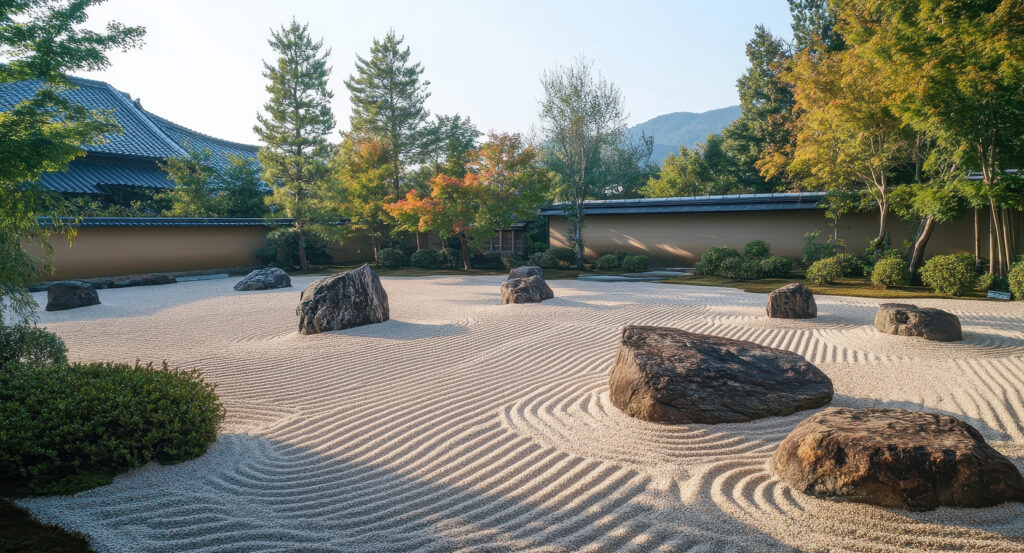
Why you should experience The Rock Garden at Ryōan-ji in Kyoto, Japan.
The Rock Garden at Ryōan-ji is Kyoto's purest silence, a landscape stripped of everything but truth.
No trees, no flowers, no water, only fifteen stones resting on an ocean of raked white gravel. Yet within this simplicity lies a universe. As you sit upon the wooden veranda, time slows to the rhythm of your breath. The gravel's raked lines flow like ripples through still water, broken only by the islands of stone that seem to hover, weightless. Light slides across the surface hour by hour, reshaping what little there is to see, the shadow of one rock merging with another, the edges of a ripple dissolving into glare. No two moments here are ever the same. What you witness depends on where you sit, how long you stay, and what you bring within you. No visitor can see all fifteen stones at once, one is always hidden, no matter your position. The garden's mystery lives in that absence: a reminder that understanding is never complete, and beauty often lies just beyond perception. This is not a place to interpret, it is a place to unlearn.
What you should know about The Rock Garden at Ryōan-ji.
The origins of The Rock Garden at Ryōan-ji are as elusive as its meaning.
Created in the late 15th century, under the direction of the Zen monk Sōami, the garden represents the pinnacle of karesansui, the dry landscape tradition that translates thought into form. The fifteen stones are grouped into five clusters, set within a rectangular bed of meticulously raked gravel measuring just twenty-five by ten meters. There is no central focus, no axis of symmetry, no defined narrative. The composition seems effortless, yet its balance is precise, an invisible geometry that reveals itself only through stillness. Over centuries, interpretations have multiplied: islands in a sea, mountains above clouds, tiger cubs crossing water, or simply the void itself. But to the Zen mind, these readings miss the point. The garden's essence is not symbolic, it is experiential. It reflects the principle of mu, emptiness as presence, silence as instruction. Even the act of maintenance is meditation: each morning, monks rake the gravel anew, their movements slow, deliberate, and circular, erasing and re-creating perfection. Few realize that the garden once faced the private chambers of the temple abbot, meant not for performance but for daily contemplation. Its purpose has not changed. Ryōan-ji's rock garden remains less an object to admire than a mirror for the mind itself.
How to fold The Rock Garden at Ryōan-ji into your trip.
Visiting The Rock Garden at Ryōan-ji is not an item to check off your list, it's an experience to surrender to.
Arrive early in the morning or late in the afternoon, when the veranda is quiet and the light is low. Remove your shoes and sit cross-legged before the garden, letting your gaze soften. At first, your mind will reach for meaning, it always does. Let it. Then, slowly, stop trying to name what you see. Notice the rhythm of the rake marks, the spacing between stones, the faint rustle of leaves beyond the wall. The longer you sit, the more the garden changes, or perhaps, the more you do. Visit in winter; a thin layer of snow transforms the gravel into cloud and the rocks into islands adrift. In spring, cherry petals occasionally drift over the wall, a single pink contrast against all that white. Spend as long as you can, twenty minutes at least, before wandering the pond and pathways beyond. As you leave, look back once more. The garden doesn't wave or whisper; it simply remains. That is its lesson, nothing needs to move to be alive.
Where your story begins.
Foresyte Travel reveals places that feel extraordinary long before you arrive.
Experience premium editorial crafted for luxury travelers.

















































































































