
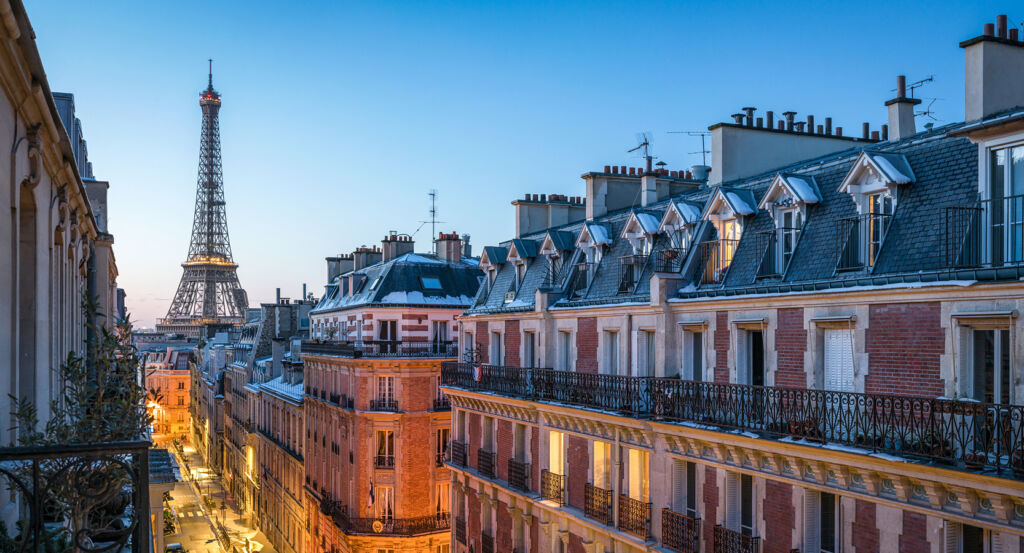
Why Sainte-Avoye matters.
Sainte-Avoye is a finely layered enclave where medieval Paris meets the western Marais through narrow inherited streets, deep courtyard parcels and fragments of religious and defensive geography preserved inside one of the Right Bank's oldest urban fabrics.
Positioned between Les Halles, Arts-et-Métiers, and the Central Marais, the neighborhood occupies a compact Right Bank pocket where Rue du Temple, Rue de Montmorency and Rue Chapon cross territory once divided between the city of Philippe Auguste and development spreading beyond its walls. Narrow and deep properties create successive layers of street frontage, passage, courtyard and rear building, producing an unusually intricate physical setting across blocks that escaped wholesale nineteenth-century reconstruction. Rue du Temple establishes the primary encounter through an ancient north-south route whose changing alignments still carry traces of the medieval gate, religious property and later aristocratic construction. Rue de Montmorency deepens the physical character through closely spaced houses and enclosed courts whose varied building periods compress several centuries into a remarkably short east-west route. Passage Sainte-Avoie adds a quieter spatial remnant by following part of the vanished fortification line between Rue du Temple and Rue Rambuteau. The result is a neighborhood where medieval boundaries, early modern institutions and inherited parcel structure remain unusually legible, preparing a history rooted in the religious community that gave Sainte-Avoye its enduring name.
What defines Sainte-Avoye.
Sainte-Avoye is best known for developing around a religious community established beside Rue du Temple near the wall of Philippe Auguste and subsequently giving its name to both the street and surrounding quarter. The community originated in 1288 when the curé of Saint-Merri acquired a house for poor widows close to the fortified boundary, establishing a charitable institution dedicated to Sainte Avoie. Rue du Temple itself crossed the enceinte through a gate occupying ground around the present junction near Passage Sainte-Avoie, placing the community beside one of the principal routes leading north from medieval Paris. The religious house passed to the Ursulines in 1622, extending its institutional life into a period when the surrounding Marais was undergoing intense residential development. A neighboring house erected in 1522 belonged first to the Abbaye Saint-Pierre de Lagny and entered Ursuline ownership in 1649, preserving part of the built environment associated with the community. Another property from the Louis XVI period also belonged to the convent, showing how its holdings expanded through adjoining parcels. Revolutionary suppression closed the convent in 1790, after which its buildings entered private residential use. The Sainte-Avoie name nonetheless remained attached to the section of present-day Rue du Temple between Rue Saint-Merri and Rue des Haudriettes from the early sixteenth century into the nineteenth, allowing a medieval charitable foundation to shape the district's urban nomenclature long after the institution disappeared.
Nineteenth-century street intervention supplied a separate mechanism for altering Sainte-Avoye without erasing the intricate parcel structure surrounding it. Passage Sainte-Avoie opened in 1828 across ground formerly occupied by the hôtels de Mesmes and Angran d'Alleray, creating a private connection whose alignment follows part of the vanished wall of Philippe Auguste. A far larger intervention arrived a decade later when Rue Rambuteau was driven east-west across Central Paris in 1838. Construction cut through the former convent property and removed much of its surviving fabric, leaving neighboring houses as fragments of the earlier religious precinct. The new artery also crossed inherited blocks whose narrow streets had developed through centuries of incremental subdivision, inserting a broad circulation route before the larger rebuilding campaigns associated with the Second Empire. Parcel evidence from the nineteenth century shows a striking contrast within Sainte-Avoye: narrow, deep properties define several blocks around Rue Chapon and Rue des Gravilliers, yet larger plots characterize territory between Rue Chapon, Rue du Temple, Rue de Montmorency and Rue Beaubourg. Later alignment decrees replaced individual buildings along selected streets, but substantial portions of the older subdivision endured. Sainte-Avoye consequently preserves both sides of nineteenth-century urban change, with a major new street crossing a district whose inherited property lines remained powerful enough to survive around it.
How Sainte-Avoye fits.
Sainte-Avoye works as the anchor for a daytime exploration connecting a medieval charitable house, an aristocratic palace transformed across three centuries and a former priory converted by the Revolution into a national center for technical knowledge.
Begin at Maison de Nicolas Flamel, built in 1407 by the Parisian scribe and property owner whose later reputation became entangled with legends of alchemy. Flamel created the house to shelter poor residents in exchange for prayers for the dead, and the surviving stone facade still carries a Gothic inscription setting out that devotional obligation; Paris Musées preserves historical images showing its carved piers and inscription, and the City of Paris recognizes the building as the oldest surviving house in the capital. Continue to Hôtel de Soubise, where François de Rohan-Soubise and Anne Chabot purchased the former Hôtel de Guise in 1700 and commissioned Pierre Alexis Delamair to reconstruct the estate around an imposing cour d'honneur between 1705 and 1708. Germain Boffrand began another major campaign in 1735, creating the oval pavilion and rocaille interiors with François Boucher, Charles Natoire, Jean-Baptiste II Lemoyne and Jacques Verberckt; Napoleon acquired the palace for the state in 1808, after which it became the home of the Archives de l'Empire and later the museum opened in 1867. Conclude at Musée des Arts et Métiers, where Henri Grégoire proposed a Conservatoire des arts et métiers in 1794 to assemble machines and inventions for technical education before the institution entered the former Saint-Martin-des-Champs priory in 1798. The galleries opened in 1802, transforming a religious complex with origins reaching a Merovingian funerary sanctuary and Henri I's eleventh-century foundation into a center for mechanical demonstration; its collections grew around objects including Jacques Vaucanson's loom, Cugnot's steam vehicle, the Chappe telegraph and Clément Ader's Avion no. 3. The progression moves from Flamel binding medieval housing to charitable devotion through Delamair and Boffrand converting an aristocratic residence into one of the Marais's great architectural ensembles into Grégoire redirecting a former priory toward technical education, revealing how religion, patronage and scientific culture successively reshaped the territory surrounding Sainte-Avoye.
Where your story begins.
Foresyte Travel reveals places that feel extraordinary long before you arrive.
Experience premium editorial crafted for luxury travelers.
Foresyte Travel may earn a commission when you book through the link on this page.














































































































