
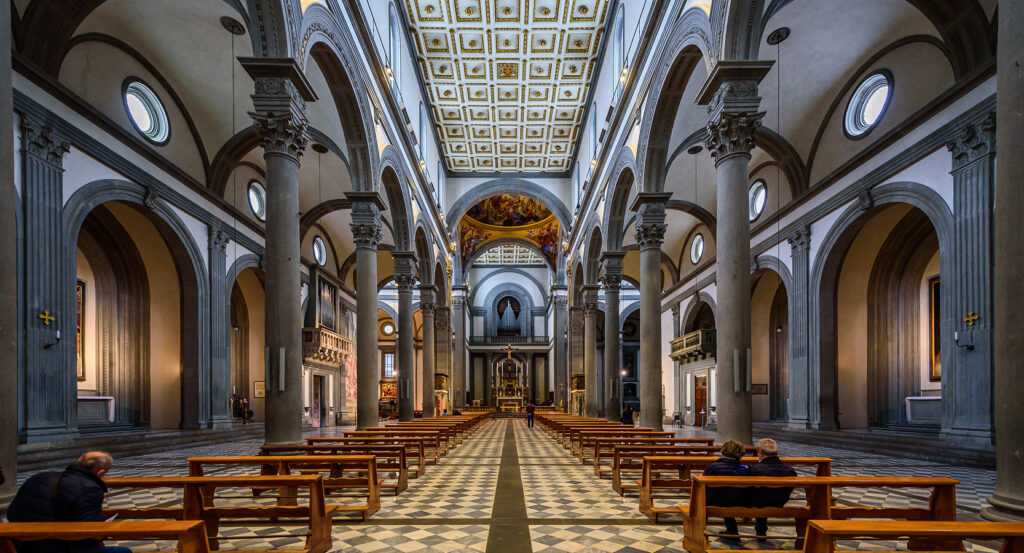
Why you should experience Laurentian Medici Library in Florence, Italy.
Laurentian Medici Library by Michelangelo at Basilica di San Lorenzo in Florence, formally known as the Biblioteca Medicea Laurenziana, is among the most breathtaking expressions of Renaissance intellect and design ever created.
Here, architecture becomes philosophy. Commissioned by Pope Clement VII in 1524 to house the Medici's vast collection of manuscripts, Michelangelo conceived the library as a living example of knowledge, a sacred temple to the human mind. The entrance vestibule, with its cascading staircase and sculpted walls, feels alive with movement: columns seem to grow out of the walls, while the stairs spill forward like liquid marble, drawing visitors upward into enlightenment. Beyond it lies the long reading hall, a masterpiece of calm proportion. Wooden desks line the sides beneath a coffered ceiling, illuminated by tall windows that bathe the space in honeyed light. Every detail, from the rhythmic floor pattern to the hand-carved benches, reflects Michelangelo's belief that knowledge itself was a divine act of creation. Standing here, you sense not only the genius of one artist, but the Renaissance conviction that beauty and intellect were one and the same.
What you should know about Laurentian Medici Library.
Laurentian Medici Library was Michelangelo's most cerebral architectural work, a design where every element carries symbolic weight.
Commissioned by the Medici popes Clement VII and Leo X, the library was built to house the family's extraordinary manuscript collection, which included ancient Greek and Latin texts rescued from monastic libraries. Michelangelo's challenge was both artistic and intellectual: to create a space worthy of the wisdom it contained. His vestibule, completed later by Bartolomeo Ammannati following Michelangelo's plans, defied convention. Instead of freestanding columns, Michelangelo embedded them into the walls, transforming architecture into sculptural tension, as if the building itself strained to contain the power of thought. The triple staircase that dominates the entrance was revolutionary: its flowing curves and dynamic energy broke from classical restraint, foreshadowing the Baroque movement. The reading room beyond, by contrast, is an exercise in order and serenity, with every dimension proportioned according to mathematical harmony. Its wooden furnishings, designed to hold chained manuscripts, display a reverence for scholarship rarely seen in architecture. The ceiling's coffering mirrors the rhythm of the desks below, creating an architectural fugue that celebrates the mind's ability to impose order on the world. Few visitors realize that the library also served as a political statement, a Medici declaration that Florence's power lay not only in wealth or art, but in knowledge itself.
How to fold Laurentian Medici Library into your trip.
Visiting Laurentian Medici Library is one of Florence's most moving intellectual experiences, a journey through space and mind alike.
Enter through the cloister adjoining the Basilica di San Lorenzo, following signs for the Biblioteca Medicea Laurenziana. As you step into the vestibule, pause before ascending the staircase, its sensuous curves and recessed columns invite reflection as much as admiration. Walk slowly up the central steps, letting your gaze trace the blend of shadow and light across the gray pietra serena stone. Once inside the reading hall, take a moment to stand at its center and feel the rhythm of the architecture: the repetition of windows and desks, the balance of ceiling and floor, the unity of proportion that makes the space feel timeless. Visit mid-morning when the sunlight enters at a low angle, illuminating the carved wood and bringing warmth to the austere geometry. If possible, look closely at the wooden lecterns, where manuscripts once lay chained, a reminder of how precious knowledge once was. Before leaving, glance back down the staircase: its fluid form now feels less like marble and more like thought in motion. Laurentian Medici Library by Michelangelo at the Basilica di San Lorenzo in Florence is not merely a building, it is the Renaissance mind made visible, a place where architecture itself seems to think.
Where your story begins.
Foresyte Travel reveals places that feel extraordinary long before you arrive.
Experience premium editorial crafted for luxury travelers.




















































































































