
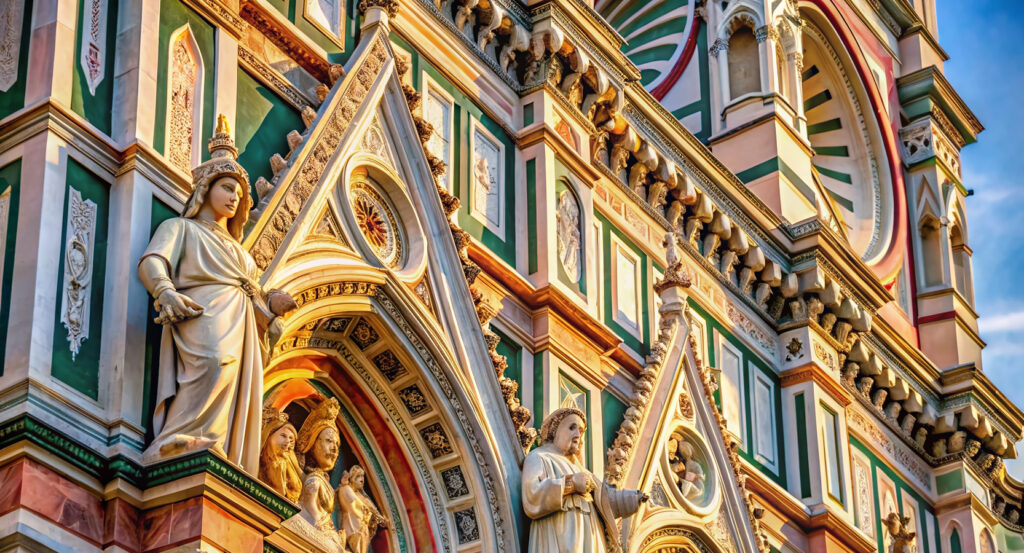
Why Pazzi Chapel matters.
Pazzi Chapel at Basilica of Santa Croce in Florence is among the purest expressions of Renaissance architecture ever conceived, a serene discussion between geometry, light, and faith.
Designed by Filippo Brunelleschi in the 1440s, the chapel stands as a perfect example of humanist harmony, where proportion becomes poetry. As you step inside the cloister and see its pale gray pietra serena stone framed against soft white walls, you immediately sense the calm precision that defines Brunelleschi's genius. Every line, arch, and dome responds to a mathematical rhythm rooted in divine order, the Renaissance belief that beauty itself was proof of God's design. The space is intimate, almost weightless, its symmetry soothing the mind. Above, a coffered dome painted with starry blue circles the room like a celestial map. Terracotta roundels by Luca della Robbia add warmth and color, their glazed surfaces reflecting the light that filters through the oculus. Pazzi Chapel isn't grand in scale, its power lies in its restraint. To stand in its center is to feel Florence's intellectual awakening crystallized in stone.
What defines Pazzi Chapel.
Pazzi Chapel was commissioned by Andrea de' Pazzi as a chapter house for the Franciscan friars of Santa Croce, but it also served as a private symbol of his family's ambition and refinement.
Its construction began in the early 1440s, when Brunelleschi, already renowned for the Duomo's great dome, was asked to design a smaller yet equally revolutionary space. The architect applied the same mathematical precision that guided his cathedral work, but here he distilled it to its purest form. The chapel's proportions follow strict geometric ratios, a square base surmounted by a circular dome, symbolizing the union of earth and heaven. Brunelleschi's pietra serena structure outlines every architectural element, creating a rhythm of dark and light that feels almost musical. Luca della Robbia's medallions of the apostles, rendered in glazed terracotta, provide splashes of color and devotion amid the chapel's austere grace. Yet Pazzi Chapel's history is shadowed by its patrons' downfall: the Pazzi family became infamous for their failed conspiracy against the Medici in 1478, leading to their exile and disgrace. The chapel, however, transcended their legacy, it remains one of Florence's most harmonious works of art, where proportion itself becomes an act of prayer.
How Pazzi Chapel fits.
Visiting Pazzi Chapel is among the most peaceful and profound experiences you can have in Florence.
After exploring the grandeur of the Santa Croce, step into the quiet cloister known as the Chiostro dei Morti, where sunlight dances through the arcades and greenery softens the air. At the far end, the small domed structure of the chapel awaits, modest yet perfectly balanced against the surrounding architecture. Enter slowly; allow your eyes to adjust to the pale light and symmetry. Stand beneath the central dome, where the circular oculus casts a glowing spotlight on the stone floor, creating a living connection between heaven and earth. Take a moment to trace the chapel's geometry with your gaze, the arches, the square panels, the rhythm of space, each one an architectural meditation. Visit in the morning when light streams softly across the walls, or late in the afternoon when the interior glows with quiet gold. Sit on one of the benches and let the silence envelop you; Pazzi Chapel isn't meant to impress, but to still the soul. Before you leave, step back into the cloister and look again at its façade, balanced, timeless, complete. Pazzi Chapel at Basilica of Santa Croce in Florence is more than architecture, it's a prayer carved into proportion.
Where your story begins.
Foresyte Travel reveals places that feel extraordinary long before you arrive.
Enjoy editorial crafted for luxury travelers.
Foresyte may earn a commission when you book.




















































































































