
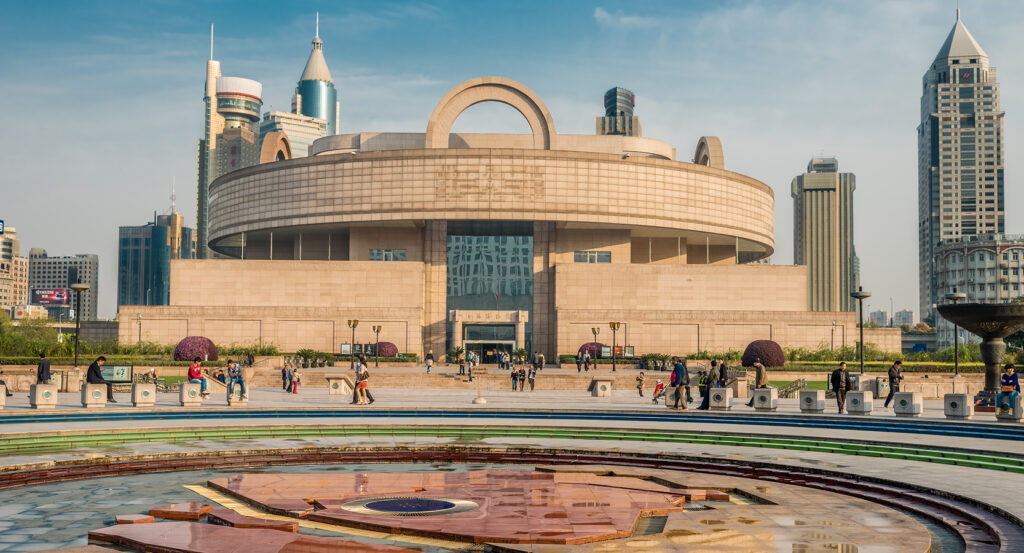
Why you should experience Chinese Calligraphy Gallery at Shanghai Museum in Shanghai, China.
The Chinese Calligraphy Gallery at Shanghai Museum is where language transcends words, where thought, breath, and movement merge into art that speaks directly to the soul.
The moment you step inside, the energy shifts. The room is calm but alive, lined with scrolls that seem to pulse with the rhythm of their makers' hands. Ink flows across silk and paper like rivers of time, from bold, confident strokes to whispers so faint they feel like memory itself. In this quiet light, every brush mark becomes a heartbeat, every character a meditation. The space feels sacred, as if the air itself holds the residue of centuries of contemplation. This isn't just handwriting; it's philosophy in motion, a visual music composed from balance, spirit, and control. To stand among these scrolls is to feel what the Chinese have known for millennia: that writing, when done with the full presence of the heart, becomes a mirror of the mind.
What you should know about Chinese Calligraphy Gallery at Shanghai Museum.
The Calligraphy Gallery holds masterpieces that span over two thousand years of artistic and intellectual evolution, from Han dynasty stone inscriptions to the free-flowing cursive of the Qing literati.
In Chinese culture, calligraphy has always been more than art, it's moral expression, a test of character, and a bridge between the visible and the invisible. The gallery's journey begins with early seal script (Zhuanshu), ancient, pictorial forms carved into stone that echo the origins of written Chinese. It then moves through clerical script (Lishu), developed for official record-keeping during the Han dynasty, where horizontal strokes stretch like waves across the page. The Tang dynasty saw the rise of the standard script (Kaishu), defined by exacting structure and clarity, epitomized by masters like Ouyang Xun and Yan Zhenqing, whose works here still radiate moral strength centuries later. By the Song dynasty, calligraphy became intimate, scholars such as Su Shi and Huang Tingjian infused emotion into each line, turning the brush into an instrument of self-revelation. The gallery's lighting and spatial rhythm mimic that progression: the early rooms are symmetrical and formal, while later sections open into freer, more fluid arrangements, reflecting the evolution from discipline to expression. One of the most remarkable pieces is Mi Fu's “Letter to Bo Yuan,” its brushwork both erratic and graceful, each stroke varying in ink tone as if written in a single breath. Few visitors realize that the calligraphy displayed is rotated every few months, not only for preservation but to honor the Daoist principle of impermanence that underlies the art itself.
How to fold Chinese Calligraphy Gallery at Shanghai Museum into your trip.
Visiting the Calligraphy Gallery is less about sightseeing and more about stillness, a moment to slow your pulse and let the art rewrite your sense of time.
Go in the early afternoon (around 1-2 p.m.) when the crowds thin and the gallery's ambient lighting deepens to a quiet glow. Move slowly along the scroll-lined walls, pausing not to read, but to feel the rhythm of each stroke, the controlled pressure, the lift at the end of a line, the way the ink breathes into the paper. Bring your attention to the space between characters, what Chinese poets call “the white silence,” where meaning lives beyond form. Spend 30 minutes here; if you listen closely, the hush of the gallery begins to sound like the breath of brush on paper. Don't miss the interactive digital display near the exit, where you can trace traditional characters with a brush stylus, an experience that reveals just how much balance, patience, and intuition each line requires. Before you leave, turn back once more toward the gallery's central wall, where an illuminated quote from the Analects reads: “To write is to cultivate virtue.” In that moment, you understand, this isn't just an exhibition of ink and script; it's a living lesson in mindfulness, discipline, and grace.
Where your story begins.
Foresyte Travel reveals places that feel extraordinary long before you arrive.
Experience premium editorial crafted for luxury travelers.

















































































































