
Why you should experience Ancient Chinese Ceramics Gallery at Shanghai Museum in Shanghai, China.
The Ancient Chinese Ceramics Gallery at Shanghai Museum is where the story of China's artistry turns to light, a gallery of fire-born perfection where earth and flame become poetry.
Step inside, and color takes over: celadon as pale as dawn mist, cobalt blues that seem to breathe beneath the glaze, porcelain white as frozen moonlight. The air feels almost sacred, the light calibrated to let each surface shimmer like still water. Here, you don't just see the evolution of Chinese ceramics, you feel the refinement of an entire civilization distilled into texture, proportion, and restraint. From the rustic pottery of Neolithic villages to the luminous porcelain of imperial kilns, every vessel carries centuries of philosophy: simplicity as elegance, balance as truth. To stand here is to witness human ingenuity transformed into beauty, fire tamed, time suspended, and perfection shaped by hand.
What you should know about Ancient Chinese Ceramics Gallery at Shanghai Museum.
The Ceramics and Pottery Hall holds over 5,000 years of Chinese ceramic history, a lineage that begins with hand-formed clay jars from the Majiayao culture (circa 3000 BCE) and culminates in the translucent porcelains of the Ming and Qing dynasties.
China's mastery of fired clay gave the world its word for porcelain, china, and its innovation reshaped global trade, aesthetics, and science. The museum's collection traces that arc with astonishing clarity. Early pieces display primitive beauty, red pottery painted with swirling geometric lines that once held grain or ritual offerings. By the Tang dynasty, color and form explode: Sancai (“three-color”) glazes ripple across horse figurines and ewers in greens, ambers, and creams, their glassy surfaces fired with the optimism of an empire in bloom. The Song dynasty represents the pinnacle of refinement, monochrome wares from Ru, Guan, and Ding kilns, celebrated for their perfect symmetry and subtle crackled glazes that evoke mist and poetry. The Yuan dynasty introduces cobalt pigment from Persia, giving birth to the world-famous blue-and-white porcelain, the design that would travel from Jingdezhen to Venice, Istanbul, and beyond. By the Ming and Qing eras, porcelain becomes imperial propaganda, dragons, peonies, and phoenixes painted with the precision of calligraphy. The gallery's design mirrors this journey: its display cases arranged in chronological spirals, the floor patterned after the swirl of a potter's wheel. Few visitors notice that the temperature and humidity inside are regulated to match those of traditional kiln rooms, preserving not just the artifacts, but the very conditions that birthed them.
How to fold Ancient Chinese Ceramics Gallery at Shanghai Museum into your trip.
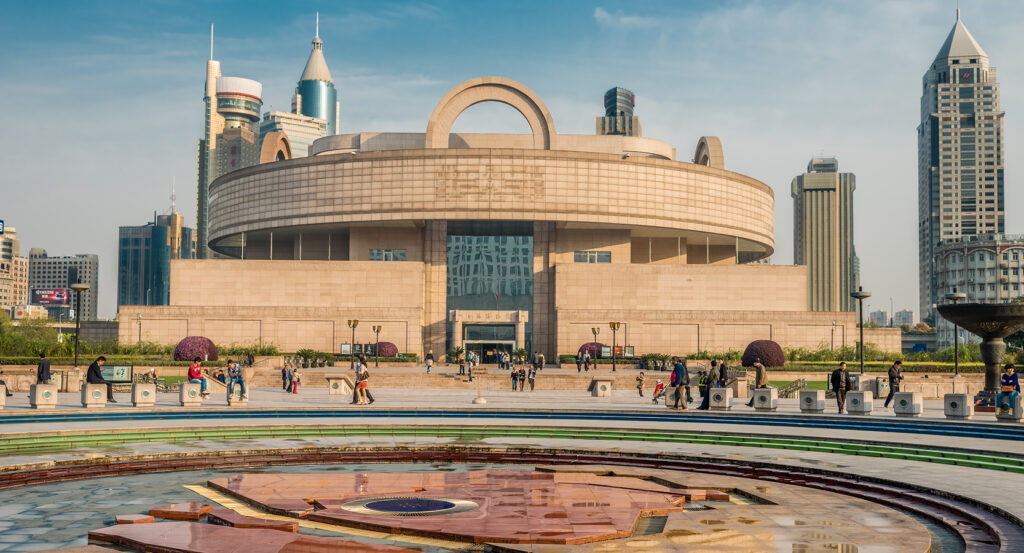
The Ceramics and Pottery Hall is the glowing heart of the Museum of Shanghai, a space best experienced in quiet observation, where beauty deepens the longer you linger.
Visit midmorning (10-11 a.m.) when the natural light filtering from the atrium above blends with the gallery's subtle illumination, setting the glazes aglow. Begin with the prehistoric pottery to appreciate the humbleness of origin, clay as survival, before progressing toward the Song and Ming masterpieces, where craftsmanship becomes philosophy. Take time with the Ru ware bowl, whose soft blue-green glaze was prized as “the color of sky after rain,” and notice how its imperfections, tiny bubbles, uneven lip, are what make it eternal. Move to the blue-and-white porcelain section and trace the brushwork; each line was drawn in a single breath, symbolizing unity between artist and object. If you stand still long enough, you can hear the faint hum of air moving through the vitrines, like the echo of a kiln cooling centuries ago. Before leaving, stop at the display of imperial yellow ceramics, a color once reserved for the emperor alone. It gleams softly under the lights, not ostentatious, but radiant with quiet authority. Step back into the museum's main hall afterward, carrying that light with you, the serene knowledge that even the simplest clay, under patient hands and fire, can become eternal.
Where your story begins.
Foresyte Travel reveals places that feel extraordinary long before you arrive.
Experience premium editorial crafted for luxury travelers.

















































































































