
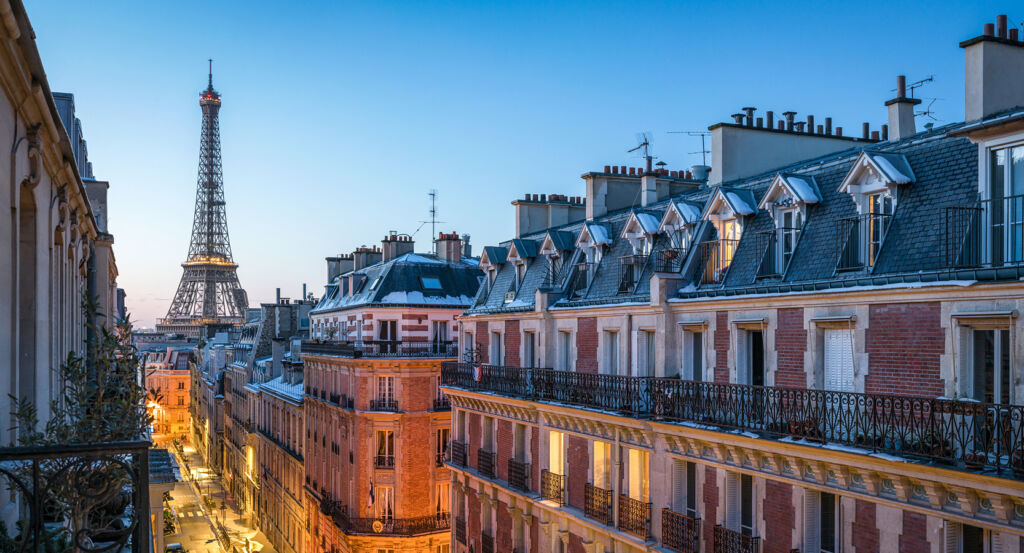
Why you should experience Sofitel Paris le Faubourg in Paris, France.
Sofitel Paris le Faubourg is a couture-inflected luxury hotel where Faubourg Saint-Honoré's fashion heritage, aristocratic architecture, artistic culture, and contemporary French hospitality converge within two historic Parisian townhouses.
Set along Rue Boissy d'Anglas near Rue du Faubourg Saint-Honoré and just steps from Place de la Concorde, the hotel combines 148 rooms and suites, Didier Gomez interiors, fashion photography, a penthouse Couture Apartment, Maison Blossom, a secluded patio, wellness facilities, and intimate salons within a property deeply connected to the surrounding couture industry. Gold leaf, Louis XV references, black-and-white photography, sculptural furnishings, marble, mirrored surfaces, and carefully controlled black, white, gray, and gold tones establish a visual language drawing directly from Paris fashion. Maison Blossom and the garden patio soften that theatricality through greenery, daylight, and contemporary French cooking, while the guestrooms carry the fashion narrative into increasingly private spaces. The result is a hotel where architecture, couture, photography, gastronomy, and French luxury hospitality operate as parts of one carefully composed identity.
What you should know about Sofitel Paris le Faubourg.
Sofitel Paris le Faubourg is best known for uniting two historic townhouses, beginning with an 18th-century residence at 15 Rue Boissy d'Anglas that became Hôtel Vouillemont in 1830, appears in Marcel Proust's Du côté de chez Swann, and retains the former carriage courtyard that now forms the hotel lobby. Hôtel Vouillemont later served as the Paris residence of Marie-Sophie of Bavaria, Queen of the Two Sicilies and sister of Empress Elisabeth of Austria, before hotelier Albert delle Donne acquired it during the 1930s and his children Robert and Marie cultivated an intellectual circle involving Luigi Pirandello, Jean Cocteau, Max Jacob, Robert Desnos, Francis Picabia, Jacques and Raïssa Maritain, Prince Youssoupoff, Maurice Rostand, and Maurice Sachs. The adjoining 19th-century townhouse developed a separate cultural history as the headquarters of Marie Claire, bringing journalists, stylists, and fashion photographers into the building before the two properties were ultimately joined, with the resulting hotel occupying numbers 15 and 11 bis, while number 13 remains absent from the street numbering. A multimillion-dollar redesign by Didier Gomez, inaugurated on March 5, 2015, reshaped the property into 111 rooms and 36 suites around a couture concept combining its preserved townhouse architecture with black, white, gray, and gold interiors, curved forms, feminine references, Louis XV-inspired furniture, gold leaf, contemporary furnishings, and fashion imagery.
Didier Gomez extended the 2015 couture narrative through museum-caliber photography by Horst P. Horst, Irving Penn, Cecil Beaton, and Erwin Blumenfeld, with Beaton's Vogue ballroom imagery entering guestrooms, Blumenfeld photographs defining Collection Suites, and Jean-Paul Gaultier imagery appearing as large sepia prints inside the top-floor Couture Apartment. Polka Galerie had already connected the property with fashion photography in 2009 through Si la mode m'était contée, exhibiting work by Gérard Uféras, Derek Hudson, Jean-Marie Périer, and Cathleen Naundorf, a project that subsequently developed into Sofitel's traveling Fashion Stills exhibition across ten international hotels. Chef Christophe Chottin, a native of Touraine, currently directs Maison Blossom around seasonal French cooking, family culinary traditions, technically precise sauces, and French terroirs, while the restaurant's wine program is devoted entirely to French vineyards with particular attention to organic and biodynamic producers. Green Key certification in 2026 adds a measurable contemporary chapter to the property through elimination of single-use plastics, waste reduction and recycling programs, and seasonal, local, responsible sourcing, connecting Sofitel's historic buildings and couture collection with documented environmental operations.
How to fold Sofitel Paris le Faubourg into your trip.
Sofitel Paris le Faubourg works as an afternoon and evening tracing the relationship between decorative art, couture, and luxury craftsmanship across Faubourg Saint-Honoré.
Begin at Musée de l'Orangerie, where Monet's vast Nymphéas rooms and the Walter-Guillaume collection establish an immersive encounter with French artistic composition before the afternoon shifts from museum culture toward fashion and hospitality. Continue to Sofitel Paris le Faubourg, where the former Hôtel Vouillemont, Didier Gomez's couture interiors, historic salons, garden patio, and Maison Blossom turn that artistic conversation into the central hospitality experience. Continue to Galerie Dior, where archival silhouettes, sketches, accessories, ateliers, and exhibition scenography trace the creative style of the house founded by Christian Dior and deepen the afternoon's exploration of Parisian couture. Conclude at Musée des Arts Décoratifs, where furniture, jewelry, textiles, fashion, graphic design, and centuries of French craftsmanship provide the evening's intellectual payoff by placing contemporary luxury within a much longer decorative tradition. The progression moves from fine art through couture hospitality and fashion history before culminating in the broader craftsmanship behind French design, revealing the creative ecosystem surrounding Faubourg Saint-Honoré.
Where your story begins.
Foresyte Travel reveals places that feel extraordinary long before you arrive.
Experience premium editorial crafted for luxury travelers.














































































































