
Why Strawberry Fields matters.
Strawberry Fields is a contemplative memorial landscape where the Upper West Side's cultural history meets wooded Central Park terrain, intimate lawns and a public place devoted to John Lennon's enduring association with New York.
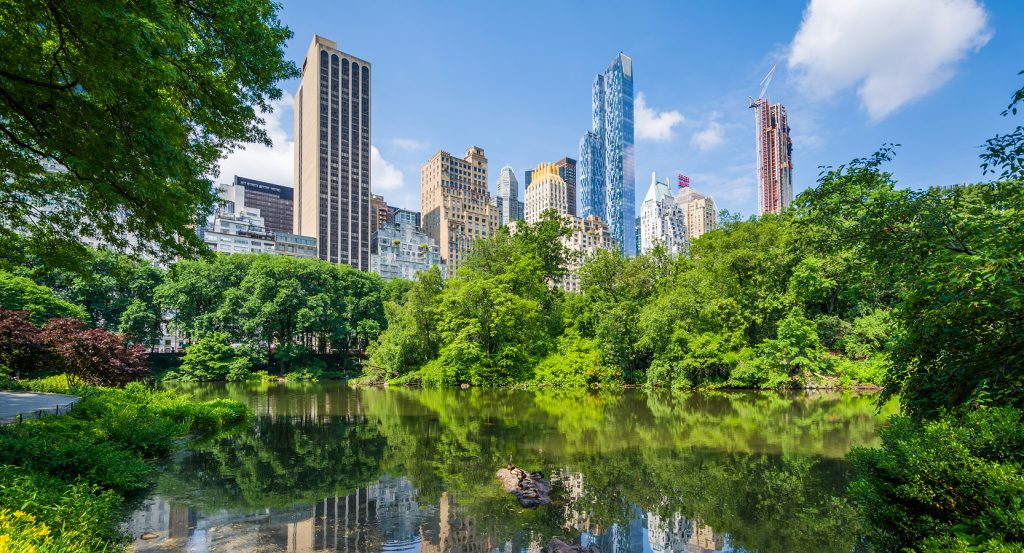
Set within Central Park near West 72nd Street and just steps from Wagner Cove, the memorial occupies five acres between West 71st and West 74th streets, where curving paths descend through a wooded section before opening into smaller clearings enclosed by mature trees and shrubs. The terrain shifts through exposed Manhattan schist, sloping ground and planted edges, giving the memorial a sequence of compressed passages and open lawns within one of the park's busiest western entrances. Benches sit along the winding paths and around the central gathering area, allowing the landscape to absorb sustained public use without losing the enclosure created by its vegetation and irregular topography. A rock outcrop carrying an inset commemorative plaque forms another physical element within the grounds, and the memorial's designation as a Central Park Quiet Zone reinforces the low-intensity character of its lawns and wooded passages. The result is a memorial whose acreage, changing elevations, intimate clearings and dense planting create a sheltered landscape within Central Park's western edge.
What defines Strawberry Fields.
Strawberry Fields is best known for commemorating John Lennon through an international garden of peace conceived after his death on December 8, 1980. New York City named the Central Park area Strawberry Fields, drawing the memorial's title from Lennon's 1967 Beatles song “Strawberry Fields Forever,” and Yoko Ono subsequently developed plans for a landscape honoring her husband. Ono invited nations around the world to contribute plants and stones, framing the project around international participation and Lennon's commitment to peace. She worked with the Central Park Conservancy and landscape architect Bruce Kelly, whose design restored a deteriorated portion of the park and incorporated donated elements into an arrangement compatible with Frederick Law Olmsted and Calvert Vaux's larger landscape. Kelly brought extensive Central Park knowledge to the commission after earlier work with the Central Park Task Force and later contributed to the 1985 Rebuilding Central Park: A Management and Restoration Plan. Ono financed the refurbishment, placing private patronage behind a project executed during the Conservancy's formative restoration period. Strawberry Fields was dedicated on October 9, 1985, Lennon's 45th birthday, fixing the memorial's opening to a date directly tied to the musician it honors.
Naples contributed the circular pavement mosaic carrying the single word “Imagine,” creating the memorial's principal work of art through a gift from an Italian city closely associated with mosaic craftsmanship. The piece occupies a special position in Central Park's artistic history: after the park received protected status in 1965, the Imagine mosaic became one of the few permanent artworks added to its historic landscape. Lennon's death subsequently gave the site a continuing commemorative role extending far beyond its 1985 dedication, with musicians and admirers gathering there on his birthday, the anniversary of his death and other dates connected with the Beatles. The memorial marked its 40th anniversary in 2025, when the Conservancy revisited its development with John Reddick, whose association with Strawberry Fields reaches back to its formative period and whose later work became part of the Conservancy's stewardship of the site. Floral tributes and musical gatherings have made the pavement around “Imagine” a recurring site of public remembrance, giving a single donated artwork a continuing role in the social life of Central Park. The Naples mosaic and four decades of commemorative use have made Lennon's memorial an unusual work of public art whose significance continues through repeated acts of music, gathering and remembrance.
How Strawberry Fields fits.
Strawberry Fields works as the anchor for an Upper West Side outing connecting folk and self-taught art, New York historical collecting and a natural-history institution shaped by exploration, scientific research and large-scale exhibition design.
Begin at American Folk Art Museum, founded on June 23, 1961 and developed from a small institution into the country's museum devoted to folk and self-taught artists. Its collection began in 1962 with the gift of Flag Gate, an unidentified artist's utilitarian sculpture from upstate New York, before expanding to 8,000 works spanning four centuries and nearly every continent. Paintings, quilts, drawings, carved figures, trade signs, ceramics and furniture share the holdings with the museum's extensive Henry Darger archive, which contains four manuscripts exceeding 30,000 pages, 3,000 pieces of source ephemera and two dozen double-sided paintings. Continue to The New York Historical, founded on November 20, 1804 by a group of New Yorkers intent on preserving the city and nation's past. Its collections grew to encompass colonial and Revolutionary manuscripts, rare books, early New York newspapers, maps, prints, sculpture, decorative arts and thousands of paintings, including John James Audubon's watercolors for The Birds of America. York & Sawyer designed its Central Park West home, completed in 1908 and expanded during the 1930s; the institution added the 71,000-square-foot Robert A. M. Stern-designed Tang Wing for American Democracy in 2026. Conclude at American Museum of Natural History, created in 1869 after Albert Smith Bickmore secured support from William E. Dodge Jr., Theodore Roosevelt Sr., Joseph Choate and J. Pierpont Morgan, with Governor John Thompson Hoffman signing its incorporation act on April 6. Ulysses S. Grant laid the cornerstone of its first permanent building in 1874, Roy Chapman Andrews later led Central Asiatic Expeditions into Mongolia's Gobi Desert beginning in 1922, and the institution installed its five-story Barosaurus group in 1991 as the world's tallest freestanding dinosaur display. The progression moves from self-taught artistic production through two centuries of American historical collecting into Bickmore, Andrews and the museum's scientific exploration, creating a west-side sequence centered on the preservation and interpretation of art, history and the natural world.
Where your story begins.
Foresyte Travel reveals places that feel extraordinary long before you arrive.
Enjoy editorial crafted for luxury travelers.
Foresyte may earn a commission when you book.







































































































