
Why Taian Table matters.
Taian Table is a three-MICHELIN-starred restaurant where Zhenning Road's secluded commercial courtyards meet Stefan Stiller's pioneering chef's-table concept, connecting European culinary technique, seasonal Asian ingredients and one of Shanghai's most consequential independent fine-dining institutions.
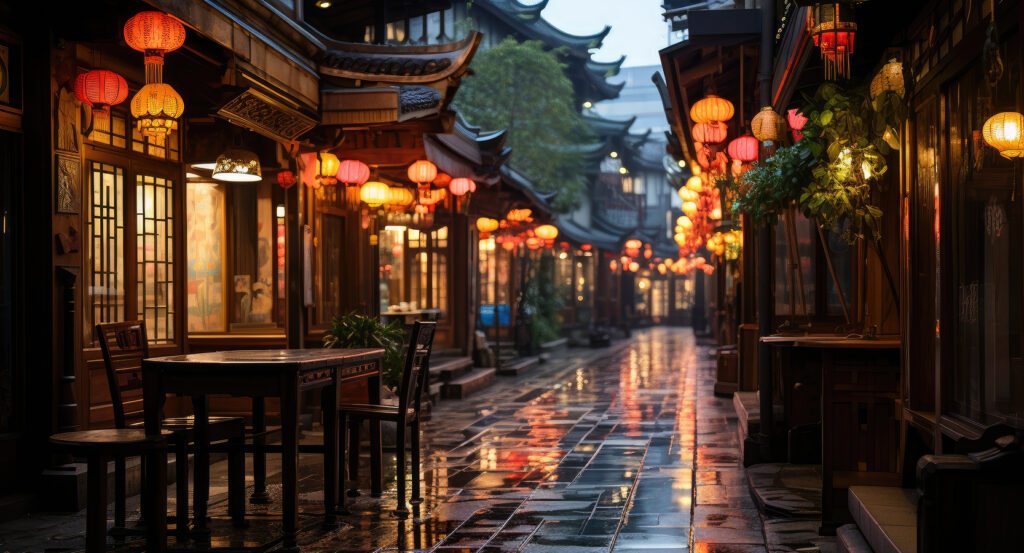
Zhenning Road runs through western Shanghai near Xinzha Road and Yuyuan Road, placing the restaurant inside Garden Office, a converted industrial compound set back from the surrounding residential streets. The establishment occupies ground-floor units within a former factory building, whose conversion into a creative commercial complex preserves the enclosed character of the original property. An open island kitchen dominates the principal dining room, surrounded by counter seating that places diners directly beside the chefs preparing their meals. Contemporary furnishings, restrained decorative finishes and carefully controlled lighting establish an intimate interior whose arrangement concentrates attention on the preparation area. The result is a secluded restaurant whose converted industrial architecture and centrally positioned kitchen create an unusually direct relationship between culinary production and fine dining.
What defines Taian Table.
Taian Table is best known for German chef Stefan Stiller transforming a small Shanghai dinner-party concept into a three-MICHELIN-starred restaurant after an extraordinary opening year that included international recognition, regulatory closure and relocation. Born in Celle, Germany, in 1966, Stiller entered professional kitchens at sixteen and completed his early training at Restaurant Endtenfang in the Hotel Fürstenhof. His subsequent development included work at Goldener Pflug in Cologne, Schweizer Stuben in Wertheim and Schweier Hahn in Deidesheim, exposing him to German restaurants operating at the highest levels of European gastronomy. In 1999, he established Restaurant Grand Cru in Deidesheim, earning a MICHELIN star within eight months of opening and demonstrating an independent culinary ambition that subsequently shaped his international career. Stiller relocated to Shanghai with his family in 2004, entering a restaurant industry experiencing rapid expansion as the city attracted international chefs and hospitality investment. His early Shanghai appointments included executive-chef positions at Club Shanghai and Mimosa Supper Club, where he developed familiarity with the city's dining audience and professional kitchen culture. In 2008, he established Stiller's Restaurant and Cooking School, combining fine dining with culinary education and introducing a platform for training aspiring cooks. The school became an important expression of his interest in professional development, extending his influence beyond individual restaurant services. Stiller also became involved in the Bocuse d'Or, assuming leadership of the competition's China and Asia-Pacific activities in 2009. Under his direction, Chinese teams qualified for the international final in Lyon in 2011 and 2013, connecting Shanghai's expanding culinary profession with one of the world's most demanding cooking competitions. His hospitality enterprise expanded in 2015 through EAST Eatery, a modern Asian restaurant established in Tianzifang with his wife, Yoshi. The following year brought the project that would define his international reputation. Stiller opened Taian Table on Tai'an Road in April 2016, organizing the original restaurant around a fourteen-seat counter and a changing tasting menu prepared directly before diners. The intimate format introduced a chef-centered approach at a time when Shanghai's luxury dining sector was strongly associated with large restaurants in prominent hotels and waterfront buildings. Recognition arrived in September 2016 when the inaugural MICHELIN Guide Shanghai awarded Taian Table one star, making Stiller's new establishment part of the first MICHELIN selection published for mainland China. The celebration lasted only a day before local authorities closed the restaurant over licensing deficiencies following complaints from residents concerning cooking fumes and noise. The interruption became an internationally publicized episode, placing the restaurant's regulatory difficulties beside its newly acquired MICHELIN distinction. Stiller responded by relocating the operation to a converted industrial property on Zhenning Road, reopening in December 2016 with a larger kitchen and a purpose-built arrangement suited to the original concept. The relocation preserved the restaurant's central culinary concept and allowed the team to continue developing its changing tasting menus. Taian Table retained its MICHELIN star through subsequent editions before receiving a second star in the 2020 Shanghai guide. The restaurant joined Les Grandes Tables du Monde in January 2021, entering an international association of distinguished independent restaurants. A further milestone arrived in November 2021 when MICHELIN awarded Taian Table its third star for the 2022 guide, making it the second restaurant in Shanghai to receive the distinction. The achievement established Stiller among the small number of German chefs to lead three-star restaurants outside Europe. His enterprise expanded into southern China that year through Taian Table Guangzhou and Stiller at the Garden Hotel, with the Guangzhou establishment earning two MICHELIN stars shortly after opening. Shanghai's restaurant retained its three stars through the 2026 guide, completing five consecutive editions at MICHELIN's highest level. Stiller's professional influence also extended through Alex Fu, who joined the Shanghai opening team as executive sous-chef in 2016 after experience in Italian restaurants and international luxury hotels. Fu contributed to the restaurant's progression through all three MICHELIN distinctions before becoming executive chef of Stiller Management Group in late 2021. Dutch-German chef Christiaan Stoop subsequently assumed executive culinary leadership of Taian Table Shanghai and Guangzhou, bringing experience developed in Munich, Barcelona, Bray, New Delhi, Dubai and Paris. His responsibilities encompass menu creation, culinary development and training, extending Stiller's founding approach through a new generation of internationally experienced chefs. Taian Table's significance rests on this progression from an unconventional independent restaurant through an unexpected regulatory crisis to sustained three-star recognition, establishing a chef-centered model that helped reshape Shanghai's contemporary fine-dining culture.
Christiaan Stoop's cooking develops Stefan Stiller's original approach through a constantly changing tasting menu that connects European technical foundations with the distinctive ingredients and seasonings available in Shanghai. The kitchen organizes dinner around eight principal courses, supplemented by selections from its Classics and Specials collections to create a ten- or twelve-course meal. This structure allows the chefs to develop a coherent seasonal sequence and gives diners some control over the ingredients and preparations that complete it. European sauces provide an important technical foundation, with reductions, emulsions and carefully controlled cooking temperatures creating the structure through which Asian ingredients enter the meal. Beurre blanc demonstrates that relationship through its delicate balance of butter, acidity and temperature, producing a smooth sauce whose richness supports seafood. The kitchen has extended that classical preparation into a frozen form accompanying Dalian scallop and Oscietra caviar, changing the sauce's physical behavior as it softens against the shellfish. The cold butter emulsion gradually releases its acidity and richness, allowing the scallop's natural sweetness and the caviar's salinity to develop through successive temperatures. This attention to changing texture carries into preparations involving Shanghai's seasonal seafood, where local ingredients receive treatments drawn from European fine dining. Hairy crab introduces a particularly consequential regional ingredient through its rich roe and delicate flesh, which acquire additional definition through winter bamboo and Chinese black vinegar. The vinegar's acidity cuts through the crab's richness, and the bamboo contributes a firmer vegetable texture that preserves the ingredient's seasonal character. Stoop extends the same approach to meat through classical preparations incorporating ingredients associated with several culinary traditions. Duck en croûte develops a substantial pastry enclosure around poultry, supported by boudin noir, crème Soubise and mulberry. The preparation connects the richness of duck and blood sausage with the sweetness of cooked onion and the fruit's acidity, creating a carefully controlled relationship between savory concentration and freshness. Other combinations introduce Japanese and German ingredients into European cooking, including Wagyu sirloin accompanied by unagi, sauerkraut and caviar. Fermented cabbage contributes acidity against the beef's richness, and eel introduces a separate savory character shaped by Japanese preparation. These combinations preserve the individual qualities of their ingredients through sauces and accompaniments whose functions remain precise. The kitchen's use of foie gras follows a similar principle through mango, lentils and vadouvan, introducing fruit acidity and warm spice around the liver's substantial fat content. Desserts continue the technical progression through preparations that connect European pastry with Asian aromatics. A bergamot tart incorporating Italian meringue and jasmine tea develops citrus acidity against sweetness, with the tea contributing a floral dimension that extends beyond the pastry itself. The wine program supports this changing culinary sequence through a substantial collection of German wines and Duval-Leroy champagnes. Shanghai-born sommelier Tendy Yang, who began working with Stiller in 2008, developed his wine expertise through the Wine and Spirit Education Trust and practical training at Winterling in Germany's Pfalz region. His selection connects the restaurant's European foundations with wines capable of accommodating the acidity, fermentation, spice and savory concentration present throughout the menu. The open kitchen completes the culinary arrangement by placing preparation and presentation within direct view of the diners, allowing the chefs to explain ingredients and techniques as the meal advances. Taian Table distinguishes itself through this sustained coordination of seasonal menu development, classical technique, Asian ingredients and personal culinary presentation, preserving the intimacy of Stiller's original concept at the highest level of MICHELIN recognition.
How Taian Table fits.
Taian Table works as the concluding destination for a western Shanghai itinerary connecting the religious history of Jing'an, the entertainment architecture of the Republican era and the residential heritage preserved along Yuyuan Road.
Begin at Jing'an Temple, the historic Buddhist institution occupying the intersection of West Nanjing Road and Huashan Road. The temple traces its origins to the Three Kingdoms period, when a Buddhist establishment was founded during the reign of Sun Quan in the third century. Its original location lay near the Wusong River, and the institution moved to its established position during the Southern Song dynasty in 1216. The relocation connected the temple with Shanghai's developing settlement geography, establishing a religious institution that survived successive dynastic periods and the transformation of the surrounding district into a modern commercial center. The surviving architectural complex incorporates substantial halls, elaborate rooflines and gilded Buddhist decoration, preserving the ceremonial character of a traditional Chinese monastery amid contemporary commercial buildings. Reconstruction and restoration during the late twentieth century returned religious functions to the site following decades of institutional disruption. Continue to Paramount Ballroom, the historic entertainment building at the intersection of Yuyuan Road and Wanhangdu Road. The ballroom opened in 1933 during Shanghai's emergence as an international entertainment center, introducing an Art Deco destination associated with jazz orchestras, fashionable dancing and the city's cosmopolitan social elite. Chinese architect Yang Xiliu designed the building, incorporating modern architectural forms associated with the period's international commercial culture. Its celebrated sprung dance floor established an important technical feature, allowing dancers to move across a resilient surface designed for prolonged ballroom use. Paramount became associated with prominent performers, wealthy patrons and the changing relationship between Chinese social customs and Western popular entertainment. Extensive restoration during the twenty-first century preserved the building's architectural character and renewed public attention to its role in Shanghai's Republican-era nightlife. Conclude at Yuyuan Road Historic District, the residential corridor extending westward toward Jiangsu Road and the neighboring streets of Changning. The district developed during the early twentieth century as Shanghai expanded beyond its original commercial center, attracting affluent residents, intellectuals and prominent political figures to newly constructed garden houses and residential compounds. Mature plane trees established a distinctive canopy above the roadway, and architectural development incorporated European-influenced villas alongside traditional Chinese residential forms. The street became associated with writers, educators, artists and political figures whose residences contributed to the cultural history of modern Shanghai. Surviving properties preserve the relationship between private domestic architecture and the city's intellectual development during the Republican period. Neighborhood conservation projects have subsequently restored historic façades, pedestrian spaces and selected residential interiors, supporting the continued use of the corridor as a cultural and residential district. The progression moves from the Buddhist institution preserving Shanghai's religious heritage through the Art Deco ballroom associated with its interwar entertainment culture and culminates along the historic residential corridor leading toward Taian Table's secluded Zhenning Road location.
Where your story begins.
Foresyte Travel reveals places that feel extraordinary long before you arrive.
Enjoy editorial crafted for luxury travelers.
Foresyte may earn a commission when you book.

















































































































