
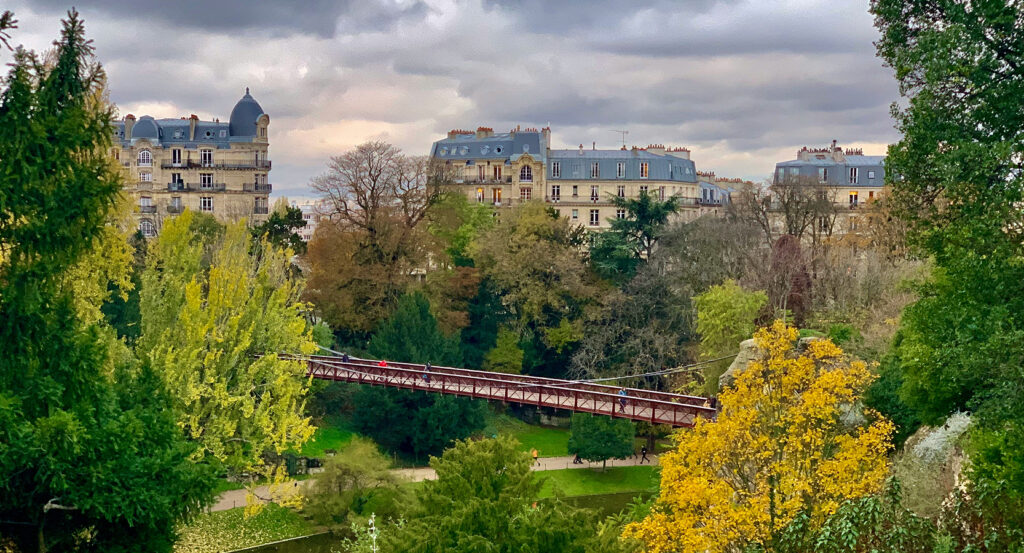
Why you should experience Temple de la Sybille in Paris, France.
Temple de la Sybille is an elegant hilltop pavilion where the 19th Arrondissement's romantic landscape design, Second Empire architecture, panoramic views, and picturesque scenery crown one of Paris's most celebrated urban parks.
Set atop the central island of Parc des Buttes-Chaumont near the suspension bridge and just steps from Lac des Buttes-Chaumont, this graceful circular pavilion combines slender Corinthian columns, a domed classical roof, rugged limestone cliffs, lush woodlands, cascading waterfalls, and sweeping views across the Paris skyline. Elevated above the park's dramatic cliffs, the structure creates one of the city's most memorable viewpoints while exemplifying the theatrical landscape compositions that defined nineteenth-century park design. The result is a destination defined by architectural elegance, romantic beauty, and exceptional urban planning.
What you should know about Temple de la Sybille.
Temple de la Sybille is best known for being constructed in 1867 as the crowning architectural feature of Parc des Buttes-Chaumont during Baron Georges-Eugène Haussmann's transformation of Paris under Emperor Napoleon III, drawing direct inspiration from the ancient Temple of Vesta at Tivoli, Italy, to create one of the French capital's finest examples of picturesque landscape architecture. Designed by architect Gabriel Davioud, with the surrounding park engineered by Jean-Charles Alphand, bridges by Gustave Eiffel's company, and plantings directed by horticulturist Jean-Pierre Barillet-Deschamps, the pavilion formed part of one of the Second Empire's most ambitious public works projects. Rising 30 meters (98 feet) above the artificial lake on a rocky island created from a former gypsum quarry, the temple occupies the park's highest point, rewarding visitors with panoramic views extending toward Sacré-Coeur, Montmartre, and Central Paris. The surrounding landscape represented an extraordinary feat of engineering, transforming a barren quarry into a romantic English-style park through the construction of artificial cliffs, caves, waterfalls, bridges, and more than 1,000 mature trees planted before the park opened for the 1867 Exposition Universelle. The pavilion itself became the visual centerpiece of this carefully orchestrated landscape, embodying Napoleon III's vision of providing every Parisian Arrondissement with grand green spaces that rivaled Europe's finest public gardens.
Graceful classical proportions, masterful siting, and exceptional integration within an engineered natural landscape continue making Temple de la Sybille one of Paris's finest examples of nineteenth-century park architecture. Its commanding hilltop position, association with Haussmann's transformation of Paris, and enduring role as the visual focal point of Parc des Buttes-Chaumont collectively establish the pavilion among the city's most accomplished landscape compositions.
How to fold Temple de la Sybille into your trip.
Temple de la Sybille works as part of an exploration through Parc des Buttes-Chaumont's celebrated landscapes.
Begin at Parc des Buttes-Chaumont, where dramatic cliffs, waterfalls, and winding paths introduce one of Paris's most imaginative public parks before ascending to Temple de la Sybille. Continue across the Suspension Bridge, whose elevated crossing provides spectacular perspectives of the lake and rocky island below. Conclude at Belvédère du Parc des Buttes-Chaumont, where expansive city views provide a memorable finale celebrating the remarkable artistry of Parisian landscape design. The progression moves naturally from romantic gardens to the park's architectural centerpiece before concluding with one of northeastern Paris's finest panoramas, revealing why Temple de la Sybille remains the defining symbol of Parc des Buttes-Chaumont.
Where your story begins.
Foresyte Travel reveals places that feel extraordinary long before you arrive.
Experience premium editorial crafted for luxury travelers.














































































































