
Why you should experience Nakanoshima in Kyoto, Japan.
Nakanoshima Island is Kyoto's quiet middle ground, a pocket of stillness suspended between the flowing arms of the Katsura River.
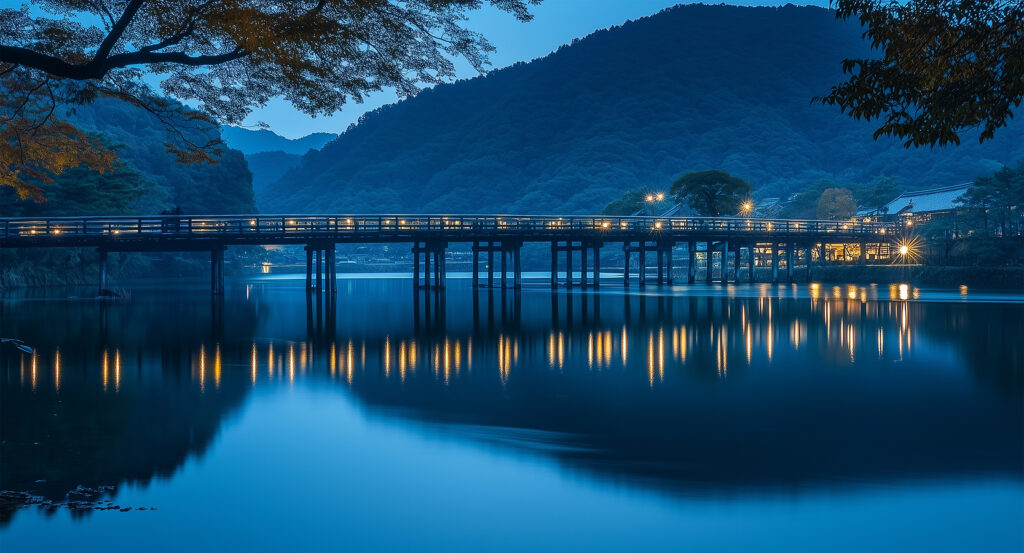
Resting directly beneath Togetsukyo Bridge, this small, tree-lined island is where Arashiyama's landscape seems to pause and listen. The water divides around it in two currents, one soft and reflective, the other fast and rippling, creating a natural discussion of calm and motion. Wooden walkways and stone paths meander through its shaded groves, connecting footbridges to the riverbanks. The island feels intimate, yet infinite: sunlight filters through cherry trees, dappling the ground; the scent of water and pine lingers in the air. Standing here, you feel Kyoto's essence distilled, that balance of nature and design, restraint and emotion. From the island's edge, the view of Togetsukyo Bridge against the Arashiyama hills is cinematic, the kind of image that feels painted.
What you should know about Nakanoshima.
Nakanoshima, meaning “middle island”, was formed naturally by centuries of river sediment, later shaped by human hands into one of Kyoto's most poetic spaces.
In the Edo period, local fishermen and boatmen began maintaining the banks to prevent erosion, planting pines and willows to stabilize the soil. Over time, their labor transformed the island into a deliberate landscape. In the Meiji era, when Arashiyama became a popular retreat for Kyoto's citizens, Nakanoshima was reimagined as part of the newly designated Arashiyama Park system in 1887. Its paths were designed following chisen kaiyu principles, the “strolling garden” style that encourages visitors to experience shifting compositions with every few steps. The island's low stone embankments and bridges were built with asymmetrical precision, creating the illusion of effortlessness. Few realize that its walkways subtly align with sightlines to Togetsukyo Bridge and the distant peaks of Kameyama Hill, guiding the eye naturally through the landscape. In spring, the cherry trees bloom so thickly that petals drift into the river like snow; in summer, dragonflies skim the water and herons perch along the shallows. Autumn brings a symphony of color, maple, zelkova, and camphor, mirrored perfectly in the river's slow current. Even winter carries beauty: the island's skeletal branches traced against silver fog, the bridge above it fading into cloud. Nakanoshima has quietly witnessed it all, floods, festivals, and centuries of poetry.
How to fold Nakanoshima into your trip.
To experience Nakanoshima Island is to step into Kyoto's rhythm, the heartbeat between movement and stillness.
Begin your walk from either side of Togetsukyo Bridge; small footpaths lead naturally toward the island's shaded interior. Visit in early morning when the mist still drifts above the water, or in late afternoon when sunlight flickers through the branches. The central trail loops gently around the perimeter, take your time. Pause at the southern edge, where the river widens and the mountains reflect in full; this is the island's most peaceful spot. Sit on the low stone walls and listen, the sound of the current, the murmur of voices from the bridge, the soft rustle of leaves. If you visit during cherry blossom season, arrive just before sunset: the petals catch the last light, turning the air pink and gold. In autumn, the island becomes a painter's palette, every leaf mirrored twice, once in the trees and once in the water. Bring no expectations; the magic lies in its understatement. Before leaving, stand on the northern path and look back toward the bridge. The scene you see, bridge, mountain, river, sky, is Arashiyama's eternal composition, perfectly framed by Nakanoshima's quiet center.
Where your story begins.
Foresyte Travel reveals places that feel extraordinary long before you arrive.
Experience premium editorial crafted for luxury travelers.

















































































































