
Why Tsukiji Outer Market matters.
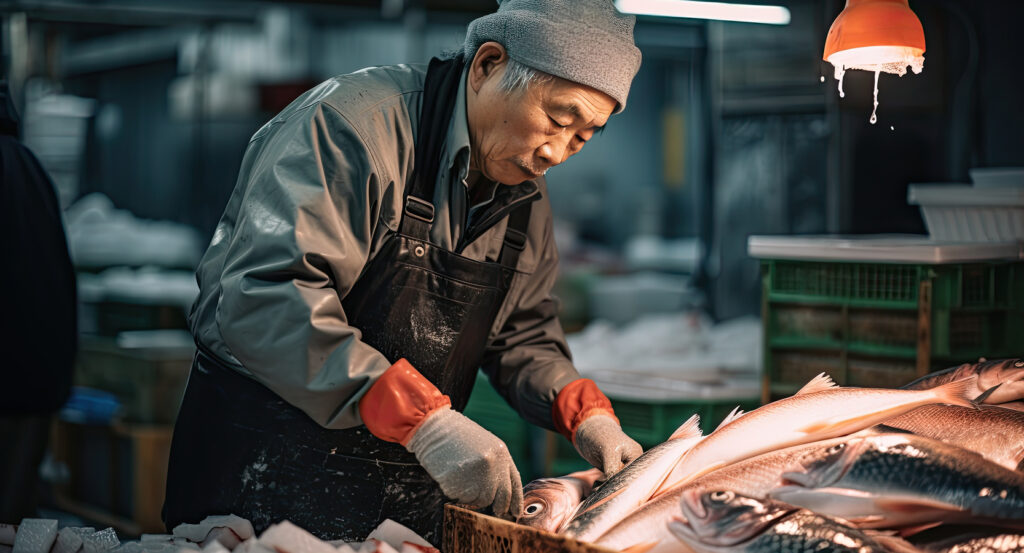
Tsukiji Outer Market is a kinetic market district where Tsukiji's mercantile character meets tightly packed seafood counters, specialist food shops and narrow lanes carrying forward the working culture of Tokyo's former wholesale market.
Set along Shin-Ohashi-dori near Harumi-dori and just steps from Namiyoke Inari Shrine, the market occupies a dense grid where covered storefronts, narrow pedestrian passages, delivery entrances and low commercial buildings press against the broader avenues separating Tsukiji from Ginza and the Sumida waterfront. Shopfronts open directly onto the lanes through displays of seafood, dried goods, knives, tea, produce and prepared foods, compressing commercial activity into spaces measured in only a few storefront widths. Delivery workers, merchants and shoppers share passages that change character block by block as counters give way to wholesalers, kitchenware specialists and compact dining rooms. Tsukiji Uogashi extends this physical world into two larger buildings near the former wholesale-market grounds, adding covered trading floors to the older streets surrounding them. The result is an intensely concentrated food district where Tokyo's seafood trade remains embedded in the small-scale commercial fabric that grew beside the former central market.
What defines Tsukiji Outer Market.
Tsukiji Outer Market is best known for developing beside Tokyo's central wholesale market after the 1923 Great Kanto Earthquake destroyed the historic Nihonbashi Uogashi and forced a fundamental reorganization of the city's food distribution system. The Nihonbashi fish trade moved temporarily to Tsukiji before Tokyo constructed a permanent central market on former naval research ground nearby. The new institution combined the relocated fish trade with the fruit and vegetable business transferred from Kyobashi's Daikongashi, placing two major food-distribution networks within the same Tsukiji complex. Tokyo formally opened the central wholesale market in 1935 after more than a decade of disputes surrounding the transition from traditional private wholesalers and brokers into a regulated system separating primary wholesalers from intermediate wholesalers. The surrounding commercial district grew through a different mechanism. Tsukiji Hongwanji had maintained an extensive temple town containing 58 subsidiary temples, burial grounds, residences and associated buildings, but the 1923 earthquake and subsequent reconstruction forced many of those temples and graves to relocate. Merchants occupied former temple parcels as the wholesale market expanded beside them, supplying dried bonito, nori, kombu, canned foods, chopsticks, cookware, work clothing and other goods required by restaurants, retailers and market workers. The district developed without a single planned founding, drawing together older merchant streets, former temple ground and businesses created to support the enormous wholesale operation next door. Trade intensified after wartime controls ended, and Tsukiji became synonymous with the immense seafood distribution network operating through the central market and its surrounding specialist businesses. Close to 500 food and culinary shops eventually occupied the Outer Market, establishing a commercial district whose development depended directly on the specialized purchasing networks generated by the wholesale institution beside it.
The departure of the central wholesale operation for Toyosu in 2018 forced Tsukiji to separate its future from the institution that had generated its commercial scale for more than eight decades. Chuo City had already responded before the relocation by creating Tsukiji Uogashi, a fresh-food trading facility intended to preserve professional purchasing activity within the district. The facility began preliminary operations in November 2016 with close to 60 businesses run principally by intermediate wholesalers specializing in seafood, marine products, fruit and vegetables. Its two buildings, Odawarabashi and Kaikobashi, established new trading floors on the edge of the Outer Market and retained direct participation by businesses rooted in Tsukiji's wholesale culture. Upper levels added spaces devoted to food preparation, instruction and events, extending the institution beyond the transactions conducted on its lower floors. When the wholesale market completed its move to Toyosu in October 2018, the independently operated Outer Market remained in Tsukiji alongside this newer municipal facility. That separation produced the district visible now: the vast auction and distribution machinery moved across Tokyo Bay, yet the specialist merchants, culinary trades and purchasing culture that had accumulated outside its gates continued on the original streets.
How Tsukiji Outer Market fits.
Tsukiji Outer Market works as the anchor for a daytime exploration through Tsukiji, the waterfront and adjoining Ginza using three nearby sites that move from a Buddhist temple rebuilt through an unconventional architectural synthesis through a Tokugawa coastal estate into the theater that became the institutional center of modern kabuki.
Begin at Tsukiji Hongwanji, whose history predates the market district by centuries and helps explain the unusual urban origins of Tsukiji itself. The temple was founded near Asakusa in 1617, burned during the Great Fire of Meireki in 1657 and received replacement ground from the shogunate in an area then covered by water. Followers reclaimed the site from Edo Bay and constructed the new temple, an act of landmaking associated with the name Tsukiji, meaning built land. Fire accompanying the 1923 Great Kanto Earthquake destroyed the main hall, and architect Chuta Ito designed its replacement, completed in 1934. Ito rejected a conventional Japanese temple exterior for a stone composition drawing heavily on ancient Indian Buddhist architecture, yet the interior retained a traditional Jodo Shinshu worship arrangement, creating one of Tokyo's most distinctive twentieth-century religious buildings. Continue to Hama-rikyu Gardens, whose ground began as coastal shallows and Tokugawa hawking territory before Matsudaira Tsunashige received permission in 1654 to reclaim land and establish Kofu Hama-yashiki. His son Tsunatoyo became the sixth shogun, Tokugawa Ienobu, bringing the estate into shogunal ownership as Hama Goten. Major work in 1707 created the Shioiri Pond, bridges, teahouses and additional garden architecture, and later shoguns continued altering the estate through the era of Tokugawa Ienari. The Shioiri Pond still draws seawater from Tokyo Bay, leaving Hama-rikyu as Tokyo's surviving garden where an Edo-period tidal-pond system continues operating with the bay. Imperial ownership followed the Meiji Restoration before the Imperial family transferred the damaged garden to Tokyo in 1945; public opening followed in 1946. Conclude at Kabukiza Theatre, founded in Kobikicho by journalist and playwright Fukuchi Genichiro as part of the Meiji-era theater reform movement and opened on November 21, 1889. Its first building paired a Western exterior with a Japanese cypress interior, and actors Ichikawa Danjuro IX, Onoe Kikugoro V and Ichikawa Sadanji I helped establish the stage at the center of modern kabuki. Reconstruction in 1911 introduced a Japanese palatial exterior, Shochiku assumed full management in 1914 and fire destroyed that second theater in 1921. The Great Kanto Earthquake interrupted the next reconstruction, a third building opened in 1925, wartime bombing destroyed much of it in 1945 and a fourth incarnation reopened in 1951 using surviving portions of its predecessor. The fifth Kabukiza opened in 2013, retaining the tiled roof, curved karahafu gable and balustrades associated with the earlier theater beneath the new Kabukiza Tower. The progression moves from Chuta Ito's reconstruction of a seventeenth-century Buddhist institution through a Tokugawa coastal estate engineered around the tides into Kabukiza's repeated rebuilding across fire, earthquake, war and metropolitan redevelopment, connecting three sites whose physical survival depended on substantial reinvention.
Where your story begins.
Foresyte Travel reveals places that feel extraordinary long before you arrive.
Enjoy editorial crafted for luxury travelers.
Foresyte may earn a commission when you book.

















































































































