
Why Ginza matters.
Ginza is a polished enclave where Tokyo's historic mercantile center meets contemporary Japan through broad commercial avenues, meticulous side streets and architecture carrying successive eras of national modernization.
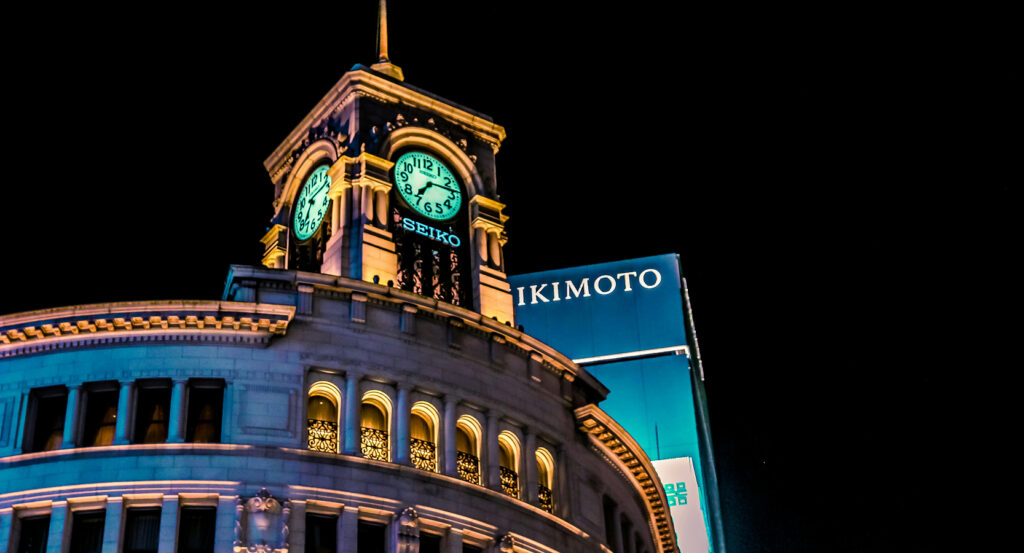
Positioned between Yurakucho, Kyobashi, and Tsukiji, the neighborhood occupies a Central Tokyo pocket where Chuo-dori forms a long north-south spine across eight numbered chome, Harumi-dori cuts east toward the former waterfront, and smaller streets divide the resulting blocks into an unusually walkable commercial grid. Stone, glass and metal facades rise from comparatively compact parcels, creating a street wall whose architectural variety ranges from prewar masonry buildings to highly engineered contemporary flagships, yet the scale shifts quickly inside narrow lanes lined with galleries, specialist shops and restaurants. Chuo-dori establishes the primary encounter through its generous width and continuous storefronts, with weekend traffic closures converting the avenue into an expansive pedestrian corridor and exposing the precision of Ginza's block structure. Streets extending toward Yurakucho and Higashi-Ginza deepen the physical character through smaller crossings, illuminated signs and entrances compressed into slender multistory buildings, giving the district an intricate vertical dimension beyond its major avenues. The numbered chome and repeated intersections add another spatial mechanism, allowing major commercial buildings to anchor corners as the smaller streets preserve a finer rhythm of independent establishments between them. The result is a neighborhood whose physical order joins metropolitan scale with close-grained exploration, preparing a history shaped first by Tokugawa silver production and then by one of Japan's most ambitious experiments in Westernized urban construction.
What defines Ginza.
Ginza is best known for developing from the Tokugawa shogunate's silver coinage district into the Westernized commercial quarter that helped define modern Tokyo. Tokugawa Ieyasu transferred the shogunate silver mint from Sunpu to present-day Ginza 2-chome in 1603, establishing the institution whose colloquial name eventually displaced the area's official Shin-ryogae-cho designation. The organization combined an office handling silver acquisition and administration with facilities producing coinage, embedding monetary activity beside the Tokaido route leading from Nihonbashi toward Kyoto. Merchants shared the surrounding district with artisan communities, Noh performers, kabuki actors, Tokiwazu practitioners and painters, connecting commerce with cultural production during the Edo period. Fire radically changed that inherited town in 1872, when the Meiji government commissioned British architect Thomas James Waters to rebuild Ginza as a Westernized brick district. Waters's scheme widened the main avenue to 27 meters, separated vehicles from pedestrians, introduced brick sidewalks, gas lamps and street trees, and organized Georgian-style brick buildings along a more regular street system. Government expenditure reached one twenty-seventh of the national budget, turning reconstruction into an unusually large state investment in the physical appearance of the new capital. Japan's first railway opened between Shimbashi and Yokohama during the same year, placing Ginza beside the Tokyo terminus and accelerating the arrival of merchants selling clocks, Western clothing, furniture, bread, wine and other goods associated with the Meiji transformation. Window displays and shops entered directly from the street helped turn walking itself into part of Ginza's commercial culture, establishing the foundations of the practice later known as Gin-bura.
The Great Kanto Earthquake of September 1923 opened a separate chapter in Ginza's rise as Japan's preeminent shopping district. Fire and structural collapse devastated the Meiji brick town, but merchants erected temporary shops and reopened together on November 10, with avant-garde artists contributing unconventional facades to the emergency commercial streetscape. Reconstruction widened Harumi-dori and introduced Showa-dori, changing circulation through the district as private businesses pursued their own architectural rebuilding. Matsuzakaya entered Ginza in 1924, Matsuya followed in 1925 and Mitsukoshi in 1930, concentrating large department stores alongside the specialist merchants already associated with Chuo-dori. The department stores introduced new forms of mass retailing, including rooftop attractions and transport services connecting shoppers with nearby stations, and their arrival increased the commercial draw of the surrounding independent shops. Real-estate rents in Ginza surpassed Nihonbashi in 1929 to become Japan's highest, marking the district's emergence as the country's dominant prestige address. Cafés simultaneously multiplied across the neighborhood, with 600 cafés and bars counted in Ginza in 1929 as neon, Western fashion and the mobo and moga culture of early Showa Tokyo transformed its nighttime streets. The subway reached Ginza from Asakusa in 1934, binding the district more directly to another major commercial center just as Ginza consolidated its position at the forefront of metropolitan retail and urban culture.
How Ginza fits.
Ginza works as the anchor for a daytime exploration connecting a Meiji stationery merchant, a gallery created specifically for graphic design and Japan's principal kabuki theater through three institutions that developed distinct branches of the district's commercial and creative culture.
Begin at Ginza Itoya, founded in 1904 as a stationery business during the period when Ginza's Westernized commercial streets were drawing merchants devoted to new categories of specialist retail. Its post-earthquake building completed in 1930 rose eight stories above two basement levels in a Renaissance Revival design, placing a specialist stationery house on an architectural scale comparable with the major department stores then reshaping Ginza-dori; that investment carried the business from a Meiji shop into the larger retail architecture of early Showa Ginza and established a physical presence commensurate with the district's growing national influence. Continue to ginza graphic gallery, established by Dai Nippon Printing on March 4, 1986 in the company's birthplace as a dedicated exhibition space for graphic design. The institution connected Ginza's concentration of art galleries with DNP's printing expertise, beginning with a Masashi Ohashi exhibition and developing a program spanning Japanese and international designers, exhibitions, lectures and gggBooks; its 2016 thirtieth-anniversary exhibition assembled 360 posters spanning its exhibition history, showing how a compact Ginza gallery had become an enduring platform for Japanese visual communication. Conclude at Kabukiza, first opened on November 21, 1889 under journalist Fukuchi Genichiro as a theater created amid the Meiji movement to reform theatrical presentation. The first building combined a Western exterior with a traditional cypress interior, beginning a sequence of rebuilding driven by changing theatrical ambitions, fire, the 1923 earthquake and wartime destruction; the theater reopened after postwar reconstruction in 1951, and the fifth Kabukiza opened in April 2013, carrying more than a century of performance history on the same Kobikicho site. The progression moves from Itoya translating specialist commerce into ambitious early Showa retail architecture through Dai Nippon Printing creating a permanent Ginza platform for graphic design into Kabukiza repeatedly rebuilding a national performing tradition on one site, revealing how commerce, design and theater became enduring cultural institutions within Ginza.
Where your story begins.
Foresyte Travel reveals places that feel extraordinary long before you arrive.
Enjoy editorial crafted for luxury travelers.
Foresyte may earn a commission when you book.

















































































































