
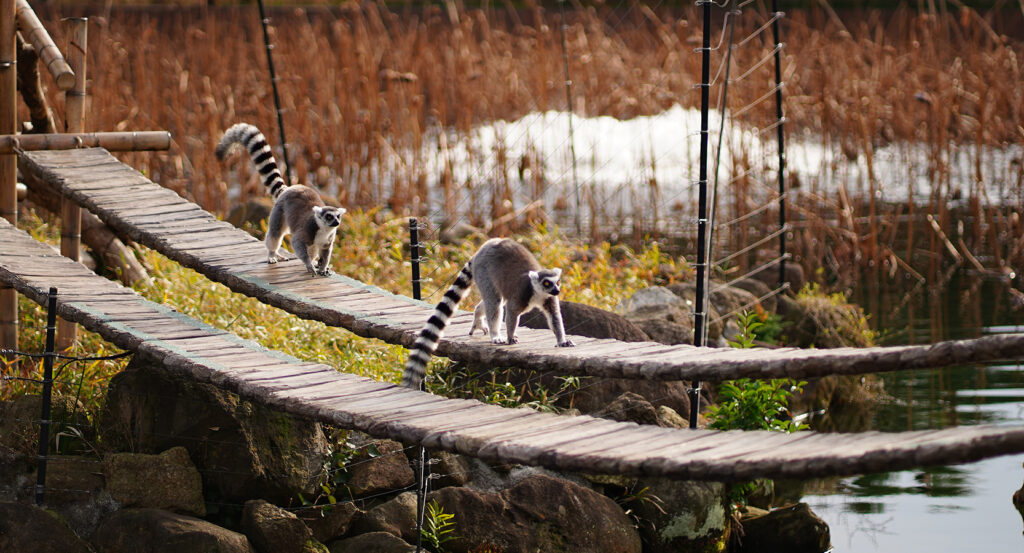
Why Ueno Zoo matters.
Ueno Zoo is a storied zoological institution where Ueno's museum-quarter character meets historic parkland, centuries-old religious architecture and an unusually dense collection of animal habitats spread between wooded upland and Shinobazu Pond. Its grounds retain a physical connection with Ueno's earlier history that few metropolitan zoos possess.
Set within Ueno Park near the approach to Ueno Toshogu and just steps from Shinobazu Pond, the zoo occupies 144,000 square meters divided between an elevated East Garden and Lower West Garden, with wooded slopes, ponds and historic structures breaking the conventional geometry of animal enclosures. The former Kan'ei-ji five-story pagoda rises inside the grounds, its 1639 timber structure introducing an Edo-period vertical marker among the zoological spaces. Kankan-tei adds another historical layer through a tea house associated with daimyo Todo Takatora and rebuilt in 1878, as the Former Main Gate preserves early twentieth-century architecture near the eastern entrance. The West Garden descends toward Shinobazu Pond, where aquatic birds and waterside habitats give the zoo a markedly different physical character from the wooded eastern half. The result is a zoological landscape embedded inside one of Tokyo's deepest concentrations of park, temple and museum history.
What defines Ueno Zoo.
Ueno Zoo is best known for developing from Meiji Japan's encyclopedic museum project into the country's principal zoological institution, carrying shifts in imperial policy, metropolitan government, wartime trauma and postwar reconstruction within the same grounds. Its earliest collection formed as the animal division of the museum established in Ueno after preparations surrounding Japan's participation in the Vienna World's Fair had encouraged a broad institution devoted to art, natural history, industry, books and zoology. The Ministry of Agriculture and Commerce initially emphasized native fauna and livestock in connection with industrial education before transfer to the Imperial Household Ministry in 1886 redirected collecting toward rare foreign species, diplomatic gifts and animals acquired through Japan's expanding international presence. Tigers, elephants from Qing China and Siam, Australian mammals and animals purchased from Carl Hagenbeck's organization progressively changed the scope of the collection. Control passed to Tokyo City in 1924 as part of the gift of Ueno Park commemorating Crown Prince Hirohito's marriage, triggering fifteen years of major rebuilding that produced a new polar-bear enclosure and the 1932 Monkey Mountain. The zoo had surpassed three million annual admissions by 1940, placing it among Tokyo's most heavily used civic institutions before war severed that growth. Tokyo authorities ordered the killing of dangerous animals in 1943, resulting in the deaths of elephants, lions, tigers, bears and other animals; surviving hippopotamuses were killed after the March 1945 air raids as feed supplies collapsed. Postwar recovery deliberately attached zoological reconstruction to peace, with the slogan “Zoo is the Peace,” a children's zoo and monkey train in 1948, the arrival of Asian elephant Indira as a gift from Indian prime minister Jawaharlal Nehru in 1949 and a major territorial expansion toward Shinobazu Pond between 1949 and 1951.
Later decades turned Ueno into a testing ground for public transportation, international animal exchange and increasingly sophisticated breeding work. Japan's first operational monorail began carrying passengers between the zoo's eastern and western sections in 1957 as a trial of suspended-rail technology intended for wider metropolitan application, operating under railway law as public transportation and surviving until service stopped in 2019; formal railway abolition followed in 2023. Giant pandas Lan Lan and Kang Kang arrived from China on October 28, 1972 to commemorate normalization of diplomatic relations between Japan and the People's Republic of China, initiating a national panda phenomenon and a breeding program extending across several generations. Huan Huan and Fei Fei produced Tonton through artificial insemination in 1986, followed by Yuyu in 1988. Xiang Xiang was born in 2017, and twins Xiao Xiao and Lei Lei followed in 2021, the first giant-panda twins born at Ueno. Panda Forest had already opened in the West Garden in 2020 with contoured outdoor spaces modeled on high-altitude Chinese forest habitat and accompanying red pandas and pheasants. Xiao Xiao and Lei Lei returned to China on January 28, 2026, leaving Ueno without giant pandas for the first time in years, even as the institution continues the conservation programs, breeding research and animal-welfare work that grew from the technical knowledge accumulated across generations of zoological care.
How Ueno Zoo fits.
Ueno Zoo works as the anchor for a daytime exploration through Ueno Park using three nearby sites that move from Tokugawa religious power through the creation of Japan's modern museum system into the national institution devoted to natural history and science.
Begin at Ueno Toshogu, founded in 1627 for Tokugawa Ieyasu and rebuilt under his grandson, third shogun Tokugawa Iemitsu, in 1651. The surviving Konjikiden, Karamon and Sukibei wall emerged from that campaign in the ornate gongen-zukuri tradition, covering structural surfaces with gold leaf, carvings and painted decoration. Their survival through earthquakes, the Battle of Ueno and twentieth-century bombing gives the complex unusual architectural continuity within parkland where much of Kan'ei-ji disappeared during the upheavals surrounding the Meiji Restoration. Continue to Tokyo National Museum, whose institutional ancestry begins with the 1872 exhibition at Yushima Seido and whose move to Ueno grew from director Machida Hisanari's ambition for an encyclopedic museum joining art, natural history, industry, a library, botanical collections and a zoo. Josiah Conder designed the first Ueno main building between 1878 and 1881, but the Great Kanto Earthquake severely damaged it in 1923. Watanabe Jin won the competition for its replacement, producing the present Honkan, a quake- and fire-resistant building of 21,500 square meters whose construction cost seven million yen and whose twenty-five galleries reorganized Japanese and Asian holdings under a new classification system. Conclude at National Museum of Nature and Science, whose institutional lineage separated from the broader museum system as scientific collecting became increasingly specialized. The Great Kanto Earthquake destroyed its earlier facilities and specimens in 1923, leading to construction of the present Japan Gallery in Ueno, completed in 1931 through a Ministry of Education design. Its Neo-Renaissance architecture later received Important Cultural Property status in 2008, as the institution expanded from nineteenth-century educational displays into Japan's national center for collections and research spanning natural history and the history of science and technology. The progression moves from Iemitsu's surviving Tokugawa shrine through the institutional experiment that joined museum, library and zoo under one Meiji project into the specialized national science museum that emerged from that intellectual world, revealing how Ueno became one of Japan's principal territories for public knowledge.
Where your story begins.
Foresyte Travel reveals places that feel extraordinary long before you arrive.
Enjoy editorial crafted for luxury travelers.
Foresyte may earn a commission when you book.

















































































































