Why Villa Dubrovnik matters.
Villa Dubrovnik is the Adriatic lived from its rarest vantage, a hotel that feels not beside the sea but inside its motion, where water, light, and the ancient city converge into an intensely present way of being.
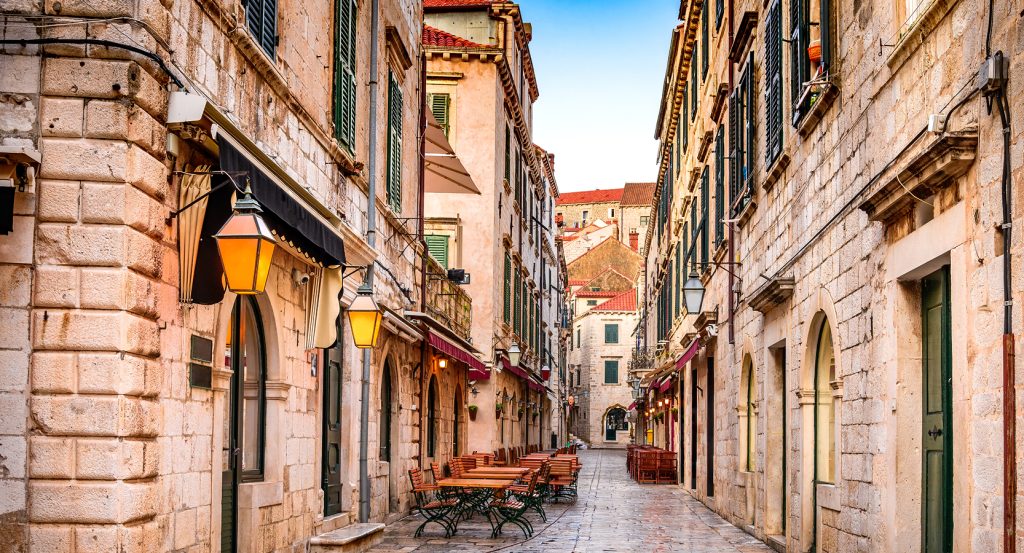
Dubrovnik is a city of stone, horizon, and light: the Old Town's limestone reflecting sun by day and moon by night, walls that hold stories on their skin, and a coast that never stops interacting with the city's movement. Villa Dubrovnik doesn't sit near these forces, it embraces them. From the moment you arrive, the transition into place is immediate and unambiguous: the Adriatic's breath fills the air, the sound of water against rock registers in your posture, and the hotel's architecture feels like a frame built for this specific geography rather than a generic idea of luxury. You don't cross thresholds into a neutral zone; you step into context. Check-in unfolds with quiet assurance, not performance, not performance, but a confidence that your stay here is about engagement with place, not escape from it. The lobby and shared spaces embody this logic. Rather than shutting the city out with vast carpets or ornate adornments, these environments extend outward: views of sea before décor, light before ornament, horizon before distraction. Sightlines favor openness; the material language embraces texture and proportion that feels forged from the same sensibility as the city's stones, sea, and sky. There is a composure here, not from restraint for its own sake, but because the place demands clarity of intention over theatricality. Guest rooms at Villa Dubrovnik are not merely spaces to sleep, they are stations of presence. Rooms feel intentionally scaled: generous enough to live in without excess, composed so that every movement feels conscious rather than rote. Beds are substantial, offering rest that feels complete. Lighting is layered and intelligent, allowing spaces to feel warm in the evening and open in the morning. Furnishings emphasize comfort and tactility, materials that feel like they were chosen for durational presence. But what truly defines these rooms are the views, window walls that frame the Adriatic in a way that makes horizon and water part of the room's architecture, not a painting you glance at before turning away. You inhabit the view. Sound is modulated in such a way that the pulse of the sea remains present, not intrusive, but undeniably real, so rest feels anchored to place. Dining at Villa Dubrovnik is another expression of this intentional grounding. Meals here are shaped by ingredient, season, and context rather than theatrical presentation for its own sake. Breakfast arrives with water in sight, served in a space where the cadence of light and tide establish mood more than décor. Lunch and dinner follow a similar compositional clarity, menus that honor Croatia's Adriatic bounty with precision, spaces that support conversation and observation. Dining becomes part of your day's rhythm. Leisure and amenity spaces are arranged with purpose, not saturation. The infinity pool doesn't hide behind walls; it declares its relation to sea and sky with unambiguous presence. Terrace spaces are not carved out as escapes from place, they are extensions of it. Whether you swim, rest, or walk toward water, the environment remains your companion, not your competitor. Step outside the property and the city's textures reassert themselves: local cafés where life continues without pause, alleyways that turn toward history, and the continuous discussion between stone and water that defines Dubrovnik. You are not cloistered from the world; you are positioned within it. Returning to Villa Dubrovnik after time spent exploring feels like arriving back into coherence, not retreating into isolation, but stepping into a place that absorbs your experience and gives it shape. This is a hotel for travelers who want presence over pretense, who value context as much as comfort, and who desire a stay where the environment is a partner in experience. Villa Dubrovnik delivers a stay defined by refinement without artifice and connection without extraction, a place where the Adriatic stops being scenery and begins to mean something in every moment of your day.
What defines Villa Dubrovnik.
Villa Dubrovnik is not just a hotel in Dubrovnik, it was conceived as a spatial continuation of the setting's unique topography and light, creating a coherence that makes the building feel like a natural concept.
The property's architecture and spatial organization emphasize outward sightlines and horizon orientation; corridors and lounges are arranged so that the sea is part of the psychic foreground, not a secondary feature. Materials are chosen to harmonize rather than dominate: surfaces age into the light, fixtures feel weighty yet unobtrusive, and the palette connects with the city's limestone and Adriatic blues. Guest rooms are laid out so that orientation happens instantly, you understand the room's logic within moments of entry, reducing cognitive friction and letting your attention settle into experience. This allows the environment to feel known. Service culture mirrors this architectural intent. Interactions are composed, meticulous, and discreet. Staff assist with readiness rather than scripted ceremony, enabling you to shape your own experience with integrity and autonomy. Hospitality here is expressed through precision, respect for your presence, and an understanding that the environment itself is part of the experience. Over time, this creates a sense that Villa Dubrovnik is not merely a place you stay, it becomes the spatial context in which you lived Dubrovnik.
How Villa Dubrovnik fits.
Villa Dubrovnik works best when you treat it as the vantage point that shapes your encounter with the city rather than a destination separate from it, letting horizon, sea, and light define how your time unfolds.
Begin your stay by orienting yourself visually: open curtains toward sea or sky, let the horizon become part of your sense of time, and allow that visual clarity to anchor your presence. Use breakfast not as a rushed routine but as a conscious transition into place, eat slowly with water in sight, let your body absorb the cadence of light before stepping into the city. When you explore the Old Town, approach it not as a checklist of monuments but as textured space: notice how light plays on walls, how windows frame distant water, how daily life moves through ancient stone. Return to Villa Dubrovnik mid-day or afternoon not because you need rest, but because the space supports recalibration, a moment to reflect, to absorb, to integrate what you've seen into your experience. Evenings are best shaped by how the day felt rather than formal itinerary: dine when hunger and mood align, let conversation unfold with ease, and let dusk arrive without pressure. Walk back to your room in the glow of sunset, let the water's motion be your frame of reference, and welcome night as part of a continuous coherent experience, not a compartment. Over several days, this approach deepens your relation to Dubrovnik, shifting it from a place you visit to a place you inhabit. Villa Dubrovnik will not feel like accommodation you used; it will feel like the spatial context that made Dubrovnik a lived experience.
Where your story begins.
Foresyte Travel reveals places that feel extraordinary long before you arrive.
Enjoy editorial crafted for luxury travelers.
Foresyte may earn a commission when you book.