Why you should experience Washington National Cathedral in Washington, D.C.
Washington National Cathedral in Washington, D.C. is the spiritual heartbeat of the nation, where faith, art, and history converge in a sanctuary that feels both celestial and deeply human.
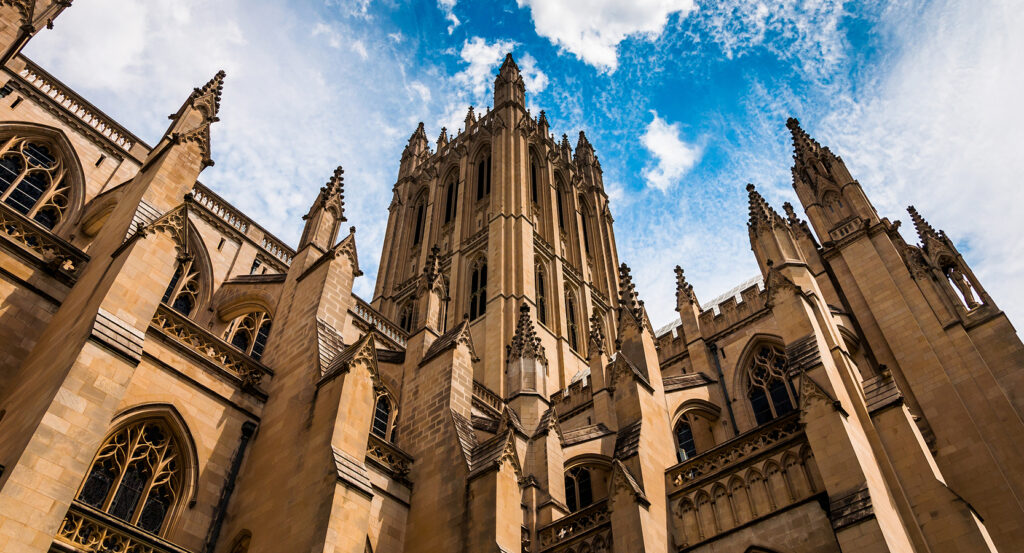
Rising high above the capital's skyline, its Gothic spires and flying buttresses pierce the air with a quiet authority, visible from miles away as a symbol of hope and unity. Step inside, and the scale alone humbles you, the vaulted ceiling soars nearly 100 feet overhead, and shafts of colored light pour through 215 stained-glass windows, transforming the limestone interior into a kaleidoscope of spirit and color. The space hums with a sacred stillness, interrupted only by the faint echo of footsteps or the distant chords of its mighty pipe organ. Every inch of the cathedral seems alive with meaning: from the carved angels tucked into its arches to the intricate stonework that tells the story of faith and creation. Construction began in 1907 and continued for more than 80 years, culminating in 1990, making it not only one of the newest great cathedrals in the world but also one of the most deliberately crafted. Though built in the traditional English Gothic style, Washington National Cathedral belongs unmistakably to America, a national house of prayer that welcomes all beliefs, all voices, and all moments of reflection. Standing within its nave, you feel not just the grandeur of architecture, but the quiet invitation to look upward, toward light, toward meaning, toward something greater than yourself.
What you didn’t know about Washington National Cathedral.
Behind its magnificent façade lies a story of perseverance, artistry, and purpose, a cathedral conceived as a unifying space for a diverse and evolving nation.
Chartered by Congress in 1893 as the Cathedral Church of Saint Peter and Saint Paul in the City and Diocese of Washington, it was envisioned as a spiritual center for all Americans, regardless of creed or denomination. Its foundation stone was laid in 1907 in the presence of President Theodore Roosevelt, who proclaimed it a monument “dedicated to the glory of God and the service of humanity.” Every U.S. president since has participated in some form of national service here, from Eisenhower's and Reagan's funerals to Obama's interfaith prayers for peace. Yet what makes the cathedral truly remarkable isn't just its history, but its artistry. More than 100 stone carvers labored for decades to bring its details to life, gargoyles, grotesques, and sculpted saints that adorn its 112-foot towers. One of its most beloved modern carvings is a Star Wars surprise: a Darth Vader gargoyle peering mischievously from the northwest tower, the result of a children's design contest in the 1980s. The cathedral's stained-glass windows are masterpieces in themselves, none more famous than the Space Window, which contains a fragment of lunar rock brought back by Apollo 11. Beneath its grandeur lies a deeply American narrative: the intertwining of science, art, and spirituality. The structure survived both the 2011 earthquake and numerous restoration efforts, emerging stronger each time, its resilience mirroring the nation's own. Many don't realize the cathedral also houses a Bethlehem Chapel at its foundation, marking the first space built and symbolizing beginnings, while the high altar sits directly above it, symbolizing ascension, a deliberate architectural metaphor for life's spiritual journey. And scattered among the memorials are reminders of America's moral arc: tributes to Martin Luther King Jr., Helen Keller, and President Woodrow Wilson, whose tomb rests in its nave, the only U.S. president buried within the capital's boundaries.
How to fold Washington National Cathedral into your trip.
To truly experience Washington National Cathedral, approach it as both pilgrimage and pause, a space not just to see, but to feel.
Begin your visit by walking up the grassy slope of Wisconsin Avenue, where the cathedral's limestone façade reveals itself piece by piece, the towers framed by elm trees and the city's distant monuments. Step through the massive bronze doors and pause in the nave, where the light from the rose window, a radiant explosion of blue and violet glass, casts the interior in dreamlike hues. Wander through the side aisles and chapels, each dedicated to a saint, a cause, or a moment in history. In the Children's Chapel, kneel before a miniature altar built for young worshippers; in the War Memorial Chapel, light a candle beneath the soaring cross salvaged from World War II debris. Don't miss the crypt-level exhibits, where you can explore the cathedral's intricate construction and its symbolic link between heaven and earth. If you're able, climb to the observation gallery in the central tower, the highest point in Washington, D.C., for sweeping views that stretch from the Potomac to the Capitol dome. Attend Evensong in the late afternoon, when the choir's harmonies float through the stone arches like prayer itself, or visit at sunset, when the exterior glows amber against the fading sky. Afterward, stroll through the Bishop's Garden, a walled oasis of roses, herbs, and medieval sculptures that feels worlds away from the bustle below. Every visit here feels different, because the cathedral itself is alive, shifting with the light, the music, and the heartbeat of the city around it. Washington National Cathedral isn't simply a monument of stone, it's a living expression of America's faith in beauty, hope, and endurance. To stand within its walls is to witness how architecture can speak the language of the soul, not through dogma, but through wonder. It's a place that doesn't just tell the story of a nation; it sings it, one note, one prayer, one lightbeam at a time.
Where your story begins.
Start your planning journey with Foresyte Travel.
Experience immersive stories crafted for luxury travelers.