
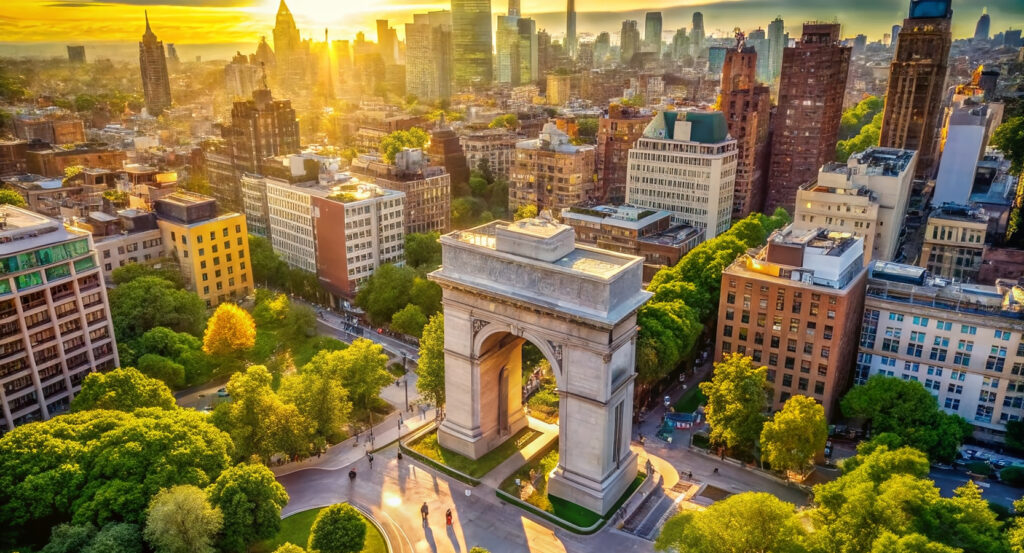
Why Washington Square Arch matters.
Washington Square Fountain is a defining public gathering place where Greenwich Village's civic character meets nineteenth-century park design, an expansive circular basin and generations of music, protest and spontaneous performance.
Set within Washington Square Park near 5th Avenue and just steps from Washington Square North, the fountain occupies the park's broad central plaza on a north-south axis that organizes long views across one of Lower Manhattan's most intensely used public spaces. A low circular stone rim surrounds an open basin with a concentrated central jet and smaller water plumes, creating a structure whose horizontal scale doubles as seating and an informal edge between water and plaza. The principal encounter unfolds directly around and inside the basin, where broad stone surfaces support sitting, gathering and performance within a space designed for unusually fluid public occupation. The surrounding paved plaza introduces a distinct secondary mechanism through uninterrupted sightlines and generous standing room that allow individual musicians, dancers and speakers to draw temporary audiences without separating activity from ordinary movement through the park. The result is a fountain where water, circular geometry and open civic space create a remarkably adaptable stage at the center of Greenwich Village.
What defines the Washington Square Fountain.
Washington Square Fountain is best known for occupying the physical and social center of a public space transformed repeatedly from burial ground to military parade ground and metropolitan park. New York City acquired land here for a potter's field in 1795, establishing a burial ground that received thousands of people during the following decades. The Common Council redirected the site toward military use in 1826, and Washington Military Parade Ground emerged as fashionable residential development advanced around its perimeter. Park improvements during 1849 and 1850 introduced new paths and fencing as the former parade ground assumed a recreational role. A circular bluestone fountain was completed at its center in 1852, introducing water as a permanent organizing feature within the evolving landscape. The Department of Public Parks assumed jurisdiction in 1871 and redesigned Washington Square with curving secondary paths under a plan associated with Jacob Wrey Mould. A replacement fountain entered that composition during the same period, incorporating a water feature transferred from Central Park and retaining the central position established by its predecessor. The Panic of 1873 interrupted ambitions for a more elaborate hydraulic centerpiece, leaving a simpler basin and spray arrangement within Mould's park plan. The fountain emerged through successive nineteenth-century reinventions of Washington Square, with its circular form surviving as the surrounding ground shifted from burial and military functions toward recreation and civic gathering.
Twentieth-century battles over traffic transformed the fountain plaza into one of Greenwich Village's most consequential public stages. Robert Moses advanced successive proposals involving vehicular circulation through or around Washington Square, prompting neighborhood resistance that intensified during the 1950s under activist Shirley Hayes. The Washington Square Park Committee gathered 4,000 petition signatures against roadway plans, and a broader coalition later brought Jane Jacobs, Eleanor Roosevelt, Margaret Mead and Lewis Mumford into the campaign. The Board of Estimate authorized a trial traffic closure in October 1958, approved continued closure in April 1959 and completed the legal process permanently removing ordinary traffic in 1963. Freed from automobiles, the fountain plaza became associated with performers including Joan Baez, Bob Dylan and Allen Ginsberg before Robert Nichols led a 1970 redesign that expanded the central area into a sunken gathering space. Another reconstruction beginning in 2007 repositioned the fountain 23 feet east, restored its stone basin and aligned the central plaza with the park's 5th Avenue entrance. The renovated fountain reopened in 2009, adding a new axial relationship to a civic space whose twentieth-century history had been shaped by battles over who controlled movement through the square.
How the Washington Square Fountain fits.
Washington Square Fountain works as the anchor for an afternoon tracing Victorian civic architecture, nineteenth-century domestic preservation and a dramatic redefinition of sculpture through Greenwich Village, NoHo and SoHo.
Begin at Jefferson Market Library, built from 1875 to 1877 as a courthouse complex designed by Frederick Clark Withers and Calvert Vaux in a vivacious Victorian Gothic style. Civil court occupied the present Adult Reading Room, police court filled the current Children's Room and prisoners waited beneath brick arches in the basement; abandonment followed the end of court operations, but preservation advocates including Margot Gayle, Philip Wittenberg, Lewis Mumford and E. E. Cummings helped defeat demolition before Giorgio Cavaglieri converted the building into a New York Public Library branch opened in 1967. Continue to Merchant's House Museum, where hatter and real-estate investor Joseph Brewster built a late Federal and Greek Revival row house in 1832 before hardware merchant Seabury Tredwell purchased it three years later. The Tredwell family remained until Gertrude Tredwell's death in 1933, leaving interiors containing thousands of family possessions, including New York furniture, clothing, photographs and decorative arts; George Chapman acquired the property and opened it as a museum in 1936, and the house became Manhattan's first designated building under New York City's new landmarks law in 1965. Conclude at The New York Earth Room, where Walter De Maria filled a Wooster Street interior with 250 cubic yards of earth across 3,600 square feet in 1977. The 22-inch-deep installation weighs 280,000 pounds and became the third of De Maria's Earth Rooms after works in Munich and Darmstadt, neither of which survives; Dia Art Foundation established the New York work as a permanent public site in 1980 and completed its first major conservation campaign in 2023, preserving an artwork whose physical scale exceeds conventional gallery display. The progression moves from a courthouse rescued through neighborhood preservation through an intact merchant household into De Maria's room-sized field of earth, connecting civic architecture, domestic survival and dramatic artistic space across Lower Manhattan.
Where your story begins.
Foresyte Travel reveals places that feel extraordinary long before you arrive.
Enjoy editorial crafted for luxury travelers.
Foresyte may earn a commission when you book.







































































































