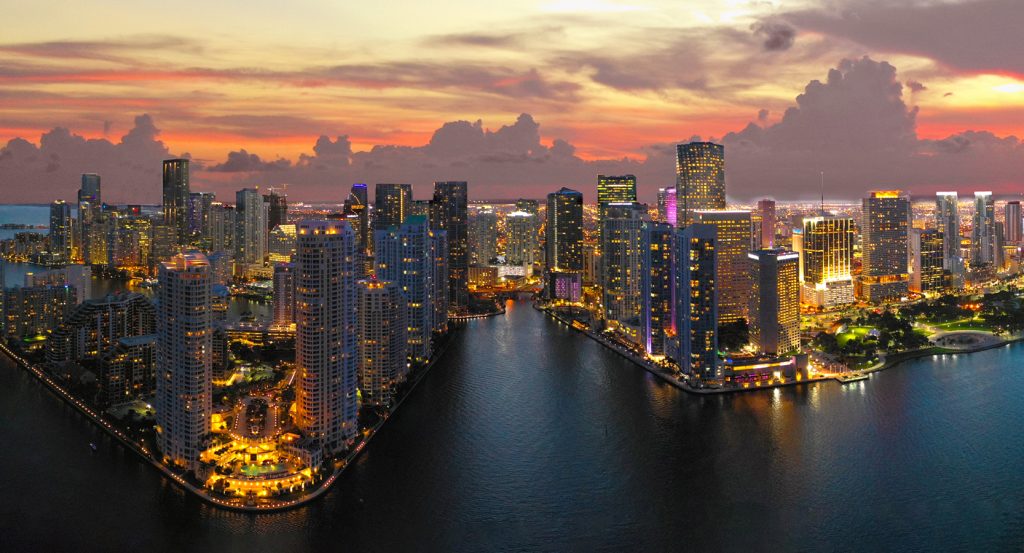
Why you should experience 57th Avenue in Miami, Florida.
57th Avenue is a energetic corridor where West Miami's multicultural character, longstanding commercial activity, and evolving suburban landscape converge along one of Central Miami-Dade County's most established north, south routes.
Running through West Miami, Coral Terrace, Flagami, Coral Gables, Schenley Park, Glenvar Heights, and South Miami, the corridor links residential neighborhoods, independent businesses, medical campuses, and civic destinations while reflecting nearly a century of metropolitan growth beyond Miami's original urban core. Royal palms, mature live oaks, neighborhood shopping centers, mid-century commercial buildings, and locally owned storefronts create a streetscape where successive generations of residents have shaped a corridor defined by mobility and enterprise. Throughout its length, family-operated businesses, cultural institutions, and established commercial districts reinforce an environment where suburban expansion and neighborhood character continue evolving together. The result is an experience defined by continuity, accessibility, and one of Miami's most recognizable arterial corridors.
What you should know about 57th Avenue.
57th Avenue is best known as Red Road, a historic boundary route whose alignment originated during the first decades of the twentieth century as Miami-Dade County expanded beyond its original settlements into newly surveyed agricultural and residential lands. The corridor followed the edge of early municipal limits before becoming a principal north, south artery linking citrus groves, truck farms, limestone quarries, and emerging suburban communities that developed throughout the twentieth century. Residential and commercial construction introduced Mediterranean Revival storefronts, reinforced concrete buildings, terrazzo entrances, decorative stucco façades, clay barrel roofs, and broad landscaped setbacks that remain characteristic of neighborhoods bordering the corridor. Expansion of the roadway strengthened connections between Coral Gables, West Miami, South Miami, and surrounding communities while encouraging sustained commercial investment that established Red Road as one of the county's defining transportation corridors. Royal palms, live oaks, gumbo limbo, sabal palms, mahogany trees, white ibis, monk parakeets, and zebra longwing butterflies continue contributing to the subtropical landscape that distinguishes the avenue despite extensive metropolitan development.
Red Road acquired its enduring name from the crushed red coral rock once spread across its surface before widespread asphalt paving transformed Miami-Dade County's early road network, preserving a visible reminder of South Florida's native limestone geology within the corridor's identity. That distinctive roadway became a recognizable geographic reference as neighborhoods, businesses, and institutions described their locations in relation to Red Road, reinforcing the avenue's role as a defining point of orientation across Central Miami-Dade. Even after modern reconstruction altered the original coral surface, the historic name remained inseparable from the corridor, linking present-day travel with the engineering materials and landscape that characterized Miami's earliest suburban expansion. Together, the roadway's geological origin, enduring name, and regional prominence demonstrate how 57th Avenue evolved into far more than a transportation route, becoming one of Miami's most historically recognizable urban corridors.
How to fold 57th Avenue into your trip.
57th Avenue works as an exploration of Central Miami's architectural heritage, tropical landscapes, and cultural institutions.
Begin at Fairchild Tropical Botanic Garden, where internationally significant botanical collections and rare tropical plants introduce the ecological richness that has long distinguished this portion of Miami-Dade County. Continue to Venetian Pool, where the restored 1923 coral rock swimming complex demonstrates the craftsmanship and Mediterranean Revival vision that helped define Coral Gables during its formative years. Conclude at Lowe Art Museum, where centuries of global art and one of South Florida's oldest collecting institutions provide the historical payoff by connecting the corridor with the University of Miami's longstanding cultural legacy. The progression moves from South Florida's natural environment through architectural achievement before culminating in artistic scholarship, revealing how 57th Avenue connects landscape, design, and cultural history.
Where your story begins.
Foresyte Travel reveals places that feel extraordinary long before you arrive.
Experience premium editorial crafted for luxury travelers.