
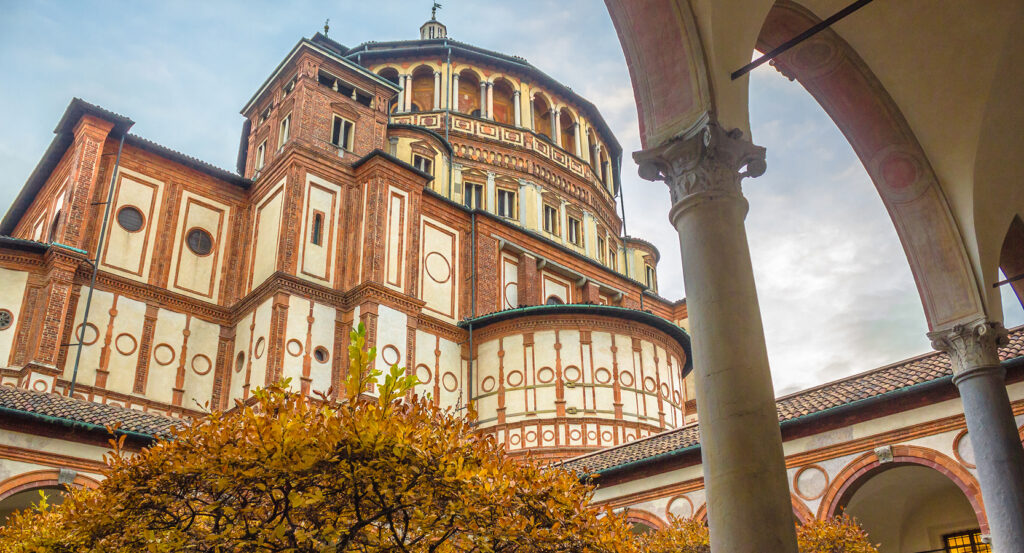
Why you should experience Museo del Cenacolo Vinciano in Milan, Italy.
In the quiet refectory of Convent of Santa Maria delle Grazie, where sunlight filters gently through arched windows, hangs one of humanity's most transcendent works of art, Museo del Cenacolo Vinciano.
More than a painting, it's a revelation frozen in pigment and plaster, a moment of divine tension captured with breathtaking humanity. Standing before it, you feel time slow. The twelve apostles, mid-conversation and mid-emotion, react to Christ's quiet words, “One of you will betray me.” Each gesture, each glance, carries centuries of meaning. Leonardo didn't paint holiness as distant or untouchable; he painted it as deeply human. His mastery of perspective, light, and psychology created not a religious tableau, but a living moment, one that has haunted viewers for over 500 years. The setting itself magnifies the intimacy: the painting occupies an entire wall of what was once the monks' dining hall, inviting visitors into the same space of reflection and communion. Here, art, faith, and science converge, and you understand why The Last Supper isn't just the soul of Milan, but one of the great turning points in human creativity.
What you should know about Museo del Cenacolo Vinciano.
Despite its enduring beauty, Museo del Cenacolo Vinciano is a miracle of survival.
Painted between 1495 and 1498 for Duke Ludovico Sforza, the masterpiece was never meant to last this long. Leonardo, always experimenting, rejected the traditional fresco technique in favor of tempera and oil on dry plaster, a method that allowed him to blend tones delicately but doomed the work to early decay. Within decades, the paint began to flake. Centuries of neglect, humidity, and even war compounded the damage, during World War II, a bomb destroyed much of the convent, leaving only the wall with The Last Supper miraculously intact beneath a web of sandbags and scaffolding. Today, the museum's climate-controlled environment preserves what remains after years of meticulous restoration. What visitors see now is a fusion of original strokes and careful conservation, a fragile harmony between what was lost and what endures. Few realize how limited and sacred each viewing is: entry is timed in 15-minute intervals, with no more than 25 people allowed at once, ensuring silence and reverence fill the room. Before entering, guests pass through sealed airlock chambers that stabilize humidity and temperature, a ritual-like procession that feels almost monastic. Beyond the mural itself, the museum tells a broader story of Leonardo's genius, his notebooks, sketches, and the innovations that shaped his vision. Many of the faces in the painting are said to be modeled after real Milanese citizens, a subtle act of democratizing divinity. Even the architecture behind Christ mirrors that of the convent's own hall, blurring the boundary between the earthly and the eternal.
How to fold Museo del Cenacolo Vinciano into your trip.
Museo del Cenacolo Vinciano is less an excursion and more a pilgrimage, an experience that demands intention and stillness.
Book your tickets well in advance, as access is tightly regulated, and aim for an early morning slot when the room is quiet and the light feels gentle. The entrance is discreet, you'll find it on Piazza di Santa Maria delle Grazie, where the Renaissance façade of the church frames the air with a sense of calm. Before the viewing, take time to explore the adjoining church designed by Bramante, a masterpiece in its own right with a dome that reflects the same harmony of proportion Leonardo pursued in his art. When you finally step into the refectory, pause before approaching the mural. Let your eyes adjust, and allow the silence to envelop you. The figures come alive gradually, Thomas questioning, Peter bristling, Judas recoiling in shadow. Even after centuries of damage, the resonant charge remains electrifying. After the visit, wander the cloister garden, where time seems to slow and the sounds of Milan fade into birdsong and rustling leaves. To deepen the experience, visit the nearby Museo Nazionale Scienza e Tecnologia Leonardo da Vinci, which showcases the mind behind the masterpiece, his inventions, machines, and anatomical sketches that reveal how art and science were one language to him. End your pilgrimage with a quiet espresso at a café nearby, letting the gravity of what you've seen settle in. The Last Supper Museum isn't just a destination; it's an awakening, a reminder that true genius doesn't shout across centuries. It whispers, softly, and still leaves the world in awe.
Where your story begins.
Foresyte Travel reveals places that feel extraordinary long before you arrive.
Experience premium editorial crafted for luxury travelers.




















































































































