
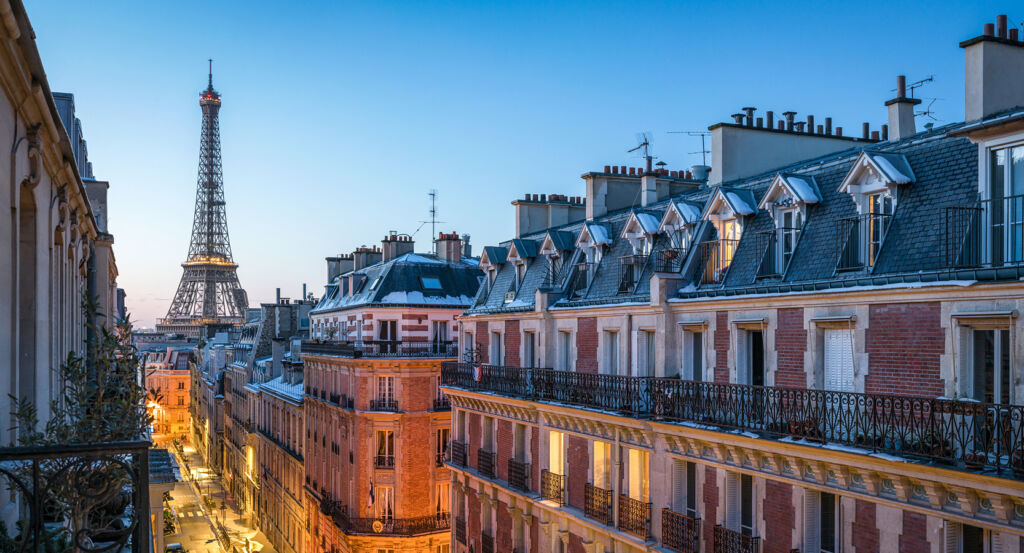
Why you should experience Hotel de l'Esperance in Paris, France.
Hotel de l'Esperance is a nostalgic three-star hotel where Croulebarbe's village intimacy, Left Bank intellectual inheritance, artisan memory and lingering traces of the Bièvre converge within a 1970s-inflected retreat near Rue Mouffetard.
Set along Rue Pascal near Rue Claude Bernard and just steps from Square René-Le Gall, the hotel sits within the former landscape of the Bièvre, the small river whose waters supported generations of dyers and craftsmen before disappearing beneath the surrounding streets. Inside, floral motifs, vintage furnishings, a bubble sofa and saturated 1970s references establish an intentionally lively counterpoint to the older Parisian fabric, while a planted courtyard creates a sheltered interior room beneath open sky. The hotel's characteristic mid-floor elevator adds another distinctly Parisian eccentricity to an address positioned between the market culture of Rue Mouffetard and the former workshops associated with the Gobelins farther south. The result is a hotel where retro design and courtyard seclusion give Croulebarbe's layered world of craftsmen, gardens and vanished waterways a charmingly unconventional hospitality expression.
What you should know about Hotel de l'Esperance.
Hotel de l'Esperance is best known for an interior character built around the design language of the 1970s, translating the decade through floral patterns, vintage references and a distinctive bubble sofa while preserving architectural peculiarities including its characteristically Parisian mid-floor elevator. The guestrooms continue the decorative program through floral motifs and vintage detailing, while the interior patio turns the building inward around a protected open-air space that functions as the quieter counterpart to Rue Pascal. The property's location places that contemporary design directly over the historical landscape of the Bièvre, a tributary of the Seine whose waters powered mills and supported tanners and dyers, including the Gobelin family whose name ultimately became synonymous with the royal mosaic workshops nearby. The surrounding Croulebarbe landscape retains physical evidence of that history through Square René-Le Gall, created between 1936 and 1938 by architect and landscape designer Jean-Charles Moreux across former Gobelins dependencies and part of the market-garden landscape once enclosed by branches of the Bièvre.
Jean-Charles Moreux developed the garden now adjoining the hotel's micro-district in a neoclassical style across more than 32,000 square meters, incorporating land that had formed part of the Gobelins mosaic workers' vegetable gardens before Square René-Le Gall opened in 1938. Mobilier national preserves the deeper artistic mechanism behind that landscape through Manufacture des Gobelins, where Henri IV first installed Flemish mosaic makers Marc de Comans and François de la Planche in buildings leased from descendants of the Gobelin dyers during the early seventeenth century. Jean-Baptiste Colbert purchased the property for the Crown in 1662 and placed Charles Le Brun, Louis XIV's premier peintre, at the head of an extraordinary concentration of painters, mosaic weavers, goldsmiths, founders, engravers and cabinetmakers producing furnishings for royal use. Together, Jean-Charles Moreux, Mobilier national, Jean-Baptiste Colbert and Charles Le Brun explain the unusual cultural landscape surrounding Hotel de l'Esperance, where a vanished river, former artisan gardens and centuries of decorative production remain embedded beneath its lively 1970s identity.
How to fold Hotel de l'Esperance into your trip.
Hotel de l'Esperance works as the anchor for an afternoon tracing Roman performance, royal craftsmanship and experimental science through the unusually deep historical layers surrounding the southern Latin Quarter.
Begin at Arènes de Lutèce, where the Gallo-Roman city of Lutetia constructed an amphitheater during the first or second century combining theatrical performance with arena combat, creating an unusual hybrid building capable of accommodating thousands before its remains disappeared beneath later Paris and were rediscovered during nineteenth-century redevelopment. Continue to Manufacture des Gobelins, where Henri IV brought Marc de Comans and François de la Planche into the former Gobelin dyeing complex before Colbert purchased the property for Louis XIV in 1662 and Charles Le Brun directed painters, weavers, goldsmiths, engravers and cabinetmakers producing royal furnishings, with high-warp mosaic becoming the workshop's exclusive weaving technique in 1826. Conclude at Musée Curie, occupying Marie Curie's former laboratory within the Institut du Radium complex created through collaboration between the University of Paris and Institut Pasteur, where Curie's preserved office and laboratory evoke the scientific world that followed her 1903 Nobel Prize in Physics and preceded the 1911 Nobel Prize in Chemistry that made her the first person awarded Nobel Prizes in two scientific fields. The progression moves from Roman Lutetia's architecture of public performance through Colbert and Le Brun's concentration of royal craftsmanship into Marie Curie's laboratory culture, revealing more than eighteen centuries of experimentation, making and intellectual ambition around Hotel de l'Esperance.
Where your story begins.
Foresyte Travel reveals places that feel extraordinary long before you arrive.
Experience premium editorial crafted for luxury travelers.














































































































