
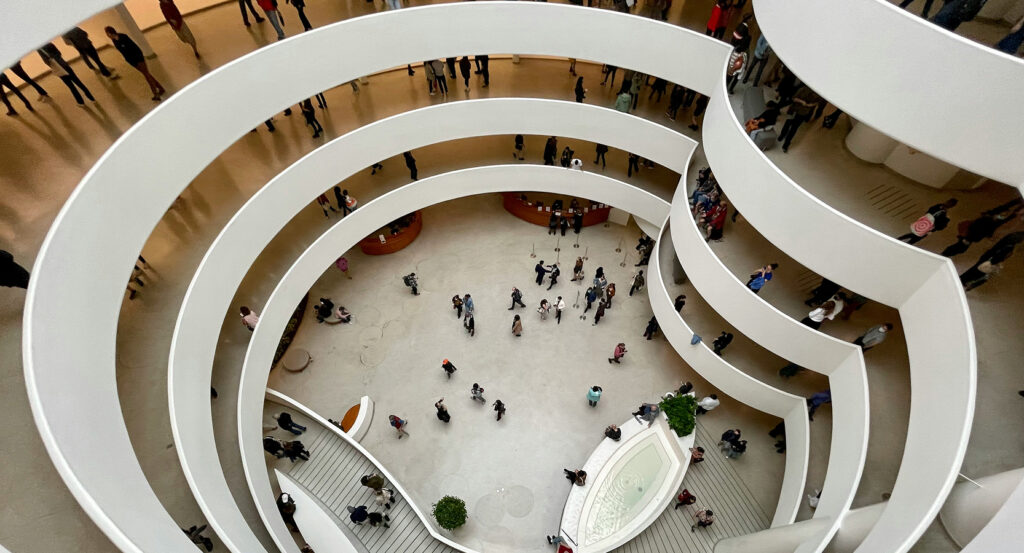
Why you should experience Upper Galleries at Guggenheim Museum in New York, NY.
The upper gallery levels of the Guggenheim are where architecture and art surrender to one another in a kind of suspended dialogue. Rising along Frank Lloyd Wright's spiraling ramp, you feel the rhythm of the building breathing around you, a rare sensation of motion embedded in structure. From this vantage, the paintings seem to shift with the curve, each masterpiece finding new light, new perspective, as you ascend. It's not just about seeing art; it's about inhabiting it, tracing the contours of space and genius at once. The gallery's palette of cream tones and skylit brilliance feels alive, an atmosphere designed to awaken reverence and curiosity in equal measure.
Visiting these levels isn't simply an act of viewing; it's a ritual of discovery. As the hum of the atrium softens above, you realize you've stepped into a space that transforms spectators into participants. You'll find yourself lingering longer than expected, absorbed in how abstraction, color, and light flirt with the curvature of the walls. Every turn reveals something new, not just about the art, but about how the human eye yearns to explore what it cannot fully define.
What you should know about Upper Galleries at Guggenheim Museum.
What most visitors don't realize is how deliberately Wright engineered these upper gallery levels to evoke a sense of elevation, not only physical but spiritual. Each ascending sweep of the ramp was meant to simulate a pilgrimage, where the visitor's ascent mirrors an inner journey toward enlightenment. The upper levels were initially controversial among curators, many of whom feared the slanted walls would distort perception. Yet, those very distortions became the Guggenheim's magic, forcing viewers to look differently, to reconsider their relationship with space, gravity, and perspective itself.
Even the acoustics here are intentional. A whisper on the upper level can echo faintly down the spiral, blurring boundaries between art, architecture, and sound. Wright saw the museum not as a container of art but as a living sculpture, and nowhere is that more apparent than on these top floors. When sunlight passes through the oculus and slides across the walls, it turns the white into gold, as if sanctifying the experience of looking. It's not about the paintings alone, it's about the ascension of thought they inspire.
How to fold Upper Galleries at Guggenheim Museum into your trip.
To fold the Guggenheim's upper gallery levels into your New York itinerary, approach them as both destination and meditation. Begin your visit early in the day, when the galleries are quieter, and ascend slowly, not just to beat the crowds but to savor the subtle choreography of movement and light. Pause midway up to look down through the spiral's center, letting your eyes trace the geometry that has captivated architects for decades.
After the descent, step outside and let the museum's organic form contrast against the city's rectilinear skyline. The contrast will stay with you, Wright's rebellion against conformity etched into your mind as vividly as any canvas you've seen. Pair your visit with a stroll through nearby Central Park or a glass of wine at a quiet café on Madison Avenue, letting the energy of the city and the serenity of the spiral intertwine. The upper galleries remind you that New York's greatest masterpieces are not just its buildings or paintings, but the way they make you feel im alive in their presence.
Where your story begins.
Foresyte Travel reveals places that feel extraordinary long before you arrive.
Experience premium editorial crafted for luxury travelers.







































































































