
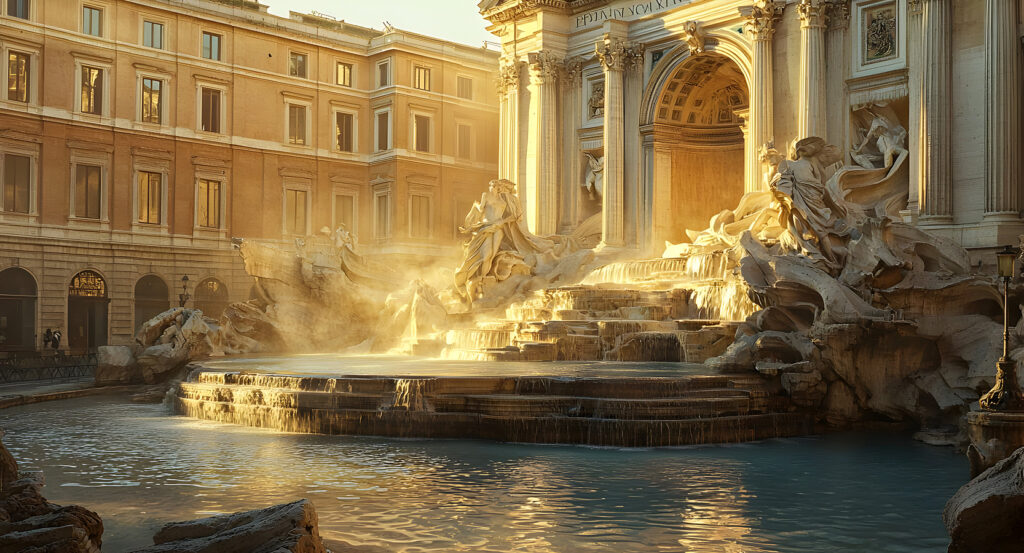
Why you should experience Oceanus at Trevi Fountain in Rome, Italy.
At the heart of the Trevi Fountain, the Oceanus statue reigns not as decoration but as dominion, a marble example of the sea's untamable will.
Carved by Pietro Bracci in the mid-18th century from Nicola Salvi's grand Baroque vision, Oceanus stands poised upon his shell chariot, muscles taut, beard curling like the waves he commands. Two Tritons guide the sea horses before him, one calm, one wild, representing the dual temper of water itself. The composition is thunderous and alive, marble somehow in motion. Water surges from beneath his feet, cascading over travertine cliffs into the crystalline pool below, its roar echoing against the palazzi that frame the square. Yet amid the chaos, Oceanus himself remains serene, eyes fixed forward, gesture restrained, the personification of mastery over nature's chaos. To stand before him is to feel both the awe of creation and the quiet surrender it demands. Rome has many fountains, but only here does water feel like theater, and the god commanding it a leading man.
What you should know about Oceanus at Trevi Fountain.
What most travelers don't realize is that Oceanus, though sculpted in the image of a Greek titan, captures a profoundly Roman idea, the triumph of human order over elemental force.
The Trevi Fountain was designed not just to honor water, but to celebrate the engineering genius that carried it. Fed by the Aqua Virgo aqueduct, first built by Agrippa in 19 BCE, its waters have flowed unbroken for over two millennia. Bracci's Oceanus doesn't merely rule the sea; he tames it, harnessing chaos into performance. Every detail was orchestrated for allegory, the abundance spilling from urns, the flora carved in relief, the rhythmic contrast of rough rock and smooth marble. Even the acoustics were engineered so that the fountain's roar would drown the city's din, forcing attention, commanding reverence. Standing before Oceanus, you sense Rome's eternal confidence: the belief that beauty is a form of control, that the divine can be shaped by hand. He is not Poseidon's twin, but civilization's mirror, the god of dominion disguised as serenity.
How to fold Oceanus at Trevi Fountain into your trip.
To fold the Oceanus statue into your Roman itinerary, arrive not at noon's chaos but in the pale hush of morning or the hush before midnight.
Approach from Via delle Muratte so the fountain reveals itself all at once, a sudden explosion of marble and sound. Stand slightly left of center to see how Oceanus aligns with the Palazzo Poli's façade, framed perfectly by Corinthian columns and cascading water. Watch the light change: in morning, it softens his features; at dusk, it carves them into myth. Toss a coin into the basin, right hand over left shoulder, not for superstition but as a ritual of return, joining centuries of travelers in silent pact. Then linger. Let the cool mist settle on your skin, listen to the rhythm of water against stone, and understand that Oceanus still rules, not through thunder, but through persistence. In a city of ruins, he remains Rome's most eloquent illusion, eternity made liquid.
Where your story begins.
Foresyte Travel reveals places that feel extraordinary long before you arrive.
Experience premium editorial crafted for luxury travelers.




















































































































