
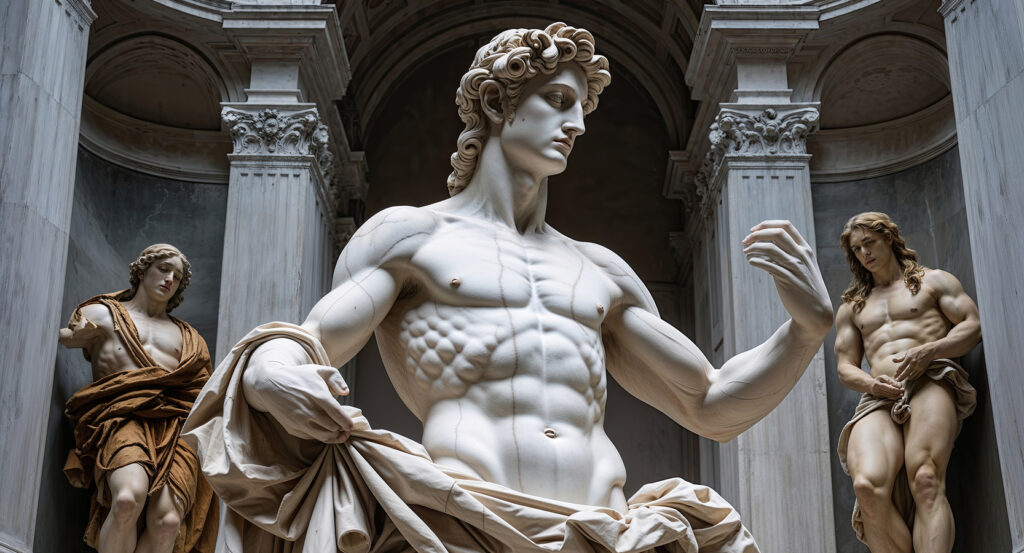
Why you should experience Gipsoteca Bartolini in Florence, Italy.
Gipsoteca Bartolini at Galleria dell'Accademia di Firenze in Florence is among the city's most quietly unique spaces, a luminous hall filled not with finished marble, but with the fragile poetry of creation itself.
Bathed in natural light, the room holds hundreds of plaster casts, models, and sculptural studies, ghostly white forms that reveal the process behind perfection. Here, the genius of the sculptor Lorenzo Bartolini (1777-1850) and his student Luigi Pampaloni comes alive through an extraordinary collection of preparatory works that once trained generations of Florentine artists. Unlike the polished marble of Michelangelo's David, the sculptures in Gipsoteca preserve every tool mark, every fingerprint, every hesitation of the hand. The space hums with intimacy, as if you've stepped into the sculptor's mind, surrounded by the thoughts he never stopped refining. The effect is both ethereal and deeply human: an archive of artistic vulnerability, where impermanence becomes its own kind of beauty.
What you should know about Gipsoteca Bartolini.
Gipsoteca Bartolini was once a teaching studio, later transformed into one of the most illuminating exhibitions of artistic process in Europe.
When the Grand Duke of Tuscany established the Accademia di Belle Arti, Bartolini, already one of the most acclaimed sculptors of his time, was appointed professor of sculpture. His approach revolutionized the academic style: rather than rigidly idealizing the human form, he urged students to study nature directly, to capture truth before beauty. The plaster casts that fill this hall were his teaching tools, anatomical studies, portrait maquettes, and life-size models created from live observation. Many of them are cast from clay originals that no longer exist, making the collection invaluable for art historians. After Bartolini's death, Gipsoteca was preserved as a tribute to his vision of realism and empathy, a bridge between the classical tradition and modern sensibility. The delicate white patina of the plasters, often mistaken for marble, conceals their fragility; each is a record of touch, of motion, of an artist's discussion with form. Even the display itself, under the gallery's diffused light, recreates the serenity of a working atelier.
How to fold Gipsoteca Bartolini into your trip.
Visiting Gipsoteca Bartolini offers a moment of calm reflection amid the grandeur of the Accademia Gallery, a space where you can feel the heartbeat of artistic creation.
After admiring Michelangelo's David and the Prisoners, make your way to the rear section of the museum, where the light changes and the noise fades. Step into the hall and let your eyes adjust to the uniform whiteness, the effect is almost dreamlike. Walk slowly among the rows of figures, from busts and mythological scenes to studies of everyday people, each frozen mid-thought. Notice how the surfaces differ: some smooth as silk, others rough with the immediacy of life. Pause at Bartolini's Faith in God and The Nymph and the Scorpion, two of his most expressive works, and imagine how these fragile plasters once guided the chisel through marble. Visit in late morning, when sunlight filters through the clerestory windows, casting soft shadows that seem to animate the forms. Before you leave, take one last look around, the room feels almost alive, a quiet chorus of uncompleted masterpieces whispering the language of the hand. Gipsoteca Bartolini at Galleria dell'Accademia di Firenze in Florence isn't just an exhibit; it's an immersion into the artist's soul, a place where imperfection is not flaw, but revelation.
Where your story begins.
Foresyte Travel reveals places that feel extraordinary long before you arrive.
Experience premium editorial crafted for luxury travelers.




















































































































