Why Adams Street matters.
Adams Street is an enterprising corridor where Chicago Loop's commercial ambition, architectural innovation, civic history, and financial legacy converge along one of downtown's defining east-west thoroughfares.
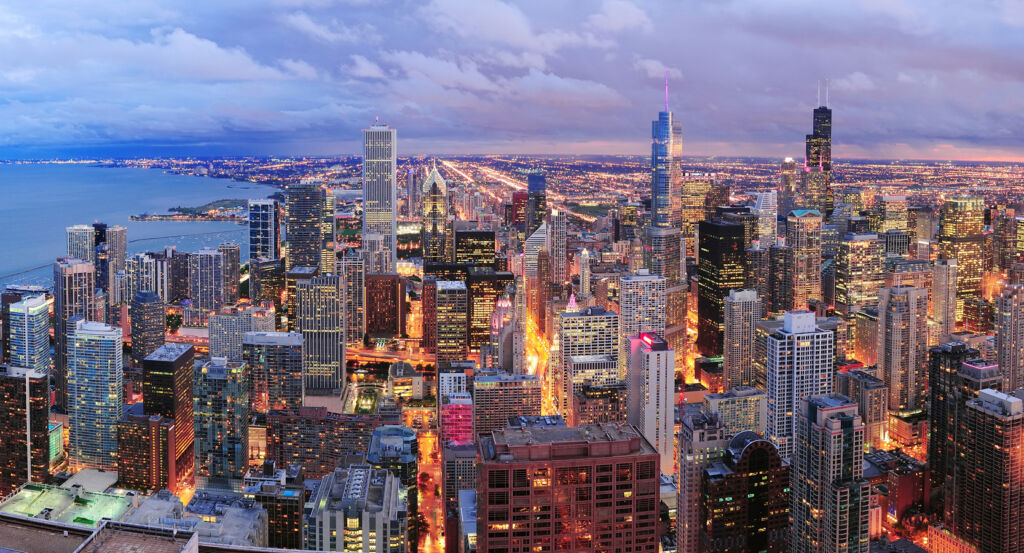
Running through the Chicago Loop between the Kennedy Expressway and Grant Park, Adams Street carries the city through expansive office towers, celebrated architectural landmarks, historic hotels, civic institutions, and generations of commercial enterprise that collectively trace Chicago's rise as a global metropolis. Every block builds a richer urban composition as Beaux-Arts façades, early skyscrapers, modern high-rises, elevated railway structures, and energetic public spaces reveal more than a century of architectural and engineering evolution. The corridor reaches its defining character where landmark buildings, civic institutions, and the constant movement of downtown life combine into one of Chicago's most complete expressions of urban ambition. The result is a corridor defined by architectural distinction, commercial influence, and the remarkable concentration of history that continues shaping the heart of Chicago.
What defines Adams Street.
Adams Street is best known for forming one of the principal east-west streets established in the 1830 Plan of Chicago, becoming a central artery in the city's original street grid before emerging as a cornerstone of the Loop following the Great Chicago Fire of 1871. Construction of the Chicago Board of Trade Building in 1930, designed by Holabird & Root with its iconic Ceres sculpture by John H. Storrs, established one of the world's most recognizable Art Deco skyscrapers overlooking the corridor. The avenue also became home to nationally significant architecture including The Rookery Building, completed in 1888 by Burnham & Root and transformed in 1905 by Frank Lloyd Wright, while nearby Union Station, opened in 1925 by Graham, Anderson, Probst & White, cemented Adams Street as one of America's foremost transportation corridors. Completion of the Congress Line, today's CTA Blue Line, beneath nearby Congress Parkway during the 1950s, continued investment by the Chicago Department of Transportation, and ongoing streetscape modernization reinforced Adams Street's role as one of Downtown's defining commercial corridors. Together, early city planning, world-renowned architecture, transportation infrastructure, engineering achievement, and financial institutions established Adams Street among the most historically significant streets in Chicago.
The corridor became closely associated with Chicago's emergence as an international financial center through the expansion of commodity exchanges, corporate headquarters, banking institutions, and legal offices that concentrated around LaSalle Street and Adams Street throughout the twentieth century. Landmark preservation protected celebrated masonry, expansive lobbies, decorative terra cotta, bronze detailing, ornamental stonework, and engineering innovations that continue distinguishing many of the avenue's historic commercial buildings. Collaborative stewardship by the Chicago Loop Alliance, the Commission on Chicago Landmarks, the Chicago Department of Planning and Development, and the Chicago Department of Transportation has supported façade restoration, accessibility improvements, streetscape enhancements, and public realm investment while preserving the corridor's historic identity. Together, financial leadership, architectural preservation, coordinated planning, and sustained civic investment explain why Adams Street remains one of the defining commercial corridors in the American Midwest.
How Adams Street fits.
Adams Street works as an exploration of Chicago's architectural heritage, commercial history, and civic identity.
Begin at The Rookery Building, where pioneering skyscraper engineering and Frank Lloyd Wright's celebrated interior renovation introduce the architectural innovation that transformed Downtown before naturally leading farther east. Continue to Chicago Board of Trade Building, whose expansive Art Deco design and enduring role in global commodities trading deepen appreciation for the city's financial influence before carrying the experience toward its conclusion. Conclude at Buckingham Fountain, where one of Chicago's grandest civic landscapes provides a sweeping finale overlooking Grant Park and the skyline, illustrating how Adams Street ultimately connects the city's commercial core with its most celebrated public spaces. The progression moves naturally from architectural innovation to financial history before culminating in one of Chicago's defining civic landscapes.
Where your story begins.
Foresyte Travel reveals places that feel extraordinary long before you arrive.
Enjoy editorial crafted for luxury travelers.
Foresyte may earn a commission when you book.