
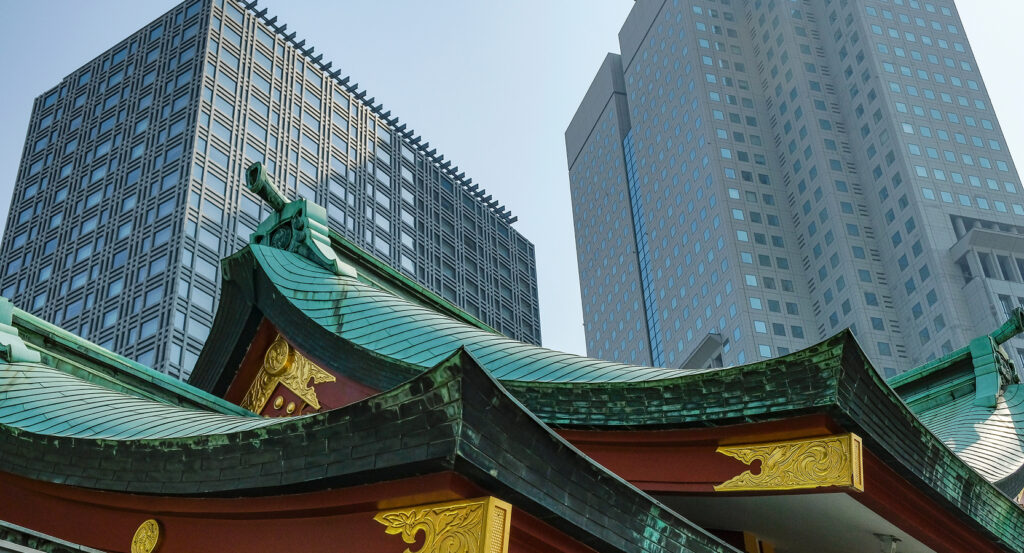
Why Hikawa Shrine matters.
Hikawa Shrine is a secluded Shinto sanctuary where Akasaka's historic hillside character meets Tokugawa patronage, surviving Edo architecture and a sacred grove that has endured at the center of Tokyo since the eighteenth century.
Set along Hikawazaka near Roppongi-dori and just steps from the residential lanes of Akasaka 6-chome, the shrine occupies wooded ground rising above the dense commercial districts surrounding Akasaka and Roppongi. A stone approach passes beneath mature trees toward the copper-roofed sanctuary, with torii, lanterns and guardian figures creating successive thresholds across the precinct. Seven pairs of komainu stand throughout the grounds, including a pair dating to 1675 that ranks as the oldest surviving stone shrine guardians in Tokyo. A great ginkgo with a trunk circumference near 7.5 meters preserves another layer of age, its fire-scarred trunk surviving the 1945 Tokyo air raids beneath a canopy that still fills the precinct. The result is a rare concentration of early modern architecture, sculpture and mature woodland whose survival makes the historical depth of Akasaka physically immediate.
What defines Hikawa Shrine.
Hikawa Shrine is best known for preserving the sanctuary commissioned by Tokugawa Yoshimune in 1730, joining a religious foundation dating to 951 with one of Akasaka's strongest surviving concentrations of Edo-period architecture. Buddhist priest Renrin established the shrine after receiving a divine message during a night in Hitotsugi Village, and a severe drought in 1066 strengthened its local importance when villagers gathered there to pray for rain. The sanctuary enshrines Susanoo no Mikoto, Kushiinada Hime no Mikoto and Oonamudi no Mikoto, linking the shrine with divine traditions surrounding agriculture, nation building and the marriage of Susanoo and Kushiinada. Tokugawa patronage intensified after Yoshimune became the eighth shogun in 1716 and drew the shrine into the political geography surrounding the family's Akasaka residence. Yoshimune ordered a new sanctuary on its present ground, which had previously formed part of the Asano clan's Miyoshi Domain residence, and the shrine was transferred from Hitotsugi on April 26, 1730. The shogun visited two days later, establishing a direct relationship between the new precinct and the highest level of Tokugawa government. The sanctuary subsequently survived the Ansei Great Earthquake of 1855, the Great Kanto Earthquake of 1923 and the Tokyo air raids of 1945, preserving the structure erected under Yoshimune across disasters that erased large portions of historic Tokyo. Tokyo designated the main sanctuary a Tangible Cultural Property in 1976, protecting an eighteenth-century building whose continued presence gives Akasaka an architectural connection with the shogunate that commissioned it.
Akasaka Hikawa Matsuri extends that Edo inheritance through a festival culture built around wheeled dashi and neighborhood mikoshi. Shogunal patronage gave the festival unusual stature during the eighteenth century, and its floats developed mechanical upper sections capable of rising to substantial height before descending to negotiate gates and restricted passages. Nine Edo-style floats survive in Akasaka, an exceptional remnant of a form once far more prevalent across the city. Their public presence diminished during the twentieth century before the Akasaka Hikawa Float Preservation Society formed in 2006 and began restoring the surviving structures for renewed processions. Floats returned to the streets in the following years, and a 2016 procession united them with the shrine mikoshi for the first time in close to a century. Traditional hayashi ensembles accompany the moving structures with flutes and taiko, reconnecting mechanical float design, neighborhood participation and musical performance within the streets surrounding the shrine. The revived festival gives Hikawa Shrine a second form of preservation beyond its sanctuary, carrying Akasaka's Edo ceremonial culture back through the district as a functioning community tradition.
How Hikawa Shrine fits.
Hikawa Shrine works as the anchor for an Akasaka route through three nearby sites that move from the final decades of Tokugawa government through the personal world of a Meiji military figure and into the political violence that reshaped Japan during the 1930s.
Begin at Site of the Residence of Katsu Kaishu, where Katsu lived from 1859 until 1868 during the years when the Tokugawa government confronted foreign diplomacy, naval modernization and its eventual collapse. Katsu crossed the Pacific aboard Kanrin Maru in 1860 in connection with Japan's mission to exchange ratifications of the Treaty of Amity and Commerce with the United States, then advanced to naval magistrate in 1862; that November, Sakamoto Ryoma arrived at this Akasaka residence intending to confront him and emerged as his disciple after hearing Katsu's arguments for naval development. Katsu was still living here when negotiations with Saigo Takamori produced the bloodless surrender of Edo Castle in March 1868, making this small Akasaka site part of the political transition from shogunate to imperial government. Continue to Kyunogitei (The Former Nogi Residence), the restrained house associated with General Nogi Maresuke and his wife Shizuko during the late Meiji period. Nogi had served in the First Sino-Japanese and Russo-Japanese wars, governed Taiwan and directed Gakushuin, where his educational responsibilities included the future Emperor Showa; on September 13, 1912, the day of Emperor Meiji's funeral, Nogi and Shizuko died at the residence. The neighboring slope, previously called Yureizaka, was renamed Nogizaka in connection with Nogi's funeral, permanently attaching his name to the surrounding district. Conclude at Takahashi Korekiyo Memorial Park, occupying the former residence of prime minister and finance minister Takahashi Korekiyo. Takahashi rose through the Bank of Japan and national government before conflict over military spending placed him against younger army officers, and audaciouss assassinated him at this residence during the February 26 Incident of 1936. His memorial association donated the property to Tokyo, which opened it as a park in 1941; the bronze statue removed during World War II returned in 1955, leaving the former residential ground as a memorial to a statesman whose death became one of the defining episodes of prewar political instability. The progression moves from Site of the Residence of Katsu Kaishu and the dissolution of Tokugawa government through Kyunogitei (The Former Nogi Residence) and the political culture of the Meiji state into Takahashi Korekiyo Memorial Park and the military revolt of 1936, carrying Hikawa Shrine through an Akasaka landscape deeply connected with successive turning points in modern Japanese government.
Where your story begins.
Foresyte Travel reveals places that feel extraordinary long before you arrive.
Enjoy editorial crafted for luxury travelers.
Foresyte may earn a commission when you book.

















































































































