
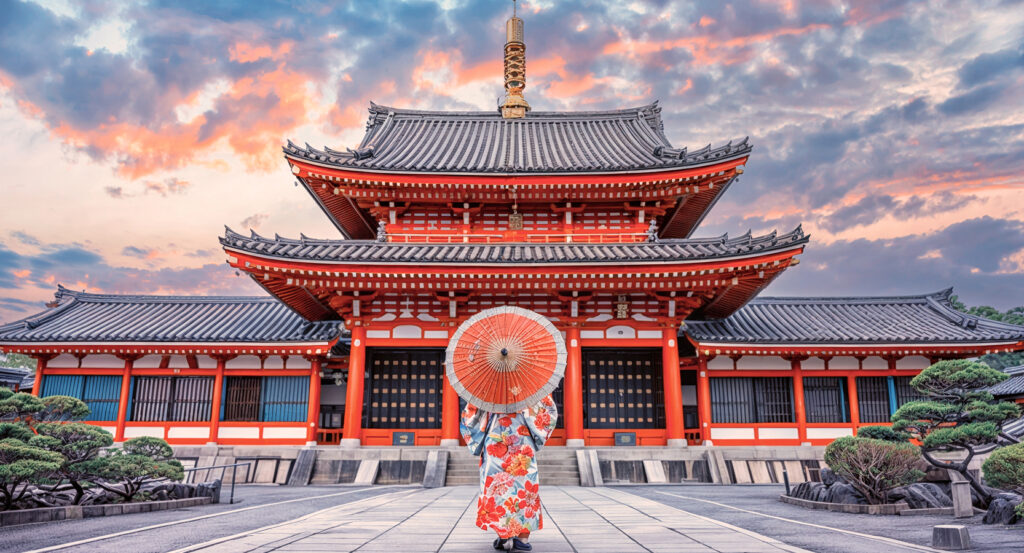
Why Asakusa Shrine matters.
Asakusa Shrine is an enduring Shinto sanctuary where Asakusa's shitamachi character meets the foundational legend of the district, preserved Edo architecture and a religious tradition inseparable from the community that grew around Sensō-ji.
Set along the eastern edge of the Sensō-ji precinct near Niten-mon Gate and just steps from the temple's main hall, the shrine occupies a compact sacred enclosure removed from the strongest pedestrian current crossing the neighboring Buddhist complex. A stone approach passes beneath a restrained torii before opening toward an intensely colored sanctuary of carved timber, lacquered surfaces and gilded ornament beneath deep tiled eaves. The worship sequence concentrates attention on a low architectural composition of connected halls, with painted phoenixes, kirin and other auspicious creatures distributed across the historic fabric. An enju tree growing within the precinct carries a direct ritual association with the shrine's foundational tradition, extending the sacred landscape beyond the principal sanctuary into the living vegetation around it. The result is an intimate encounter with Asakusa's religious depth, where architecture, worship and local memory remain embedded beside the far larger Buddhist precinct that shaped the surrounding district.
What defines Asakusa Shrine.
Asakusa Shrine is best known for enshrining Hamanari Hinokuma, Takenari Hinokuma and Hajino Nakatomo, the three figures whose legend connects the shrine directly to the origin of Sensō-ji and the emergence of Asakusa as a religious center. Shrine tradition places the initiating event in 628, when the Hinokuma brothers drew a statue of Kannon from the waters of the Sumida River during a morning of fishing and brought it ashore near present-day Komagata. Hajino Nakatomo recognized the figure as Shō Kannon, subsequently took Buddhist vows and converted his home into a temple where the image was enshrined. A later descendant of Hajino received a revelation directing that the three men be worshipped as local deities beside the Kannon hall, leading to the creation of Sanja Gongen Shrine during the period when gongen belief linked Buddhist divinities with manifestations of kami. The exact foundation date remains unresolved, though the shrine places its emergence after the late Heian period and around the beginning of the Kamakura period, when that religious synthesis had become established. The surviving sanctuary belongs to a much later architectural chapter: Tokugawa Iemitsu commissioned and donated the present complex in 1649, joining the honden, heiden and haiden in the gongen-zukuri configuration also associated with Nikkō Tōshō-gū. It escaped successive fires, the Great Kantō Earthquake and wartime destruction, and the national government designated the building an Important Cultural Property in 1951. A major conservation campaign in 1996 renewed deteriorated lacquer and polychrome decoration at a cost of ¥350 million, preserving the architectural work through which the Tokugawa shogunate gave permanent form to a cult rooted in Asakusa's much earlier foundation tradition.
The Meiji separation of Shinto and Buddhism transformed the institution without severing the ritual connections that had bound the shrine to Sensō-ji for centuries. The shrine became Sanja Myōjin Shrine in the first year of Meiji, received village-shrine status four years later and adopted the name Asakusa Shrine in the following year as the tutelary shrine of the wider Asakusa community. Earlier practice had treated its principal festival and the neighboring temple as a unified religious world: the mikoshi entered Sensō-ji's outer sanctuary on the eve of the celebration, and the festival was known as Kannon Matsuri or Asakusa Matsuri. A boat procession tied to the shrine's origin tradition began in 1312, establishing a ceremonial relationship with the river from which the Kannon image had emerged. The modern Honzon Jigen-e reconnects these traditions each March, when three shrine mikoshi are raised into Sensō-ji's main hall and Buddhist clergy recite sutras alongside Shinto priests offering norito before the portable shrines return to Asakusa Shrine. The ceremony was revived in 2000 as part of a reconstruction of the older boat procession, and its combination of Buddhist and Shinto rites deliberately restores part of the religious order fractured during the Meiji reforms. Asakusa Shrine preserves a rare living mechanism through which premodern shinbutsu practice remains legible inside a modern Shinto institution.
How Asakusa Shrine fits.
Asakusa Shrine works as the anchor for an Asakusa route through three nearby sites that move from a surviving nineteenth-century neighborhood shrine through the craft traditions generated by temple-town growth and into a literary institution rooted in the streets of Meiji Tokyo.
Begin at Hikan Inari Shrine, founded after Shinsuke Tatsugorō's gravely ill wife recovered following prayers to Fushimi Inari in Yamashiro; local residents responded by bringing a divided deity from the Kyoto shrine to Asakusa and establishing the small sanctuary in 1855. Tatsugorō donated its frontal torii, and the original cedar-bark-roofed structure survives beneath a protective shelter as a tiny example of ichikensha nagare-zukuri construction within the grounds administered as a subordinate shrine of Asakusa Shrine. Continue to Edo Taito Traditional Crafts Center, whose collections preserve the artisanal culture generated as shrines, temples, entertainment and urban expansion drew specialist makers into present-day Taito. The Great Fire of Meireki accelerated movement of artisans and merchants toward Asakusa and Ueno, and the later relocation of Yoshiwara, kabuki and ningyō jōruri theaters intensified demand for specialist production; the center opened as the Edo Shitamachi Traditional Crafts Museum in 1997 and relaunched under its present name in 2019. Its displays encompass 250 objects across 50 craft fields, connecting contemporary makers with disciplines including Edo sashimono, lacquerware and carved wood. Conclude at Ichiyo Memorial Museum, which opened in 1961 in Ryūsen to preserve the work of Higuchi Ichiyō, whose residence in the area placed her close to Yoshiwara and supplied the social setting for Takekurabe. The collection brings together handwritten poetry, correspondence, drafts and an unfinished manuscript of Takekurabe with representations of the neighborhood she knew, grounding one of Meiji literature's major careers in the physical world north of Asakusa. The progression moves from Hikan Inari Shrine's surviving neighborhood devotion through Edo Taito Traditional Crafts Center's preservation of the artisan economy fostered by temples and entertainment into Ichiyo Memorial Museum's literary reconstruction of Meiji-period Ryūsen, extending Asakusa Shrine into the religious, productive and literary history of the surrounding shitamachi.
Where your story begins.
Foresyte Travel reveals places that feel extraordinary long before you arrive.
Enjoy editorial crafted for luxury travelers.
Foresyte may earn a commission when you book.

















































































































