
Why Sensō-ji matters.
Sensō-ji is a foundational Buddhist temple where Asakusa's temple-town character meets more than thirteen centuries of Kannon devotion, grand sacred architecture and the popular culture that grew around Tokyo's oldest temple.
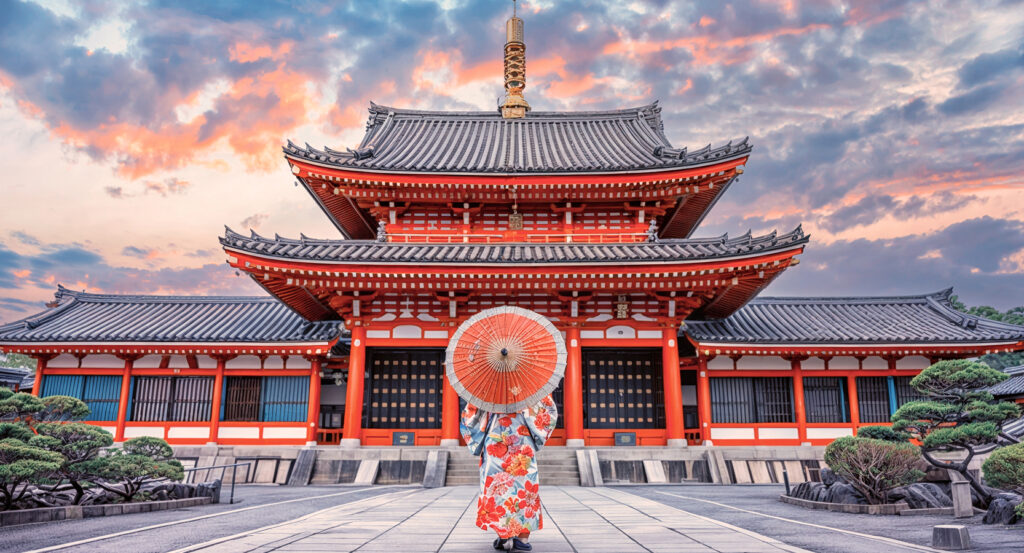
Set along Nakamise-dori near Kaminarimon-dori and just steps from the Sumida River, the expansive precinct unfolds along a ceremonial axis that carries the city through Kaminarimon, a long corridor of shops and Hozomon before reaching the Main Hall. Vermilion gates, deep tiled roofs and the Five-Storied Pagoda establish an architectural scale that repeatedly opens into broad courts, with incense smoke and the movement of worshippers animating the spaces between them. Approaching the Main Hall brings the immense roof progressively into view before a broad stair rises toward the outer sanctuary, where the transition from open precinct to devotional interior occurs beneath painted ceilings and hanging lanterns. Smaller halls, stone monuments, garden walls and surviving historic structures spread away from this central axis, allowing the temple to shift from immense public spaces into quieter pockets within only a few minutes of walking. The result is a religious complex whose physical sequence makes thirteen centuries of accumulated devotion legible through movement, carrying Asakusa from the commercial energy of its approach into the sacred center from which the surrounding district developed.
What defines Sensō-ji.
Sensō-ji is best known for tracing its origin to March 18, 628, when brothers Hinokuma Hamanari and Takenari pulled a statue of Sho Kannon from the Sumida River and brought it to local leader Haji no Nakatomo. Nakatomo recognized the figure as Avalokitesvara Bodhisattva and converted his house into a place of worship, establishing the devotional nucleus from which the temple developed. Priest Shokai constructed a Kannon hall in 645 and, following a dream revelation, concealed the principal image inside a miniature shrine, beginning the hibutsu tradition under which it has remained hidden. Ennin, third head priest of Enryaku-ji and one of the major figures of Japanese Tendai Buddhism, arrived in 857 and carved the maedachi image placed before the concealed Kannon. Taira no Kinmasa expanded the institution dramatically in 942 after receiving appointment as governor of Musashi Province, reconstructing a major complex and donating extensive agricultural land. Minamoto no Yoshiie prayed at Sensō-ji during his northern campaigns in 1070, and later Kamakura shoguns extended military patronage as Asakusa grew into a commercial settlement connected with river traffic. Tokugawa Ieyasu transformed that relationship after entering Edo in 1590 by designating Sensō-ji a prayer temple of the Tokugawa government. Successive shoguns maintained the association, and Tokugawa Iemitsu financed the seventeenth-century rebuilding campaign that produced a Five-Storied Pagoda in 1648 and Main Hall and Niomon in 1649. These interventions placed shogunal authority behind a cult whose beginnings lay with fishermen and a village headman, allowing Sensō-ji to become simultaneously an elite object of patronage and one of Edo's great centers of popular Kannon devotion.
Asakusa's rise as an entertainment center developed directly around the religious crowds drawn to the temple, creating a second history in which pilgrimage helped generate one of Japan's most important districts of popular culture. The Okuyama area within the precinct became known for performers, temporary entertainments and commercial attractions, and flower gardens devoted to peonies and chrysanthemums expanded this recreational world during the late Edo period. Government reorganization converted the temple precinct into Asakusa Park in 1873, followed in 1884 by division into seven sections that formalized entertainment alongside the sacred core. Hanayashiki grew from a flower garden established during this period, and Ryounkaku later raised a twelve-storey observation tower above the district as Meiji-era Asakusa embraced new forms of metropolitan amusement. The 1923 Great Kanto Earthquake destroyed Ryounkaku, yet Section Six subsequently revived as a major concentration of theaters and cinemas that helped sustain Asakusa's importance in Japanese popular entertainment. The March 10, 1945 air raid brought another rupture, destroying the Tokugawa Main Hall, Niomon, Five-Storied Pagoda and sutra repository even as Demboin, Niten-mon and several other structures survived. Donations from worshippers funded reconstruction of the Main Hall in 1958, Konosuke Matsushita financed Kaminarimon in 1960, Yonetaro Otani financed Hozomon in 1964 and nationwide contributions supported completion of the Five-Storied Pagoda in 1973. Sensō-ji emerged from postwar reconstruction with its devotional axis restored, carrying forward a historical mechanism in which religious pilgrimage repeatedly generated commerce, entertainment and collective investment in the surrounding city.
How Sensō-ji fits.
Sensō-ji works as the anchor for an Asakusa route through three nearby sites that extend its history into Shinto worship, Edo-period commercial entertainment and the performing culture that made the surrounding district one of Tokyo's great popular stages.
Begin at Asakusa Shrine, where the three people at the center of Sensō-ji's foundational tradition became objects of worship themselves. Hinokuma Hamanari, Hinokuma Takenari and Haji no Nakatomo are enshrined there as the figures associated with recovering and first venerating the Kannon image, giving the shrine its familiar name Sanja, or Three Shrines. Tokugawa Iemitsu funded the present sanctuary in 1649 during the same broad campaign of shogunal patronage that reshaped Sensō-ji, and its connected honden, heiden and haiden form a gongen-zukuri composition now designated an Important Cultural Property. The building survived the 1945 air raid that destroyed much of the neighboring Buddhist complex, preserving seventeenth-century fabric beside reconstructed postwar halls. Its continuing Sanja Matsuri carries the relationship between shrine, temple and neighborhood into one of Asakusa's major annual communal events. Continue to Asakusa Hanayashiki, whose origins reveal how entertainment became embedded beside Sensō-ji long before amusement parks assumed their modern form. Gardener Rokusaburo Morita opened a botanical attraction in 1853, during the final years of the Tokugawa shogunate, on ground belonging to the temple's wider recreational district. Peonies and chrysanthemums initially defined the attraction, followed by animals, mechanical devices and new amusements as Meiji-era Asakusa absorbed technologies and spectacles from abroad. Its development paralleled the 1873 creation of Asakusa Park and the subsequent emergence of Okuyama and Section Six as concentrated entertainment zones filled with performers, theaters and commercial attractions. Hanayashiki survived those transformations and later became associated with compact mechanical rides, leaving its small site as a physical descendant of the pleasure culture that grew beside pilgrimage traffic. Conclude at Asakusa Engei Hall, where the district's long relationship with live popular performance survives through yose entertainment. The hall occupies Asakusa's former Section Six entertainment quarter, whose theaters and cinemas flourished after the Great Kanto Earthquake and produced generations of comedians, actors and variety performers. Its stage maintains the yose format through rakugo accompanied by forms including manzai, magic, mimicry and traditional comic performance, preserving an entertainment structure built around successive short acts and close contact between performer and audience. That tradition extends the cultural mechanism visible across Asakusa for centuries: immense religious crowds created sustained demand for diversion, performers gathered around the temple district, and permanent venues eventually inherited functions once supplied by street entertainers and temporary stages. The progression moves from Asakusa Shrine's deification of the people inside Sensō-ji's founding tradition through Hanayashiki's evolution from Edo flower garden to amusement ground into Asakusa Engei Hall's preservation of yose performance, tracing how worship, recreation and popular entertainment became inseparable forces in the development of Asakusa.
Where your story begins.
Foresyte Travel reveals places that feel extraordinary long before you arrive.
Enjoy editorial crafted for luxury travelers.
Foresyte may earn a commission when you book.

















































































































