
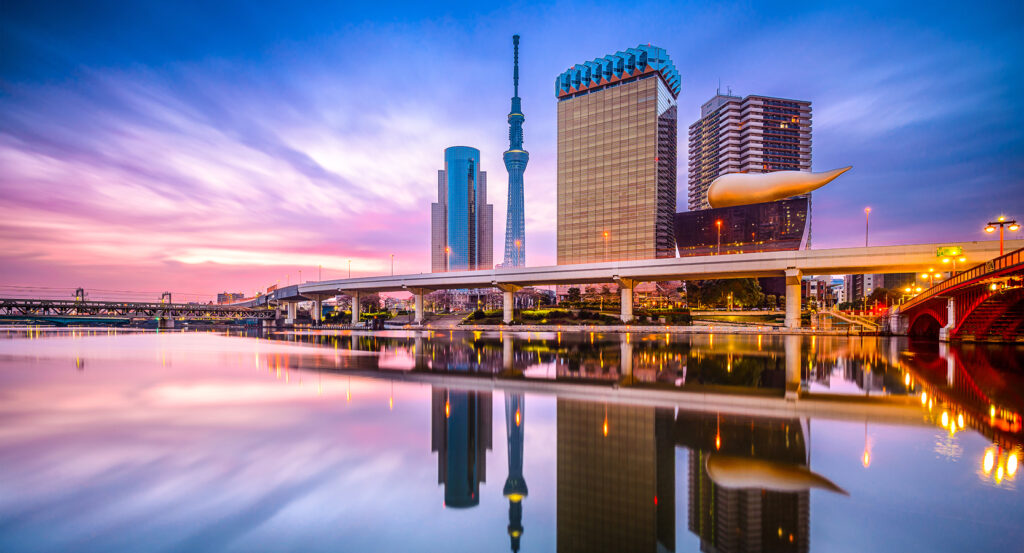
Why you should experience Azuma Bridge in Tokyo, Japan.
The Azuma Bridge, or Azumabashi Bridge, is one of Tokyo's most photogenic intersections, where the timeless flow of the Sumida River meets the dazzling skyline of modern Japan.
Painted in a striking vermilion hue that gleams under the sun and glows like molten gold at dusk, the bridge is both a passageway and a stage for the city's endless performance. Standing upon it, you feel suspended between worlds: the ancient rhythm of Asakusa's temples behind you and the futuristic silhouette of Tokyo Skytree rising ahead. Couples pause to take in the water's mirrorlike calm; cyclists glide by, their wheels whispering against the planks. In the evening, the air shimmers with city light, neon reflections ripple across the Sumida as boats pass beneath in slow procession. Visiting Azumabashi isn't just about crossing the river; it's about witnessing Tokyo's dual nature, reverent and restless, tranquil and electric, captured in a single gaze.
What you should know about Azuma Bridge.
What you may not realize is that Azumabashi's origins trace back over a century, making it one of Tokyo's most enduring arteries of connection.
The bridge was first constructed in 1774, when it served as a critical link between the merchant districts of Asakusa and Mukojima. Though destroyed multiple times by fire and war, each reconstruction told a story of resilience. The current steel design, completed in 1931, was revolutionary for its era, a symbol of Japan's modernization before World War II. Yet subtle details still pay homage to Edo-period craftsmanship: the decorative lamps shaped like cherry blossoms, the arched ironwork echoing the fluidity of the river below. Locals still call it “the people's bridge,” a reminder that it has always belonged to the city's pulse. If you look closely along the railing, you'll find bronze plaques depicting Sumida's storied past, tiny vignettes that turn a simple crossing into a walk through living history.
How to fold Azuma Bridge into your trip.
To fold Azumabashi Bridge into your journey, time your visit for early morning or twilight, when the river carries the city's softest light.
Start from Asakusa Station and walk toward the Skytree's reflection; the view from mid-bridge offers one of Tokyo's most cinematic perspectives. Pair your visit with a short detour to nearby Asahi Beer Hall, whose gleaming golden sculpture, the “Flamme d'Or”, adds an avant-garde flourish to your photos. Continue across into the quieter Sumida side, where riverside cafés serve coffee with uninterrupted views of the skyline. If you're lucky enough to visit during cherry blossom season, the bridge transforms into a corridor of pink petals, and the entire scene feels like Tokyo itself is pausing, just long enough for you to fall in love with it.
Where your story begins.
Foresyte Travel reveals places that feel extraordinary long before you arrive.
Experience premium editorial crafted for luxury travelers.

















































































































