Why Blue Bay Marcel Ravin matters.
Blue Bay Marcel Ravin is a two-MICHELIN-star restaurant where Larvotto's Mediterranean resort heritage meets Marcel Ravin's Martinican culinary roots, the technical foundations of French haute cuisine and a distinctive gastronomic relationship between Caribbean ingredients and the French Riviera.
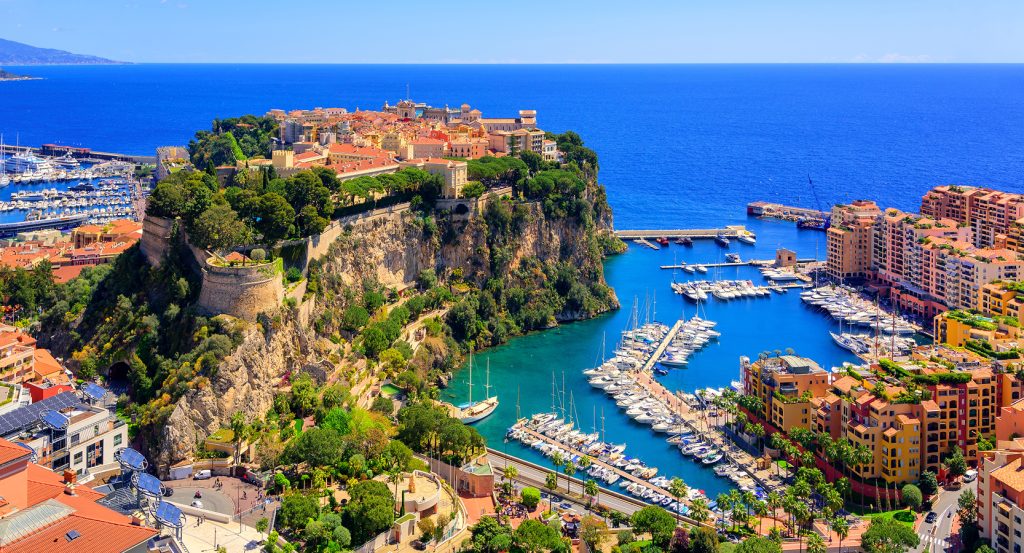
Occupying the seaward dining pavilion of Monte-Carlo Bay Hotel & Resort, the restaurant overlooks the Mediterranean from the eastern end of Monaco's Larvotto peninsula, near the Monte-Carlo Sporting complex and the coastal approaches to Roquebrune-Cap-Martin. Its principal dining room incorporates curved partitions, custom-designed circular tables, cream and tobacco-colored marble flooring, and a sculptural ceiling whose illuminated forms recall tropical foliage. Natural wood, copper-toned metal, textured plaster and botanical textiles establish a richly detailed interior, with a central pastry island introducing a distinctive architectural focal point. An adjoining private dining chamber incorporates an imposing carved oak table, shell-inspired wall coverings and sculptural furnishings, and the waterfront terrace extends the restaurant toward uninterrupted views of the Mediterranean. The result is an intimate gastronomic setting whose organic architectural forms, specialized dining spaces and exceptional coastal position establish a physical connection between Monaco's contemporary resort culture and the natural environments central to its chef's cooking.
What defines Blue Bay Marcel Ravin.
Blue Bay Marcel Ravin is best known for establishing Martinican chef Marcel Ravin as one of Monaco's leading gastronomic figures through a sustained culinary partnership with Monte-Carlo Société des Bains de Mer and an approach to French haute cuisine shaped by Caribbean food traditions. Ravin was born in Le Diamant, a coastal commune in southwestern Martinique, where his childhood introduced him to the agricultural ingredients, seafood and domestic cooking practices of the French Antilles. His grandmother Yvanesse became an important influence through preparations associated with the island's Creole culinary traditions, including calalou, blaff and dishes developed from ingredients cultivated around the family home. Ravin initially pursued vocational studies unrelated to professional cooking before completing a culinary qualification and leaving Martinique during his late teenage years. His first substantial experience in metropolitan France developed at Château d'Isenbourg in Rouffach, Alsace, where he encountered the organization and technical demands of luxury hotel kitchens. Subsequent positions across eastern France strengthened his command of classical preparations, professional kitchen management and the relationship between regional ingredients and established French cooking methods. He returned to the Caribbean during his twenties and assumed responsibility for the kitchen of a luxury hotel, developing an independent culinary approach grounded in the ingredients of his native island. His professional advancement continued through the MICHELIN-starred Bistroquet in the Nancy region, where chef Marie-France Ponsard contributed to his development within the traditions of French gastronomy. Ravin subsequently joined the kitchens of L'Arc-en-Ciel at Le Méridien Part-Dieu in Lyon, extending his experience in hotel-based fine dining and large-scale hospitality operations. His appointment as executive chef at Le Méridien Brussels established an important international leadership position, combining responsibility for a major hotel's culinary organization with the development of his own gastronomic repertoire. The experience prepared him for a substantial opportunity in Monaco, where Monte-Carlo Société des Bains de Mer was developing a new luxury resort on the principality's eastern waterfront. The Monte-Carlo Bay Hotel & Resort project formed part of the hospitality company's effort to expand its portfolio beyond the historic establishments surrounding Place du Casino, introducing a contemporary seaside destination with extensive leisure facilities. General manager Sergio Mangini recruited Ravin to direct the resort's culinary operations, establishing a professional relationship that would become central to the chef's subsequent career. Ravin joined the company in 2005 and assumed responsibility for Blue Bay as the hotel's signature gastronomic restaurant, developing a menu that combined the culinary foundations of his French training with ingredients and preparations associated with Martinique. The original concept introduced Caribbean aromatic herbs, tropical fruits, cassava, spices and traditional cooking references into the established gastronomic environment of Monte-Carlo. Ravin's approach gradually developed into a recognizable culinary style distinguished by the relationship between Mediterranean seafood, European agricultural products and the concentrated flavors of the French Antilles. His personal history became increasingly important to the restaurant's development, with childhood memories and family preparations providing the foundation for original gastronomic creations. In 2012, he published D'un rocher à l'autre, itinéraire d'un chef through Éditions de La Martinière, connecting his upbringing in Martinique to his professional development in Monaco. The title established a geographical relationship between the volcanic island of his childhood and the Mediterranean principality where he had developed his international reputation. Blue Bay received its first MICHELIN star in 2015, recognizing a decade of culinary development under Ravin's direction. The award established the restaurant among Monaco's principal gastronomic establishments and strengthened the international recognition of the chef's distinctive Caribbean-Mediterranean cooking. Ravin subsequently expanded his professional activities through additional restaurant projects, including Mada One in Monaco and Le Grand Réfectoire within Lyon's historic Grand Hôtel-Dieu. These establishments introduced different expressions of his culinary approach, extending its influence into more informal dining environments and additional French regional markets. The chef's long-term work at Blue Bay also developed through a growing commitment to seasonal agriculture and the cultivation of ingredients within the resort's grounds. Its organic vegetable garden became an important source of herbs, vegetables and edible plants, strengthening the relationship between the restaurant's culinary program and the surrounding Mediterranean environment. Ravin's cooking achieved another major distinction in March 2022, when the MICHELIN Guide awarded Blue Bay its second star. The recognition established him among the relatively small number of Caribbean-born chefs directing two-MICHELIN-star restaurants in Europe and strengthened the visibility of Martinican culinary traditions within international fine dining. The restaurant subsequently entered a period of substantial redevelopment intended to align its architectural environment more closely with the chef's established culinary direction. Ravin collaborated with interior designer Alexandra Saguet, founder of AS Interior Design, developing a decorative program centered on the five natural elements of water, earth, fire, metal and wood. The project required five months of construction and introduced a comprehensive transformation of the restaurant's dining spaces, furnishings and decorative details. Artist Solène Eloy contributed textured wall treatments recalling marine movement and natural surfaces, establishing a distinctive artistic component within the architectural program. Designer Peggy Desmeules developed bespoke presentation plates inspired by volcanic landscapes, coral formations and the meeting of land and sea, extending the restaurant's creative direction into its tableware. The renovation also introduced La Table de Marcel, an exclusive private dining arrangement accommodating eight guests around a substantial oak table. Its development established a specialized setting for direct interaction with Ravin and his culinary brigade through an extended sequence of individually prepared courses. The restaurant received admission to Les Grandes Tables du Monde in February 2024, strengthening its international institutional recognition immediately before the completion of the reconstruction. Prince Albert II attended the formal inauguration on February 10, 2024, alongside Monte-Carlo Société des Bains de Mer chairman and chief executive Stéphane Valeri and resort general manager Frédéric Darnet. The restaurant reopened to the public on February 14 under the expanded name Blue Bay Marcel Ravin, establishing the chef's personal authorship as a permanent component of its public designation. The renewed culinary program introduced additional Caribbean preparations, a dedicated vegan tasting menu and an expanded approach to nonalcoholic beverage pairings. Pastry chef Floriane Grand subsequently strengthened the restaurant's gastronomic reputation through desserts combining tropical fruit, aromatic plants, spices and contemporary French pastry techniques. Her work received the MICHELIN Passion Dessert distinction in March 2025, extending the restaurant's recognition beyond its principal savory culinary program. Blue Bay Marcel Ravin's historical significance emerges from the sustained development of a chef whose professional journey connected Martinican domestic cooking, French gastronomic training, international hotel leadership and the establishment of a distinctive Caribbean culinary presence within Monaco's luxury hospitality industry.
How Blue Bay Marcel Ravin fits.
Blue Bay Marcel Ravin works as the culminating dining destination for an exploration connecting Monaco's principal public beach, its contemporary cultural infrastructure and the architectural development of its eastern Mediterranean waterfront.
Begin at Larvotto Beach, the principality's principal public bathing destination and a substantial example of Monaco's twentieth-century coastal engineering. Its modern development accelerated under Prince Rainier III, whose land-reclamation program began in 1961 and expanded the available shoreline through the construction of new coastal infrastructure. A subsequent reconstruction in 1965 introduced imported sand and protective breakwaters, establishing sheltered swimming areas along the Mediterranean. The waterfront underwent another major transformation between 2019 and 2021, with Renzo Piano Building Workshop contributing to the design of a reconstructed promenade, contemporary public facilities and improved coastal protection. The redevelopment introduced extensive landscaped planting, accessible circulation routes and a continuous pedestrian environment connecting the beach to the surrounding residential district. Continue to Grimaldi Forum Monaco, the expansive convention and cultural center occupying reclaimed coastal land near the western end of the beach. Designed by architects Fabrice Notari and Fred Génin, the complex opened in 2000 as a major institution supporting international conferences, exhibitions and performing arts. Its architectural composition incorporates extensive glass façades, substantial underground exhibition spaces and a prominent coastal position overlooking the Mediterranean. The Salle des Princes auditorium accommodates more than 1,800 spectators, supporting concerts, theatrical productions and major international events. The institution's annual summer exhibition program has introduced major artistic collections and historical subjects to Monaco, strengthening the principality's position within the international cultural calendar. Conclude at Japanese Garden, the landscaped public garden developed under Prince Rainier III as a tribute to Princess Grace. Japanese landscape architect Yasuo Beppu designed the garden, which opened in 1994 and introduced a traditional Japanese landscape composition into Monaco's densely developed coastal environment. Its 7,000-square-meter site incorporates a pond, waterfall, stone lanterns, wooden bridges and carefully arranged vegetation. A traditional tea house and meticulously positioned rocks establish the garden's relationship with Japanese horticultural principles, connecting the symbolic qualities of water, stone and cultivated plants within a compact urban setting. The project incorporated consultation with Japanese specialists and a Shinto blessing ceremony, strengthening its connection to the cultural traditions underlying its design. The progression moves from Larvotto Beach's engineered public shoreline through Grimaldi Forum Monaco's contemporary cultural architecture and concludes at Japanese Garden's carefully composed horticultural landscape, establishing the geographical and cultural context for an evening at Blue Bay Marcel Ravin.
Where your story begins.
Foresyte Travel reveals places that feel extraordinary long before you arrive.
Enjoy editorial crafted for luxury travelers.