
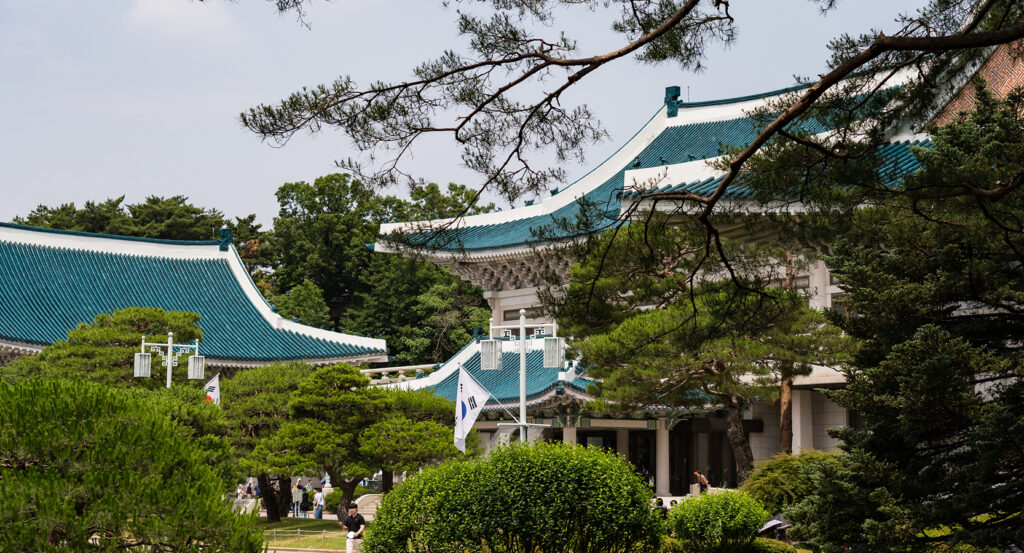
Why Blue House matters.
Blue House, or Cheong Wa Dae, is a symbol of South Korea's identity, a bridge between ancient tradition and modern leadership tucked against the serene backdrop of Bugaksan Mountain.
From its signature blue tiles glinting beneath the Seoul sun to the quiet dignity of its curved hanok-style roofs, Cheong Wa Dae radiates harmony and restraint. The approach alone feels ceremonial, a tree-lined avenue that opens into a sprawling complex framed by mountains and gardens, where history breathes in every stone. Once the nerve center of the nation's political life, Blue House now stands as a public cultural landmark, inviting visitors to walk through halls once closed to all but heads of state and dignitaries. The scent of pine and fresh grass lingers as you step through its courtyards; the air seems calmer here, almost reverent. It's a place where the past and present converse, where traditional architecture meets the echoes of modern governance, and where the heart of Seoul beats quietly beneath the shadow of the mountains. Cheong Wa Dae isn't merely beautiful; it's profound, a place that invites reflection on power, heritage, and the delicate balance between the two.
What defines Blue House.
Blue House's story stretches far beyond its gleaming tile roofs, it's a microcosm of Korea's political, spiritual, and architectural evolution.
The site itself has been sacred for centuries; during the Joseon Dynasty, it served as part of the royal gardens behind Gyeongbokgung Palace, chosen for its geomantic perfection, backed by protective mountains and facing a gentle river. This ideal balance of natural elements, known as pungsu-jiri (Korean feng shui), was believed to ensure prosperity and stability for the nation's leaders. In 1948, when the Republic of Korea was established, the site was transformed into the presidential residence, symbolizing both continuity and rebirth. Its signature blue tiles, 150,000 of them, individually baked and curved, became an instant emblem of the Korean state, representing peace, integrity, and the open sky. Over the decades, Blue House bore witness to seismic moments in history: democratic protests echoing through the streets below, diplomatic meetings that shaped global alliances, and periods of tension and renewal that tested the nation's spirit. Few realize how deliberately its design weaves together tradition and modernity, the buildings constructed in classical hanok form but equipped with state-of-the-art facilities, mirroring the dual character of Korea itself. When Blue House opened to the public in 2022, it marked a powerful turning point: a place once defined by exclusivity became a national park of shared memory. Today, its gardens, exhibition halls, and preserved offices tell a more human story, one not of politics, but of people, resilience, and rebirth.
How Blue House fits.
Visiting Blue House is more than a tour, it's an immersion into the narrative of a nation rediscovering its voice.
Start the journey at the main entrance off Sejong-ro, where security gates once closed to the public now open freely to welcome visitors. As you pass through, pause to take in the Blue Roofs shimmering against the green rise of Bugaksan, a view that has graced countless state photographs yet feels far more intimate in person. Walk slowly through the gardens first; cherry blossoms in spring, maples in autumn, and snow-dusted pines in winter make this a place of perpetual beauty. Inside the main compound, explore the Presidential Office and Reception Hall, where art and diplomacy once intertwined, gifts from global leaders, traditional screens depicting mountains and cranes, and calligraphy expressing virtues like harmony and righteousness. For deeper context, visit the newly established Cheong Wa Dae Museum, which chronicles the evolution of Korea's democracy through artifacts, photographs, and multimedia exhibits that give weight to the silent grandeur of the halls. Afterward, stroll through the surrounding grounds to glimpse the historic Chilgung Shrine and Gyeongbokgung Palace nearby, the former residence of kings, now standing in discussion with the home of presidents. The route between the two offers a moving perspective: Korea's journey from monarchy to modern republic traced across just a few hundred meters. For the perfect close, climb one of the nearby Bugaksan trails at golden hour and look back toward the complex, the blue rooftops glinting in the fading light, a quiet metaphor for endurance and renewal. Blue House doesn't just reflect Korea's leadership; it mirrors its soul, steadfast, adaptive, and ever luminous.
Where your story begins.
Foresyte Travel reveals places that feel extraordinary long before you arrive.
Enjoy editorial crafted for luxury travelers.
Foresyte may earn a commission when you book.

















































































































