Why Blue Lagoon matters.
Blue Lagoon Iceland is a geothermal bathing complex where Grindavík's volcanic landscape meets the industrial development of the Svartsengi geothermal field, the mineral chemistry of geothermal seawater and Iceland's emergence as an international center for geothermal bathing and skin research.
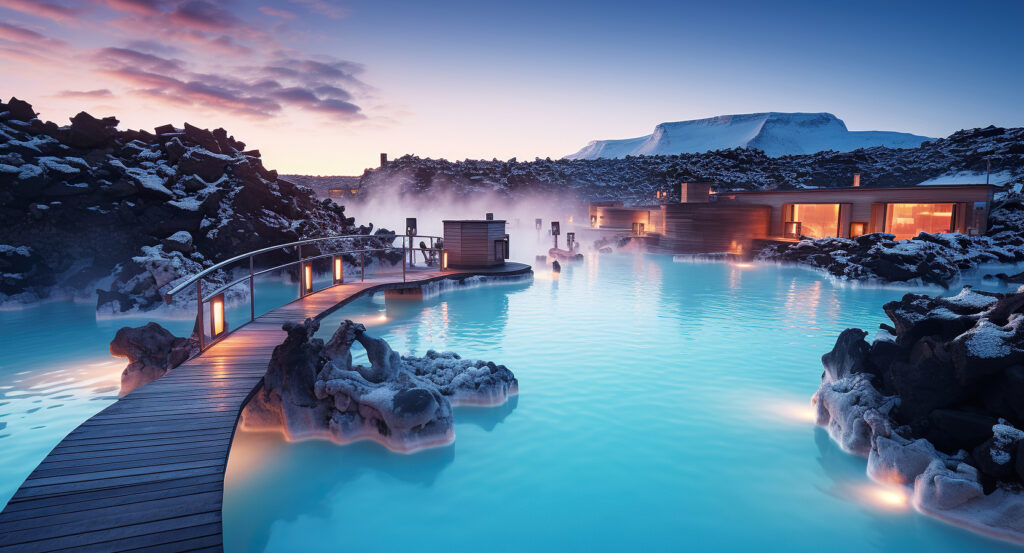
Set within the Illahraun lava field north of Grindavík on the Reykjanes Peninsula, the geothermal complex occupies a basin of milky-blue water surrounded by dark volcanic rock, where bathing pools, treatment facilities and low-profile buildings extend across terrain formed by historic lava eruptions. The main lagoon follows an irregular shoreline shaped by the surrounding lava formations. Silica deposits create pale surfaces along the water's edge, contrasting with the porous volcanic rock. Bridges, submerged seating areas and sheltered passages connect different sections of the bathing facilities. The result is a geothermal complex whose physical character derives from the relationship between volcanic geology, industrial water circulation and the mineral composition of its bathing pools.
What defines Blue Lagoon.
Blue Lagoon Iceland is best known for its silica-rich geothermal seawater, its origins beside the Svartsengi geothermal power station and its development into one of Iceland's principal bathing destinations. The Reykjanes Peninsula lies within an active volcanic zone associated with the Mid-Atlantic Ridge, where tectonic extension creates conditions favorable for geothermal circulation. Underground seawater enters fractured volcanic rock, absorbs heat and dissolves minerals before returning toward the surface. The Svartsengi geothermal power station began operating in 1976, supplying thermal energy to communities on the peninsula. Its geothermal operations produced mineral-rich water that accumulated in nearby lava formations. The resulting pools developed a distinctive pale-blue appearance associated with suspended silica particles. Local residents began bathing in the water during the early 1980s, establishing the recreational use of a basin originally connected with energy production. Valur Margeirsson, who suffered from psoriasis, became associated with early experimentation in bathing in the geothermal water. Interest in the water's effects on skin conditions encouraged scientific investigation into its chemical and biological properties. A formal bathing facility opened in 1987, marking the beginning of organized public access. The enterprise subsequently developed purpose-built facilities and a broader program of geothermal bathing and dermatological research. In 1992, Blue Lagoon Limited was established to oversee the commercial and scientific development of the operation. A larger bathing complex opened in 1999, moving the principal facilities into a purpose-designed setting within the surrounding lava field. Subsequent expansion introduced specialized treatment spaces, accommodation and research facilities associated with the geothermal water. Volcanic activity on the Reykjanes Peninsula beginning in 2023 brought renewed attention to the relationship between the complex and the region's active geological systems. Eruptions near Grindavík and Sundhnúkur prompted temporary closures and changes to access arrangements as authorities assessed volcanic hazards.
How Blue Lagoon fits.
Blue Lagoon Iceland works as the geothermal bathing centerpiece for a Reykjanes Peninsula outing connecting Iceland's volcanic activity, maritime history and the coastal landscapes surrounding Grindavík.
Begin at the Bridge Between Continents, a pedestrian bridge spanning a fissure within the Reykjanes volcanic zone. The structure crosses a small depression associated with the tectonic extension occurring along the Mid-Atlantic Ridge. Its setting introduces the geological forces responsible for the peninsula's volcanic activity and geothermal resources. Interpretive information explains the divergence of the North American and Eurasian tectonic plates and the resulting formation of faults and fissures. The surrounding terrain contains lava fields and exposed volcanic rock shaped by repeated geological activity. Continue to Reykjanes Lighthouse, the coastal lighthouse standing near the southwestern tip of the peninsula. The first lighthouse on the site was constructed in 1878, establishing an important navigation aid along Iceland's Atlantic approaches. The surviving structure dates from 1907 and occupies an elevated position above the surrounding coastline. Its white tower and red lantern distinguish the building against the dark volcanic terrain. The nearby coastal cliffs support seabird colonies, and the surrounding geothermal landscape contains steam vents and altered volcanic rock. The lighthouse preserves the relationship between maritime navigation and the exposed geological setting of southwestern Iceland. Conclude at Gunnuhver, the geothermal field situated near the Reykjanes coast. The area contains boiling mud pools, steam vents and mineral deposits produced by geothermal fluids rising through fractured volcanic rock. Its name derives from a local legend concerning a ghost named Gunna, connecting the geothermal landscape with Icelandic folklore. Boardwalks provide access to viewpoints overlooking the steaming ground and unstable geothermal features. The field's high-temperature activity exposes the geological processes operating beneath the Reykjanes Peninsula. The progression moves from tectonic plate separation through coastal navigation and culminates at an active geothermal field, connecting Blue Lagoon Iceland with the volcanic and maritime history of southwestern Iceland.
Where your story begins.
Foresyte Travel reveals places that feel extraordinary long before you arrive.
Enjoy editorial crafted for luxury travelers.