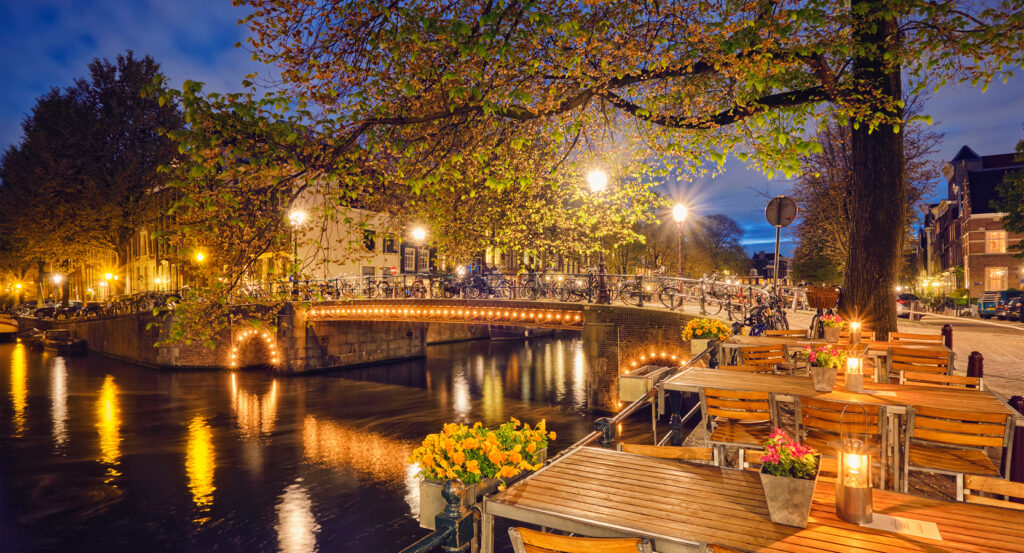
Why you should experience Bos en Lommer in Amsterdam, Netherlands.
Bos en Lommer is Amsterdam's neighborhood of reinvention, where postwar architecture, multicultural communities, emerging creative energy, and expansive green spaces have transformed a once-overlooked district into one of the city's most dynamic residential quarters.
Developed during Amsterdam's twentieth-century expansion, the neighborhood unfolds through broad avenues, canal-side pathways, neighborhood markets, community squares, contemporary cafés, and residential blocks that reflect both its historic foundations and ongoing evolution. Longtime residents share streets with young professionals, students, and entrepreneurs drawn to the area's accessibility and growing cultural scene. Along the border of neighboring De Baarsjes, canal-lined streets and local gathering places create a seamless transition between districts, while Bos en Lommer maintains a character shaped by diversity, affordability, and community life. Cyclists stream through leafy corridors connecting parks and plazas, and the neighborhood's blend of everyday authenticity and quiet momentum gives it a distinctly modern Amsterdam identity.
What you should know about Bos en Lommer.
Bos en Lommer is best known for being among the most prominent neighborhoods developed under Amsterdam's General Expansion Plan, the visionary urban planning structure that guided much of the city's twentieth-century growth.
Designed to address housing demand while improving quality of life, the district embodied modern planning principles that emphasized sunlight, green space, recreation, and organized residential development. Wide streets, generous public spaces, and carefully integrated community infrastructure reflected a belief that cities should be built around the needs of their residents. Over the decades, Bos en Lommer evolved into one of Amsterdam's most diverse neighborhoods, shaped by successive waves of migration that enriched its cultural and social fabric. Today, redevelopment projects, new businesses, and public investments continue to build upon that foundation while preserving the neighborhood's strong sense of community. Few districts provide such a clear illustration of how Amsterdam's planning ideals adapted to the realities of a changing city.
How to fold Bos en Lommer into your trip.
Bos en Lommer is an ideal centerpiece for a day spent exploring Amsterdam's evolving neighborhoods, parks, and local culture.
Begin the morning in Erasmuspark, where tree-lined pathways and open lawns provide a peaceful introduction to the district before leading naturally into the surrounding residential streets. From there, explore local cafés, independent businesses, and community gathering spaces that showcase the neighborhood's multicultural character before continuing toward nearby green spaces and cultural attractions. Westerpark, Erasmuspark, and De Hallen all sit within easy reach, creating a natural progression between outdoor recreation, neighborhood life, and one of Amsterdam's most celebrated creative hubs. As the afternoon unfolds, Bos en Lommer rewards curiosity with canal-side walks, hidden courtyards, and local businesses that reveal a side of Amsterdam often missed by visitors focused solely on the historic center. Bos en Lommer fits naturally into that spirit of discovery, serving as both a reflection of modern Amsterdam and a showcase of the city's ongoing evolution.
Where your story begins.
Foresyte Travel reveals places that feel extraordinary long before you arrive.
Experience premium editorial crafted for luxury travelers.