
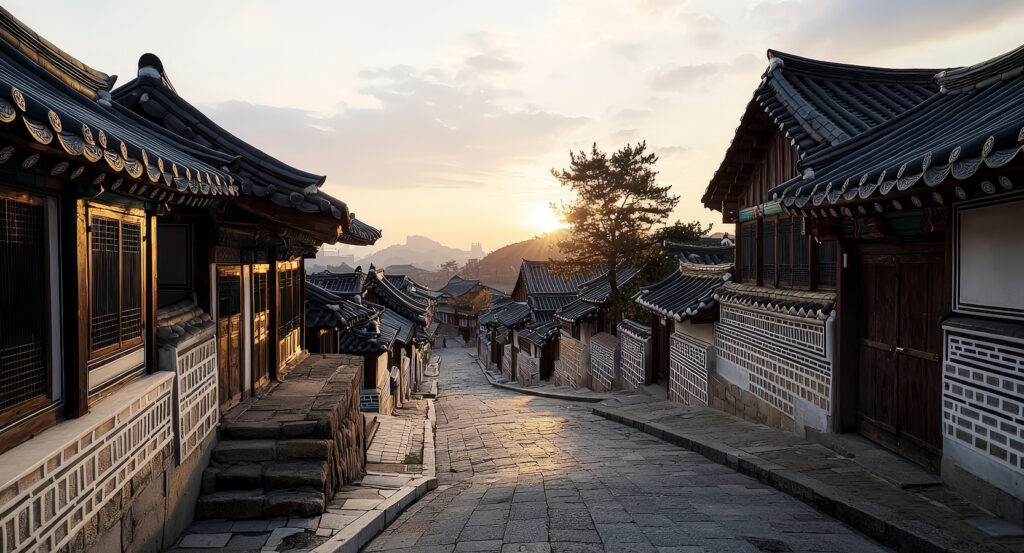
Why you should experience House of Baek Inje in Seoul, South Korea.
House of Baek Inje in Seoul is Bukchon's hidden jewel, a perfectly preserved window into the elegance, intellect, and discipline of Korea's modern awakening.
Tucked at the crest of a quiet hill, the residence radiates balance: clay-tiled roofs curved like waves, pine pillars polished by time, and latticed doors that filter daylight into calm geometry. Step inside, and the hush of the city dissolves. What you find instead is rhythm, the creak of polished floorboards, the slow rustle of wind through paper doors, the faint scent of cedar and earth. Each room reveals harmony between tradition and modernity: an ondol-heated sitting area for winter comfort, a Western-style drawing room for guests, and a study overlooking the courtyard where light falls just so. The house doesn't merely display history, it lives it. To walk its corridors is to trace the heartbeat of Seoul's transformation from a Confucian capital into a modern nation.
What you should know about House of Baek Inje.
Built in 1913, House of Baek Inje stands as one of the largest and most intact hanok residences in Bukchon, spanning over 2,400 square meters.
Its architecture represents a rare synthesis of late-Joseon tradition and early-20th-century modernization. Originally commissioned by Han Kyu-seol, a high-ranking official of the Korean Empire, it later became home to Baek In-je, a pioneering surgeon and founder of Baek Hospital, among Seoul's earliest private medical institutions. The residence mirrors its owner's dual identity: steeped in Confucian values yet open to Western influence. The home's traditional wooden structures, male and female quarters (sarangchae and anchae), are connected by wide verandas, but beyond the garden lies an addition with Western architectural touches: glass-paneled windows, a marble staircase, and imported furnishings that marked the birth of a new cultural era. During the Japanese occupation, the house became a refuge for intellectuals and patriots, and after liberation, it symbolized the endurance of Korea character amid rapid change. Few visitors realize that the structure also features an unusually advanced heating system, combining traditional ondol flues with modern chimney ventilation, decades ahead of its time. The entire residence was restored by the Seoul Metropolitan Government in 2009 using period-accurate materials, right down to the pigments of its dancheong trim. Today, it serves not merely as a museum but as a blueprint for how cultural heritage can survive industrialization.
How to fold House of Baek Inje into your trip.
House of Baek Inje works as a pause, a deliberate slowing of pace amid Bukchon's winding hills.
Visit in the early morning or late afternoon when the light slips across the wooden floors and paints the courtyards in honey-colored warmth. Begin in the outer garden, where pines cast long shadows over stone lanterns, and then step through the threshold of the sarangchae, the men's quarters, once used for receiving guests and conducting business. From there, move through the connecting hallway to the anchae, the women's quarters, where family life unfolded in quiet dignity. Pause at the small study overlooking the pond; it's one of the most peaceful vantage points in Bukchon. Take time to notice the subtle details, the slope of the tiled roofs designed to direct rainfall into the courtyard basin, the alignment of doors that frame distant mountain views, the slight unevenness of handmade paper glowing in afternoon light. Join one of the guided tours offered in both Korean and English; the docents, often architects or historians, bring to life the personalities who once lived here. Afterward, linger on the terrace above the lower courtyard, from here, you can see the layered rooftops of Bukchon descending toward modern Seoul, a perfect metaphor for Korea's journey. Pair your visit with the nearby Hanok Heritage Center or Bukchon Cultural Center for a deeper understanding of the architectural lineage. The House of Baek Inje in Seoul isn't just a preserved home, it's a meditation on character itself, proof that progress and tradition can share the same light.
Where your story begins.
Foresyte Travel reveals places that feel extraordinary long before you arrive.
Experience premium editorial crafted for luxury travelers.

















































































































