
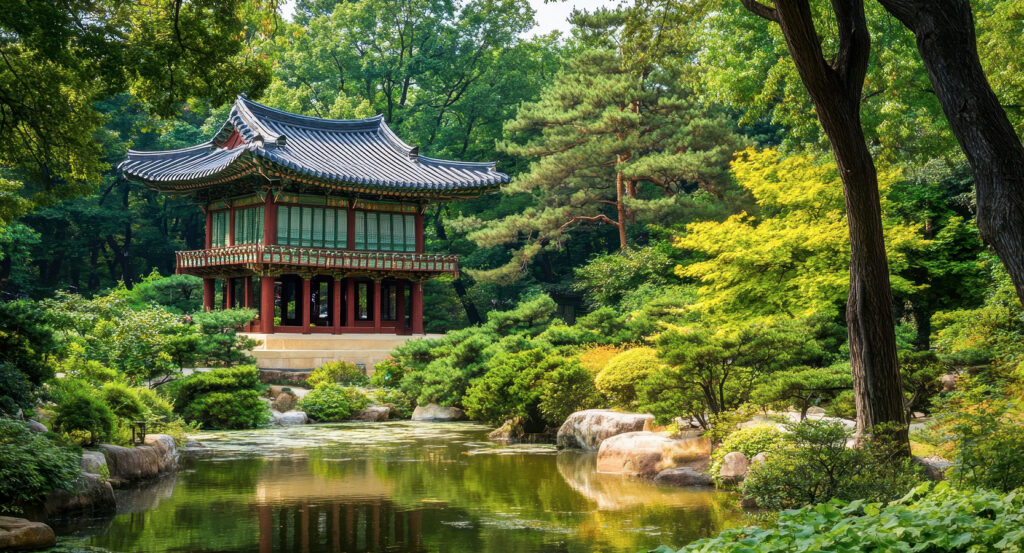
Why you should experience Buyongji Pond in Seoul, South Korea.
Buyongji Pond is the quiet heart of Changdeokgung's Secret Garden, a mirror of heaven set gently into the earth.
Encircled by ancient trees and framed by wooden pavilions that seem to float upon its surface, the pond captures the Korean ideal of natural harmony. Stand at its edge, and time softens. The water holds the reflection of the Juhamnu Pavilion above, its elegant roofline trembling in the light breeze. Dragonflies trace lazy circles overhead, lotus blossoms open in summer like notes in a silent melody, and every ripple on the surface feels deliberate, a gesture of peace in motion. The soundscape is hushed but alive: rustling leaves, the faint trickle of nearby streams, the soft creak of old timber breathing with the wind. This is where Joseon kings once read poetry and scholars recited verses, where thought itself seemed to drift like mist across the water. Buyongji isn't just a pond, it's a living painting, one that renews itself with every season, every reflection, every breath.
What you should know about Buyongji Pond.
Buyongji Pond was constructed in 1456 under King Munjong as part of the royal retreat known as Huwon, or the Secret Garden.
Its shape, an elongated oval, was chosen to represent both the Confucian principle of balance and the Taoist ideal of effortless flow. The pond's name, Buyong (“Floating Lotus”), references the lotus flower's symbolism of purity rising from mud, a visual metaphor for enlightenment and moral clarity. The Juhamnu Pavilion to the north served as the king's study and royal library, its upper floor reserved for reading and its lower floor for resting or hosting discussions with scholars. Nearby stands the Gyujanggak Pavilion, where royal scribes stored scrolls and manuscripts, linking intellect and reflection in one space. Few realize that the pond's depth and curvature were mathematically designed to reflect the pavilion's roof perfectly in calm weather, a feat of early Korean landscape engineering that blended aesthetics with geomantic precision. The surrounding layout forms a symbolic triad: water (wisdom), stone (strength), and wood (virtue). During the Joseon Dynasty, this site hosted examinations for civil officials and small-scale poetry contests, with candidates tested on their ability to interpret philosophical meaning through the landscape itself. The pond's perimeter stones, etched faintly with ancient markings, once guided ceremonial processions. Even its ecology was deliberate, lotus and water lilies planted alongside native reeds to ensure seasonal color harmony. Buyongji remains one of the earliest examples of Korean environmental design, where philosophy, artistry, and function coexist seamlessly.
How to fold Buyongji Pond into your trip.
Buyongji Pond works as the still point of your journey through the Secret Garden, the moment where movement turns to mindfulness.
Join the guided tour of Huwon that begins at Changdeokgung Palace, and when you arrive at the pond, allow yourself to linger. Approach from the south path to see the perfect composition unfold: the pond, the pavilion, and the reflection forming an unbroken circle. Visit in early morning or late afternoon, when the light drapes softly over the water, and you can see the sky's colors shift through the trees. Step onto the small stone terrace that extends toward the water, once the king's reading platform, and take a moment to look at your reflection mingling with the pavilion's. That blend of self and structure, of present and past, is the essence of Buyongji. In summer, the lotus flowers rise like lanterns from the surface; in autumn, the mirrored maples turn the pond into a liquid fire. Winter, though quiet, reveals its geometry, the frozen lines and bare branches showing the architecture of balance beneath the beauty. Pair your visit with the Juhamnu Pavilion directly above and the nearby Yeonghwadang Hall for a fuller sense of how the Joseon court lived within philosophy itself. The Buyongji Pond at the Secret Garden of Changdeokgung Palace in Seoul isn't merely scenery, it's enlightenment made visible, a still water that has reflected the Korean soul for over five centuries.
Where your story begins.
Foresyte Travel reveals places that feel extraordinary long before you arrive.
Experience premium editorial crafted for luxury travelers.

















































































































