Why you should experience Gwangtonggyo Bridge in Seoul, South Korea.
Gwangtonggyo Bridge is the soul of Cheonggyecheon, a stone whisper from Seoul's ancient heart that still stands beneath the city's modern glow.
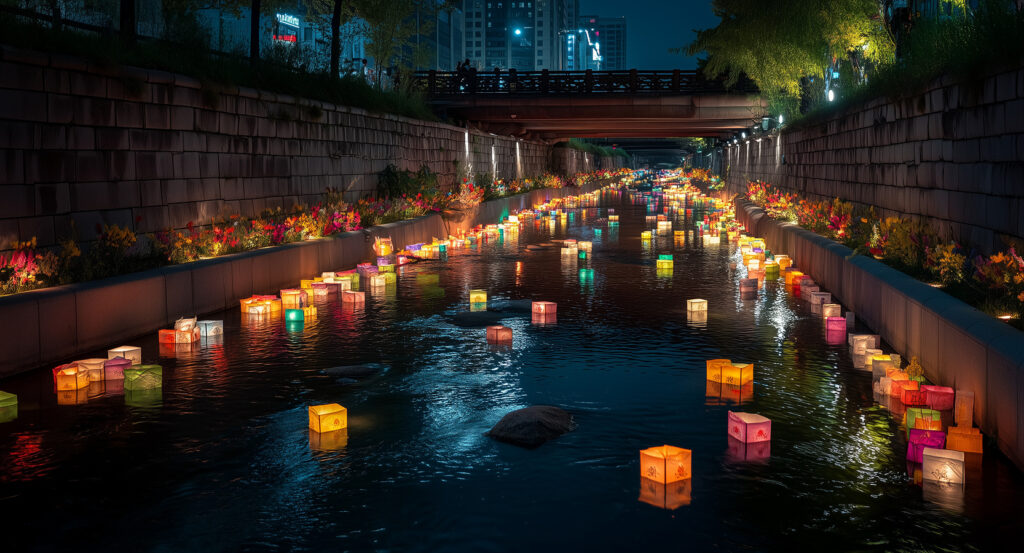
Walk along the stream's edge, and you'll find it there: weathered granite arches spanning clear water, their reflection forming a perfect circle of calm amid the city's restless pace. Lanterns sway above it at night, and the soft splash of water echoes against the centuries-old stones below. Office workers cross it without pause, children trace their hands along its cool surface, and yet most have no idea they're walking across one of the oldest surviving structures in Seoul. To stand here is to stand where time folds, where the Joseon Dynasty's royal processions once crossed the same current that now flows through a reborn city. It's not grand in scale, but in spirit: a bridge that carries the weight of history with quiet, enduring grace.
What you didn't know about Gwangtonggyo Bridge.
Gwangtonggyo Bridge dates back to the early Joseon Dynasty, built in 1410 as part of King Taejong's expansion of the capital's infrastructure.
Its name, translating roughly to “Bridge of Widespread Communication,” reflected both its physical purpose and its philosophical one, a link between palace and people, between the royal avenue of Jongno and the neighborhoods that thrived along Cheonggyecheon's banks. Crafted from solid granite blocks, the bridge originally featured carved guardian faces beneath its arches, fierce spirits meant to ward off floods and misfortune. When Cheonggyecheon was covered by concrete in the 1950s, the bridge disappeared into darkness for over half a century, entombed beneath the city's raised expressway. It wasn't rediscovered until the early 2000s, during the stream's massive restoration project. Archaeologists unearthed the original stones and meticulously reconstructed the bridge on its exact foundation, reinforcing it with hidden steel supports while keeping every visible surface authentic to the 15th century. The carved guardians were preserved, their details softened by time but still discernible, silent witnesses to six hundred years of transformation. Few realize that beneath the bridge lies a subtle intersection of old and new engineering: a filtration system now circulates fresh water beneath its arches, ensuring that what once was stagnant flows clean again.
How to fold Gwangtonggyo Bridge into your trip.
Gwangtonggyo Bridge is best experienced as both pause and passage, a place to linger before continuing along Cheonggyecheon's reflective path.
Begin your walk at Cheonggye Plaza and follow the stream eastward until you reach the bridge, marked by its simple stone form and quiet dignity. Visit in late afternoon, when sunlight catches the water and glows against the bridge's weathered face, or come at night, when lanterns illuminate the arches in soft gold. Step down to the lower walkway to stand beneath it, from this angle, you can see the craftsmanship of the granite blocks and the faint carvings of guardian faces that have survived centuries of flood, fire, and urban upheaval. Sit for a moment on the stone steps beside the water, where the hum of traffic above fades into the steady rhythm of the stream. If you continue east, the modern bridges that follow, Supyogyo, Mojeongyo, Gwanggyo, trace Seoul's evolution from tradition to innovation. Yet Gwangtonggyo remains the emotional anchor, a reminder that the city's story flows forward only because it remembers where it began. For the ideal pairing, visit Gyeongbokgung Palace earlier in the day, then come here as dusk settles, the same water that once ran beneath the palace gates now whispers beneath your feet. Gwangtonggyo Bridge at Cheonggyecheon Stream in Seoul isn't just a crossing, it's a testament carved in stone, proof that what endures does so not by resisting change, but by flowing with it.
Where your story begins.
Start your planning journey with Foresyte Travel.
Experience immersive stories crafted for luxury travelers.