
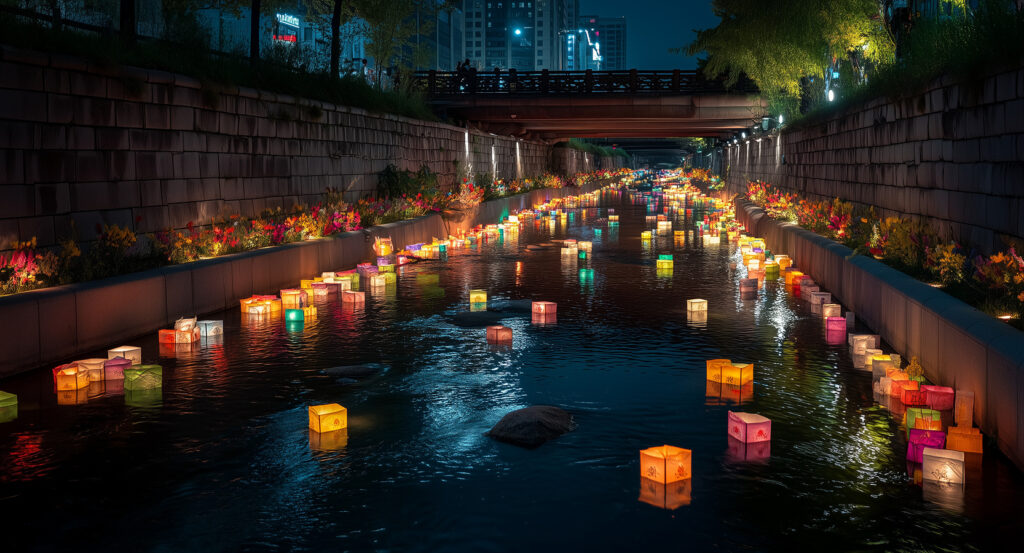
Why Supyogyo Bridge matters.
Supyogyo Bridge is where the story of Seoul's water truly comes alive, a place where science, symbolism, and serenity flow together beneath the heart of the city.
Spanning one of the most tranquil stretches of Cheonggyecheon Stream, Supyogyo feels timeless, its clean stone arches mirrored in the water as willows drift gently overhead. The air here hums softly with movement, footsteps, laughter, the quiet rush of the current below, and yet, there's a stillness that draws you in. Each stone bears witness to Seoul's centuries of resilience: royal messengers once crossed here, merchants rested on its banks, and for generations, citizens watched the stream rise and fall beneath it as the seasons turned. Today, the bridge's surroundings blend art, architecture, and memory, a delicate balance between the city's technological heartbeat and the enduring calm of water and stone.
What defines Supyogyo Bridge.
Supyogyo Bridge has long been the pulse reader of Seoul, home to the Supyo, the nation's oldest known hydrological device.
Installed beside the bridge in the 15th century during the reign of King Sejong, the Supyo (or “Water Gauge”) was a carved stone pillar marked with precise measurements used to monitor the depth of Cheonggyecheon. This ingenious tool helped predict floods and regulate the city's water systems, allowing officials to make decisions that protected homes and harvests. The bridge's name, Supyogyo, meaning “Bridge of the Water Gauge”, honors this legacy of early scientific thought and civic care. When the stream was covered in the 20th century, both the bridge and the gauge vanished beneath asphalt, surviving only in maps and royal records. During the Cheonggyecheon Restoration Project in the early 2000s, archaeologists reconstructed Supyogyo using original stones unearthed nearby and recovered the Supyo marker itself, reinstalled in its original position beside the bridge. Few visitors realize that the site's design mirrors Joseon geomantic principles: the bridge's alignment with Namsan Mountain in the distance was intended to balance elemental forces, water flowing eastward beneath earth and stone. Today, digital sensors embedded beneath the bridge quietly continue the same work begun six hundred years ago, recording rainfall, water levels, and temperature in real time. Supyogyo stands as both monument and machine, proof that innovation and heritage can flow in unbroken rhythm.
How Supyogyo Bridge fits.
Supyogyo Bridge works as a moment of quiet observation, a literal and symbolic measure of Seoul's living pulse.
Walk east from Cheonggye Plaza for about ten minutes along the stream's lower path, and you'll see the stone bridge arch gracefully over the water. Pause beside the Supyo pillar, now protected by glass, and trace the ancient markings still visible on its face, each line a story of patience, precision, and stewardship. Visit in the early morning if you want solitude, or at twilight when the bridge glows softly under ambient light and the reflections seem endless. Sit on the low stone steps nearby and listen to the sound of the water echoing beneath the arches; it's the same rhythm that once guided a dynasty. For an enriching route, pair your stop here with Gwangtonggyo Bridge just upstream, together, they form a discussion between art and science, faith and function. Continue walking east afterward toward Mojeongyo Bridge to watch the stream's character evolve with the city around it. Supyogyo Bridge at Cheonggyecheon Stream in Seoul isn't merely a crossing, it's a living equation, a tribute to how wisdom, when carried forward, can turn even the simplest flow of water into the architecture of civilization.
Where your story begins.
Foresyte Travel reveals places that feel extraordinary long before you arrive.
Enjoy editorial crafted for luxury travelers.
Foresyte may earn a commission when you book.

















































































































