Why you should experience The Textiles Collection at Coptic Museum in Cairo, Egypt.
The Textiles Collection at Coptic Museum in Old Cairo is where faith meets fabric, a silent symphony of color, texture, and devotion that tells Egypt's Christian story not through words or icons, but through thread.
Step into its dimly lit halls, and your eyes adjust to the glow of woven art that has survived nearly two millennia. Linen tunics embroidered with crimson borders, woolen tapestries alive with saints and vines, fragments of garments that once adorned both monks and nobles, each piece feels as if it still holds a pulse. Here, color becomes scripture. The deep indigo and rust-red patterns seem to whisper the liturgy of early Egyptian life, blending pagan symbols with Christian imagery in a seamless discussion of transformation. The silence of the gallery feels sacred, almost monastic, as though the air itself has absorbed centuries of prayer and craft.
What you should know about The Textiles Collection at Coptic Museum.
The Textiles Collection at Coptic Museum houses one of the largest and most important collections of ancient textiles in the world, spanning from the 3rd to the 12th centuries CE.
These works were discovered in burial sites, monasteries, and desert settlements across Egypt, where the arid climate preserved fibers that elsewhere would have turned to dust. The textiles bridge the Pharaonic, Greco-Roman, Byzantine, and Islamic eras, embodying Egypt's long tradition of cultural synthesis. Early Coptic weavers used linen and wool, often combining the two in elaborate tunics decorated with clavus bands, roundels, and narrative scenes, depictions of mythological figures like Dionysus, biblical stories such as Jonah and the Whale, and abstract floral motifs inspired by the Nile's cycles of rebirth. As Christianity spread, pagan imagery gradually gave way to crosses, angels, and scriptural monograms, though the artistry never lost its rhythmic harmony. Many of these pieces were produced in workshops in Akhmim, Antinoë, and Bawit, renowned centers of Coptic weaving. The dyes, indigo, madder, and saffron, were natural, their brilliance enduring after 1,500 years. Conservation of these fragile textiles remains a feat of science and faith: fibers are stabilized under low light and humidity to ensure their survival. Scholars continue to study them not only as art but as social documents, revealing details about fashion, class, and spiritual character in early Christian Egypt. Together, they form a woven chronicle of a civilization in transition, from the temples of Osiris to the monasteries of Saint Anthony.
How to fold The Textiles Collection at Coptic Museum into your trip.
A visit to The Textiles Collection at Coptic Museum is an intimate experience, one best approached slowly, with patience and awe.
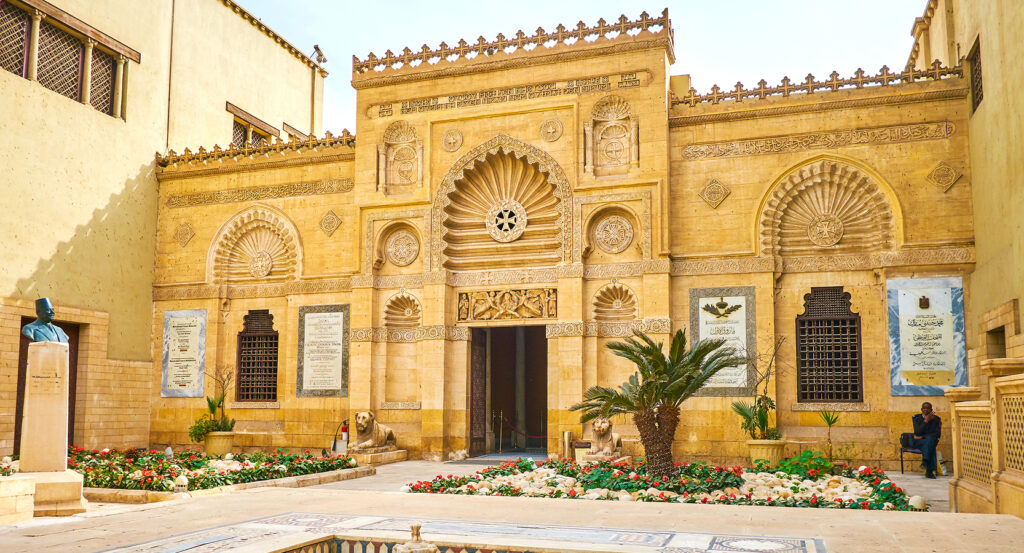
Plan the visit for the late morning, when the galleries are quiet and the filtered light allows the fabrics' colors to emerge gently from shadow. Begin with the earliest displays, where the transition from pagan to Christian motifs becomes visible in the smallest of details, a vine transforming into a cross, a Greek muse replaced by an angel. Spend 45-60 minutes tracing the evolution of these patterns, moving from the tunics of the Roman era to the monastic garments of the early medieval period. Don't rush, these pieces demand contemplation. Pause before the panel known as the “Tunic of Bawit,” whose delicate purple threadwork and repeating cross motifs are considered the pinnacle of Coptic design. The gallery's soft lighting and near-silence invite reflection; it feels almost like entering a chapel of cloth. Afterward, wander through the museum's wooden courtyard, where the scent of aged cedar mingles with desert air, before continuing your exploration of Coptic Cairo's nearby churches and monasteries. The experience leaves you with a rare feeling, that holiness can be stitched, and that beauty, when made with devotion, never fades.
Where your story begins.
Foresyte Travel reveals places that feel extraordinary long before you arrive.
Experience premium editorial crafted for luxury travelers.