
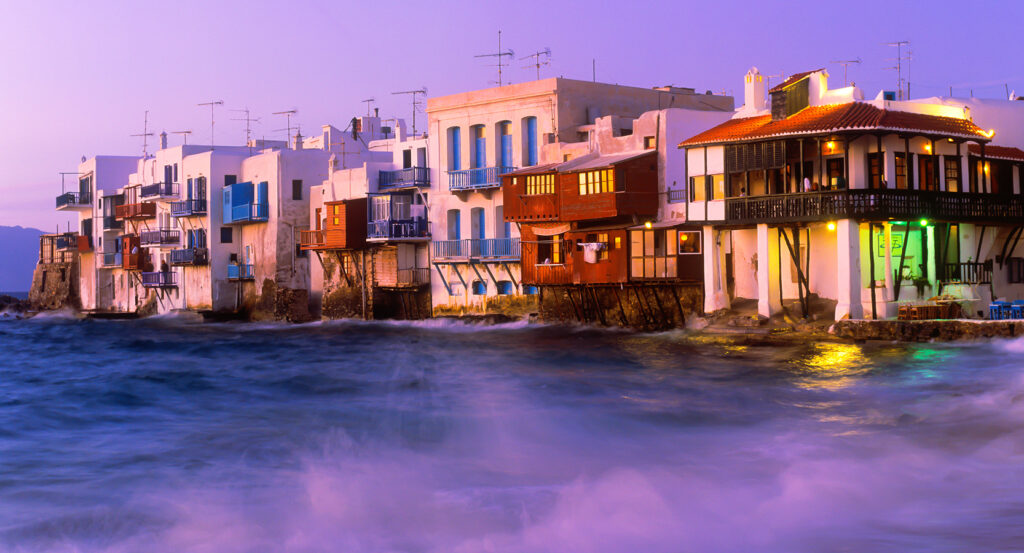
Why Cosmo Café matters.
Cosmo Café is a family-run breakfast destination where Mykonos Town's Cycladic streets meet the Sikiniotis brothers' longstanding hospitality, Greek café traditions and a neighborhood institution that has preserved a distinctly local character within the island's international tourism scene.
Tucked into the Fabrika district near Dionysou and Axioti streets, Cosmo Café occupies a pedestrian corner south of Matogianni, between the Fabrika bus station, the lanes approaching Tria Pigadia and the coastal route leading toward the windmills above Alefkandra. The café's whitewashed exterior and bougainvillea-covered terrace preserve the intimate architectural scale of Mykonos Town, with shaded tables occupying a small outdoor gathering space beside the surrounding streets. Breakfast unfolds beneath the flowering canopy, where Greek yogurt, fresh fruit, honey, egg preparations and espresso drinks establish the restaurant's distinctive morning character. Inside, a compact dining area complements the terrace, extending the familiar atmosphere of a Greek neighborhood café into a setting frequented by residents and international travelers. The result is a modest Cycladic café whose family stewardship, traditional breakfast cooking and position near the southern entrance to Chora preserve a quieter dimension of Mykonos hospitality.
What defines Cosmo Café.
Cosmo Café is best known for the Sikiniotis family's longstanding involvement in Mykonos Town's breakfast culture, sustaining a small independent establishment through the island's transformation into an international dining and entertainment destination. Brothers Petros and Christos Sikiniotis became closely associated with the café's operation, developing a neighborhood business centered on traditional Greek hospitality and substantial morning meals. Their involvement extended across successive decades, preserving family ownership within a commercial district increasingly shaped by seasonal tourism and internationally oriented restaurants. Cosmo's culinary direction connected familiar Greek breakfast ingredients with preparations drawn from the wider European café tradition. Greek strained yogurt accompanied by fruit, honey and muesli became a defining specialty, placing a traditional dairy preparation at the center of the morning menu. Omelettes, crêpes, croissants and fresh juices extended the restaurant's cooking into a broader breakfast format suited to the international clientele arriving through Fabrika. The café also preserved the character of a family-operated establishment through direct involvement in its dining room, with Petros and Christos maintaining a personal connection to the business during its established operation in the 2010s. By 2017, another generation of the family participated in the restaurant's daily hospitality, extending that continuity beyond the original brothers. The flowering terrace became an enduring element of Cosmo's public character, giving the small café a recognizable setting within the densely built streets of Chora. Its proximity to Fabrika connected the establishment with one of Mykonos Town's principal transportation entrances, establishing a natural relationship between morning dining and journeys toward the island's beaches. The restaurant's continued operation through the 2020s preserved its original breakfast emphasis, maintaining Greek preparations alongside international morning dishes as the surrounding hospitality market continued changing. Cosmo subsequently earned Tripadvisor Travellers' Choice recognition, reflecting its established position within the island's independent café scene. Its significance rests on the continuity of family stewardship and a recognizable Greek breakfast tradition, connecting the quieter routines of Mykonos Town with the extraordinary growth of the island's visitor economy.
How Cosmo Café fits.
Cosmo Café works as the morning starting point for a walk through Mykonos Town connecting the island's wind-powered maritime economy, the preservation of Greek seafaring history and the medieval religious architecture of Chora's waterfront.
Begin at Kato Mili Windmills, the surviving coastal milling complex whose development connected Mykonos with the maritime commerce of the Cyclades from the Venetian period onward. Windmills appeared on the island during the sixteenth century, exploiting the powerful northerly meltemi winds to grind wheat and barley for local consumption and passing merchant vessels. By 1700, the lower milling complex contained eleven installations, and wind-powered flour production had become a consequential component of the island's commercial economy. The surviving seven cylindrical mills preserve the architectural form of an industry that expanded through the eighteenth and nineteenth centuries before mechanical milling gradually displaced traditional production. Continue to Aegean Maritime Museum, founded in 1983 by Mykonian shipowner George M. Drakopoulos and his wife Ioanna before opening to the public in 1985. The institution occupies a nineteenth-century Cycladic residence formerly associated with Captain Nikolaos Sourmelis, whose merchant vessel Enosis supported the Cretan struggle against Ottoman rule. Drakopoulos assembled a collection encompassing ancient maritime objects, historical navigational instruments, ship models, maps and documents tracing Greek seafaring across successive centuries. The museum also undertook preservation of the 1909 cable vessel Thalis o Milissios and the 1940 sailing vessel Evangelistria, extending its work from displayed artifacts into the conservation of historic ships. The Academy of Athens honored Drakopoulos in December 1987 for his contribution to maritime heritage. Conclude at Panagia Paraportiani, the whitewashed religious complex developed beside a former secondary entrance to Mykonos' medieval Kastro. The oldest church, Agios Anargyros, originated during the late fourteenth or early fifteenth century, followed by additional chapels constructed through successive periods of religious development. Four ground-level churches dedicated to Agios Efstathios, Agios Anargyros, Agios Sozon and Agia Anastasia support an elevated fifth sanctuary dedicated to the Virgin Mary. Their gradual architectural consolidation produced an irregular composition of rounded surfaces, arches and domes whose changing geometry preserves the physical history of the medieval settlement. The progression moves from Kato Mili Windmills' contribution to Aegean commerce through Drakopoulos' preservation of Greek maritime heritage into Panagia Paraportiani's centuries-long architectural development, connecting the economic and religious traditions that shaped Mykonos Town.
Where your story begins.
Foresyte Travel reveals places that feel extraordinary long before you arrive.
Enjoy editorial crafted for luxury travelers.




















































































































