Why Temple of the Delians matters.
Temple of the Delians on Delos stands at the heart of one of the most sacred landscapes in the ancient world, a place where myth meets sunlight, and the divine feels almost tangible.
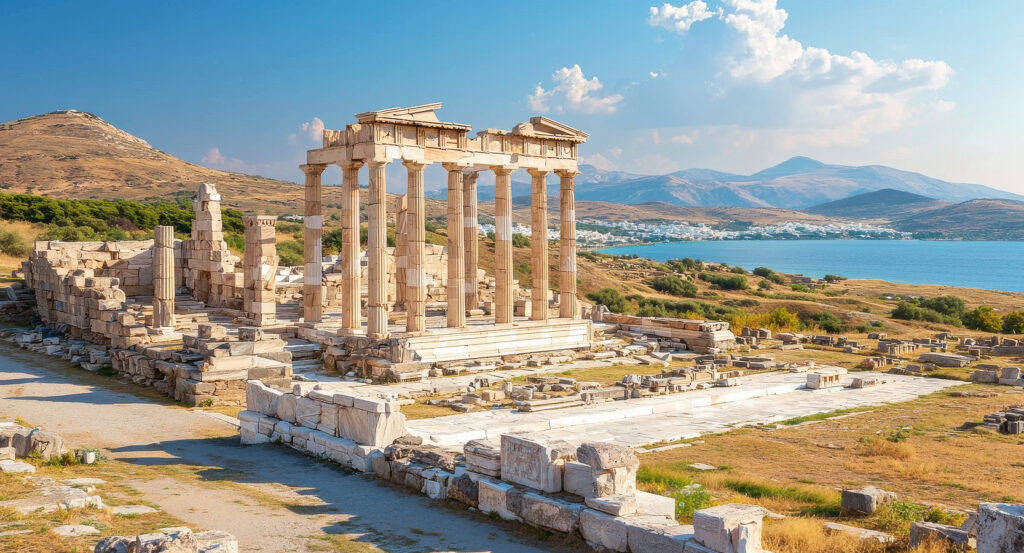
Even in ruin, its marble foundations and towering columns radiate a sense of grandeur, a stillness that commands reverence. This was the spiritual core of the island, where pilgrims from across Greece gathered to honor Apollo, god of light, music, and prophecy, born here, according to legend, beneath the shimmering Aegean sky. Standing among the temple's scattered blocks, you can almost hear the echo of ancient hymns, the rustle of olive branches, and the hum of prayers rising with the wind. The sunlight that floods the site feels different here, sharper, purer, as if the god of the sun himself still claims this ground. To visit the Temple of Apollo is to step into a discussion that began more than two millennia ago and has never truly ended.
What defines Temple of the Delians.
Temple of the Delians is not a single temple but a complex of three successive shrines, each built as the island's devotion, and wealth, grew.
The oldest, the Porinos Naos, dates back to the 6th century BCE and was constructed from the local island stone. The larger, more elaborate temples that followed were made of marble and adorned with sculptures and offerings sent by cities across the Greek world. The sanctuary served as both a religious and cultural hub, home to festivals, athletic games, and musical competitions that drew visitors from Athens, Naxos, and beyond. The Treasury of the Athenians, once filled with gold and sacred gifts, testified to Delos's prestige as Apollo's birthplace and to its political importance within the Athenian Empire. Archaeologists have uncovered votive statues, inscriptions, and fragments of ritual vessels, revealing how worship here blended beauty with ceremony. Few realize that the alignment of the temple's axis corresponds precisely with the sunrise on Apollo's feast day, an architectural ode to the god of light.
How Temple of the Delians fits.
Temple of the Delians is the centerpiece of any visit to the Archaeological Site of Delos, and the experience is best savored slowly and deliberately.
Take the morning ferry from Mykonos, arriving as the island glows gold in the early light, the same light that once greeted ancient pilgrims. From the port, follow the Sacred Way toward the temple, pausing at the Terrace of the Lions to feel the sequence of devotion that once led to this altar. As you approach the sanctuary, notice how the ruins frame the sea, a reminder that Apollo's domain extended far beyond these stones. Bring water and good shoes; the ground is uneven, and the sun is fierce. After wandering through the columns and tracing the outlines of the ancient altars, climb the nearby Mount Kynthos for a panoramic view of the temple against the Aegean, a view that perfectly captures why Delos was known as the island of light. When you descend, you'll carry that brilliance with you, the quiet certainty that you've stood in the birthplace of radiance itself.
Where your story begins.
Foresyte Travel reveals places that feel extraordinary long before you arrive.
Enjoy editorial crafted for luxury travelers.
Foresyte may earn a commission when you book.