Why Archaeological Site of Delos matters.
The Archaeological Site of Delos is among the most powerful places in all of Greece, a sacred island frozen in time where myth, history, and sunlight converge.
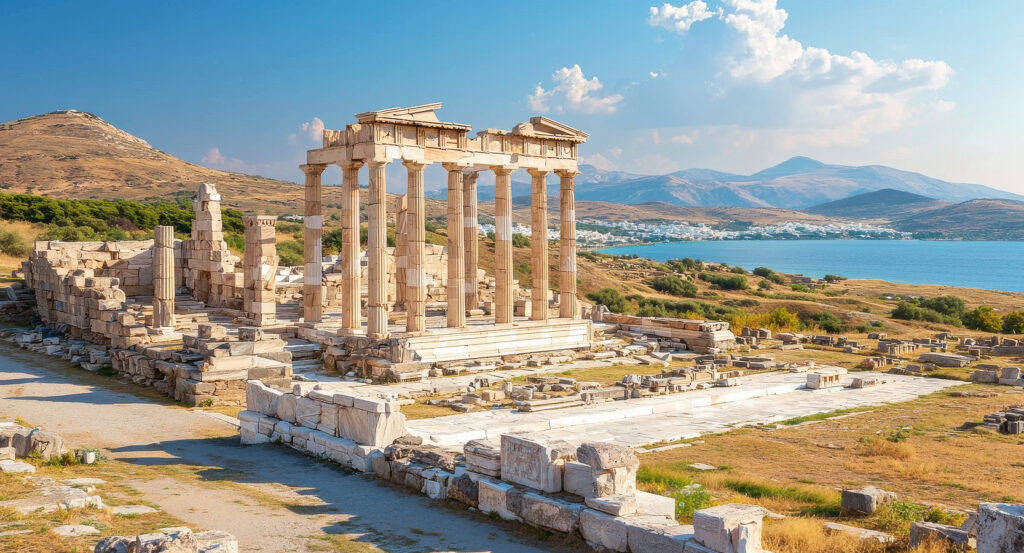
Set against the turquoise shimmer of the Aegean, this sprawling open-air museum feels less like ruins and more like a living memory. Every path, column, and fragment seems charged with divine energy. According to legend, this is where Leto gave birth to Apollo and Artemis, transforming Delos into the most sacred island of the ancient Greek world. As you walk its marble-lined streets, surrounded by the remnants of temples and homes, it's easy to imagine the sound of ancient hymns rising over the sea breeze. Unlike the glamour of nearby Mykonos, Delos offers a silence that humbles, a rare glimpse into the cradle of civilization itself.
What defines Archaeological Site of Delos.
Delos was once a thriving cultural and commercial center, an island so sacred that no one was allowed to die or be born on its soil.
By the 2nd century BCE, the island had become a cosmopolitan hub where traders, pilgrims, and artisans from across the Mediterranean mingled under the watchful eyes of marble gods. Its streets were lined with luxurious homes boasting intricate mosaics, colonnaded courtyards, and private shrines. The Sacred Way once connected the port to the Sanctuary of Apollo, where worshippers brought offerings from every corner of the Greek world. Among the site's most iconic landmarks is the Terrace of the Lions, a row of ancient stone guardians gifted by the Naxians to honor Apollo, still poised proudly after 2,500 years. Archaeological excavations, begun in the 19th century and continuing today, have revealed not just temples and altars but also the heartbeat of daily life, pottery, inscriptions, and jewelry that bridge the divine and the human.
How Archaeological Site of Delos fits.
Visiting the Archaeological Site of Delos from Mykonos is like traveling through centuries in a single morning.
Take an early ferry from the Old Port, the light is softest then, and the crowds sparse. Upon arrival, follow the ancient Sacred Way toward the Sanctuary of Apollo, pausing at the ruins of the agora and the circular Temple of Isis. Continue uphill to the House of Dionysus, where one of Greece's finest floor mosaics, the god riding a panther, still shimmers in the sunlight. If time allows, climb Mount Kynthos for panoramic views across the Cyclades, a perspective the ancients themselves revered. There are few trees, so bring water, sunscreen, and a hat, and move slowly, the heat here feels timeless too. Before leaving, visit the small but remarkable Archaeological Museum of Delos, where statues and frescoes bring the island's former glory into sharp relief. As you sail back to Mykonos, the island recedes into the Aegean haze, glowing like an apparition, a place that once birthed gods, and still refuses to die.
Where your story begins.
Foresyte Travel reveals places that feel extraordinary long before you arrive.
Enjoy editorial crafted for luxury travelers.
Foresyte may earn a commission when you book.