Why Dill Restaurant matters.
Dill Restaurant is Iceland's pioneering MICHELIN-starred New Nordic restaurant where Miðborg's independent dining culture meets Gunnar Karl Gíslason's reinvention of Icelandic culinary traditions, the country's extraordinary natural ingredients and a commitment to environmentally responsible gastronomy.
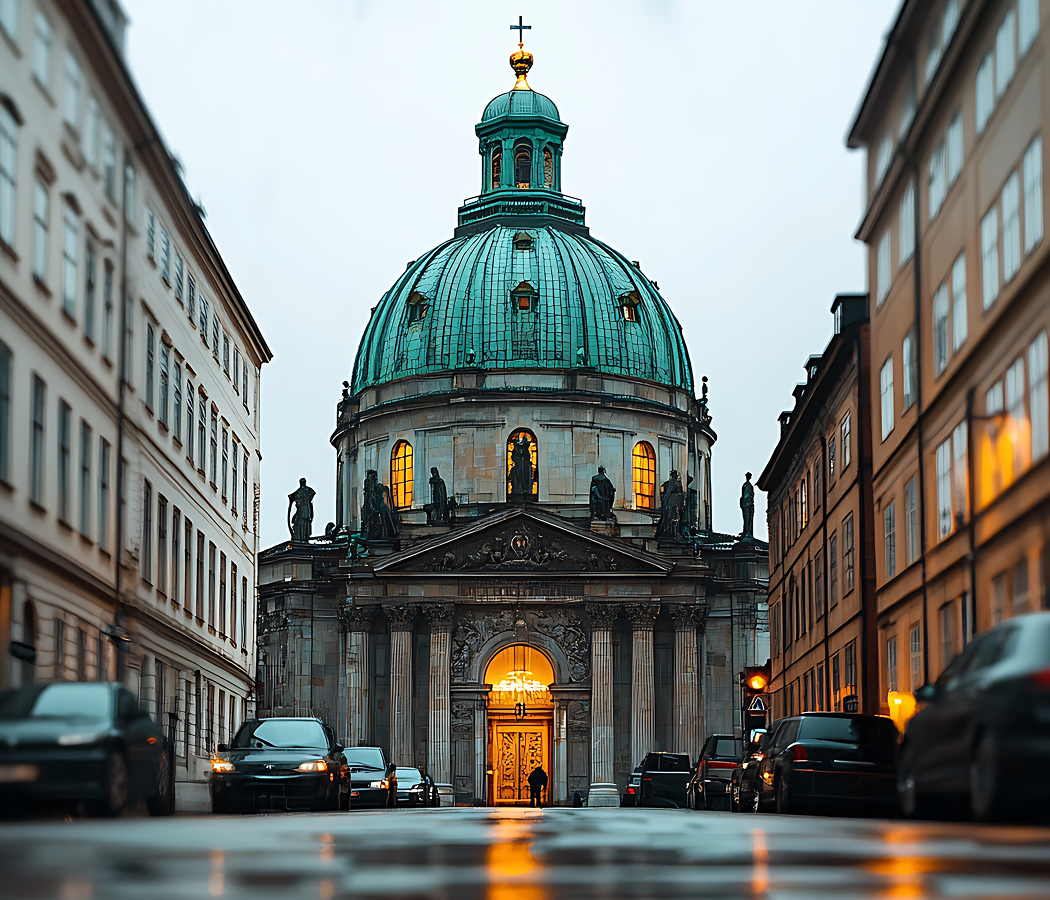
Set along Laugavegur near Frakkastígur and a short walk from the Skólavörðustígur shopping district, the restaurant occupies an upper-floor premises within Reykjavík's principal commercial corridor, surrounded by colorful residential buildings, independent boutiques and the compact streets connecting the capital's historic center with its eastern neighborhoods. A discreet street entrance leads to a black spiral staircase, creating a distinctive transition from the commercial activity below to the dining room above. Natural timber paneling, dark-stained tables and subdued lighting establish an intimate interior whose restrained finishes draw upon Icelandic building traditions. Large windows overlook the surrounding streets, and an open kitchen places the chefs within view of the dining tables. The result is a restaurant whose modest entrance, carefully controlled interior and direct relationship between kitchen and dining room create an unusually personal setting for Iceland's most internationally consequential modern culinary institution.
What defines Dill Restaurant.
Gunnar Karl Gíslason established Dill in 2009 with sommelier Ólafur Örn Ólafsson, creating a restaurant devoted to exploring Icelandic ingredients through the emerging principles of New Nordic gastronomy. Raised in northern Iceland, Gíslason developed an early appreciation of regional produce through his family's vegetable and herb garden, where the country's demanding growing conditions encouraged close attention to seasonal availability. His professional development coincided with a broader transformation in Scandinavian cooking, as chefs increasingly reconsidered the culinary possibilities of local agriculture, wild plants and traditional preservation techniques. The New Nordic Food Manifesto, developed in Copenhagen in 2004, helped articulate this regional movement through its emphasis on seasonality, purity, ethical production and the distinctive food cultures of northern Europe. Gíslason brought those ambitions into Reykjavík during a period of economic uncertainty following Iceland's 2008 financial crisis. The restaurant initially occupied the Nordic House, the modernist cultural institution designed by Finnish architect Alvar Aalto, whose connection with Nordic cultural exchange provided a fitting setting for the project. Financial difficulties complicated the establishment's opening, and Gíslason used personal credit to sustain the business after anticipated investment failed to materialize. The kitchen nevertheless developed a distinctive reputation through its treatment of vegetables, herbs and wild Icelandic ingredients as essential components of sophisticated restaurant cooking. Its approach attracted international attention as Reykjavík's restaurant industry began developing a more confident relationship with the country's agricultural and culinary heritage. Dill subsequently relocated to Laugavegur, establishing a permanent presence within the capital's central commercial district. Interior designer Hálfdán Pedersen developed the restaurant's distinctive architectural character, and the project received a nomination for the 2015 Restaurant & Bar Design Awards. Gíslason's professional ambitions also extended to New York, where he collaborated with Danish restaurateur Claus Meyer on Agern, the restaurant established inside Grand Central Terminal in 2016. His departure from Reykjavík placed chef Ragnar Eiríksson in charge of Dill's kitchen, preserving the restaurant's culinary direction during an important period of international expansion. In February 2017, Dill became the first restaurant in Iceland to receive a MICHELIN star, marking a historic achievement for the country's professional culinary community. Agern also earned MICHELIN recognition, extending Gíslason's influence into the development of contemporary Nordic cooking in the United States. Dill lost its MICHELIN star in 2019 before regaining the distinction in February 2020, demonstrating the resilience of the restaurant's culinary ambitions through changing professional leadership. Gíslason subsequently returned to direct the Reykjavík kitchen, reconnecting the establishment with the chef whose original approach had helped establish Iceland as a destination for ambitious modern gastronomy. The MICHELIN Guide later awarded Dill a Green Star for its environmental commitments, recognizing the relationship between its culinary practices, responsible sourcing and the careful use of ingredients. The restaurant's sustained international reputation established an important foundation for the subsequent recognition of other Icelandic fine-dining establishments, placing its development at the center of the country's modern culinary history.
Gunnar Karl Gíslason's cooking develops Iceland's traditional relationship with the land and sea through contemporary techniques that preserve the natural character of individual ingredients. His childhood familiarity with cultivated herbs, vegetables and wild plants established an enduring interest in products whose availability depends upon Iceland's short growing season and demanding northern climate. The kitchen works with domestic farmers, fishermen and foragers, selecting ingredients that connect the restaurant with the country's agricultural regions, coastal fisheries and uncultivated landscapes. Wild herbs, spruce shoots, crowberries and rhubarb contribute distinctive aromatic and acidic qualities, allowing preparations to develop through flavors associated with Iceland's natural environment. Preservation techniques extend the usefulness of seasonal ingredients, incorporating drying, curing, fermentation and controlled smoking into compositions that connect historical necessity with contemporary culinary precision. The kitchen's treatment of seafood emphasizes species harvested through responsible fishing practices, including line, gill-net and seine methods selected for their relatively limited environmental impact. Shellfish collected by an individual diver provides another expression of this approach, connecting ingredient selection with a carefully controlled relationship between harvesting and marine conservation. Icelandic meat receives comparable attention through the selection of wild or organically raised animals and a commitment to using the entire carcass. Cuts traditionally associated with slower cooking acquire new possibilities through careful temperature control, concentrated reductions and complementary preparations developed from other parts of the animal. Free-range pork cheek and belly demonstrate this approach through contrasting textures, with warm spiced cream, pine, cabbage and mushrooms connecting rich meat with aromatic ingredients associated with northern forests. Vegetable preparations contribute an equally substantial dimension, allowing root crops, brassicas and seasonal greens to develop through roasting, fermentation and carefully balanced acidity. Gíslason's use of ingredients extends into the treatment of kitchen byproducts, transforming vegetable trimmings, animal offcuts and other residual products into crisps, seasonings and fermented condiments. Miso-style preparations provide a particularly distinctive example, adapting fermentation methods associated with East Asian cooking to ingredients produced within Iceland's agricultural environment. The kitchen also reuses packaging and directs spent cooking oil toward biofuel production, extending its environmental commitments into the practical organization of restaurant operations. A changing tasting menu develops these principles across successive courses, allowing the natural characteristics of each ingredient to determine the relationship between preparation, texture and presentation. Earlier menus have incorporated wolffish from the Westfjords, cured lamb, delicate vegetable broths and preparations combining goose with bilberries and brown butter, demonstrating the breadth of Icelandic products available to the kitchen. Bread production contributes another connection with the country's culinary heritage, adapting traditional grain preparations through contemporary baking techniques. The wine program emphasizes smaller European vineyards, developing pairings that complement the acidity, herbal complexity and concentrated flavors of the seasonal menu. Gíslason's culinary achievement rests upon the sustained refinement of Icelandic ingredients through careful sourcing, technically sophisticated preparation and a commitment to extracting meaningful value from the country's agricultural and marine resources.
How Dill Restaurant fits.
Dill Restaurant works as the evening culmination of an outing connecting Reykjavík's changing commercial culture, the development of modern Icelandic sculpture and the establishment of a permanent national institution for dramatic performance.
Begin at Hlemmur Mathöll, the former central bus terminal whose transformation into a public food hall established a new chapter in Reykjavík's commercial development. The surrounding district became an important transport interchange as the capital expanded eastward during the twentieth century, connecting the historic center with growing residential neighborhoods. Architect Gunnar Hansson designed the terminal building, which opened in 1978 with a distinctive structural system of exposed steel and broad interior spaces originally intended to accommodate commercial activity alongside public transport. The building subsequently became associated with Reykjavík's alternative youth culture, including the punk movement that developed during the 1980s. Filmmaker Ólafur Sveinsson explored the terminal's social history in his 2002 documentary Hlemmur, preserving the experiences of people whose lives became closely connected with the building. Architects led by Helga Gunnarsdóttir subsequently directed its conversion into a food hall, which opened in 2017 and restored the original building's commercial ambitions through independent food businesses. Continue to Sun Voyager, the stainless-steel sculpture created by Jón Gunnar Árnason as a symbolic vessel representing exploration, hope and the promise of undiscovered territory. The work originated in a competition organized for Reykjavík's bicentenary in 1986, when Árnason's design was selected as a permanent public artwork commemorating the capital's development. Its elongated steel structure draws upon the structural qualities of traditional boats, creating an abstract composition whose open form connects the vessel with the surrounding sky and sea. Árnason died in 1989 before the completed sculpture was installed, and the full-scale work was unveiled on August 18, 1990, the anniversary of Reykjavík's municipal foundation. Positioned on polished granite beside the waterfront, the sculpture establishes a distinctive relationship between Icelandic artistic imagination and the maritime environment that shaped the country's settlement and cultural history. Conclude at National Theatre of Iceland, the institution whose construction established a permanent architectural foundation for professional Icelandic drama. State architect Guðjón Samúelsson developed the building's design during the 1920s, drawing upon Icelandic folklore and the image of illuminated chambers concealed within volcanic rock. Construction began in 1929, but financial difficulties during the Great Depression interrupted the project before its interior could be completed. British military occupation during the Second World War introduced another interruption, and the unfinished building was temporarily used for storage before construction resumed. The theatre opened on April 20, 1950, establishing a national stage dedicated to Icelandic dramatic literature, international repertoire and the professional development of the performing arts. Samúelsson's distinctive exterior incorporates crushed obsidian, quartz and Iceland spar, and the principal auditorium's ceiling draws upon the geometry of columnar basalt, connecting the institution's architectural character with Iceland's geological landscape. The progression moves from the transformation of Reykjavík's former transport infrastructure into a center of independent commerce through Jón Gunnar Árnason's artistic interpretation of maritime exploration and culminates in a national theatre whose architecture and dramatic traditions connect Icelandic cultural ambition with the country's distinctive natural environment.
Where your story begins.
Foresyte Travel reveals places that feel extraordinary long before you arrive.
Enjoy editorial crafted for luxury travelers.
Foresyte may earn a commission when you book.